Floating Pavilion

Roofs Shape the Landscape

The Floating Pavilion in Songyang

Planner

Studio RE+N
Hangzhou, Zhejiang, China

Yuting Zhang, Pu Zhang

Building owner

Xinxing Town Government, Songyang County

Structural Engineers

Lihui Feng

Implementation

Hangzhou Baiguyuan Construction Co., Ltd.
, Zhejiang Huafang Construction Co., Ltd.


Special Features
  • Open-Air Viewing Pavilion
  • Suspended, prefabricated steel structure
  • Thin steel sandwich roof
  • Tiered viewing platforms
  • Installation without heavy construction equipment
  • Minimal impact on the landscape
Address

Organic Tea Valley
Xinxing Town
Songyang County
CN-Lishui, Zhejiang

Opening

2025

Photos

Kejia Mei

Plans

Studio RE+N
, Kejia Mei

Text

Johannes Bühlbecker
More Sports Media
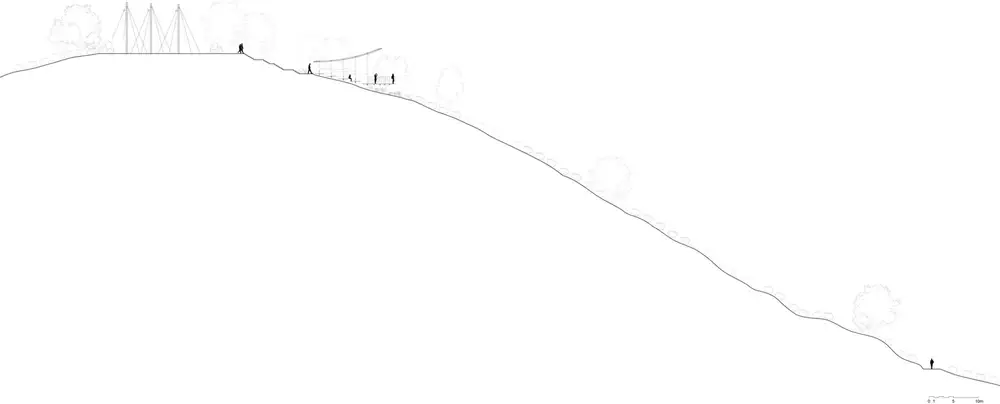
Not every roof is primarily meant to protect against rain. Sometimes, its main purpose is simply to create a space.

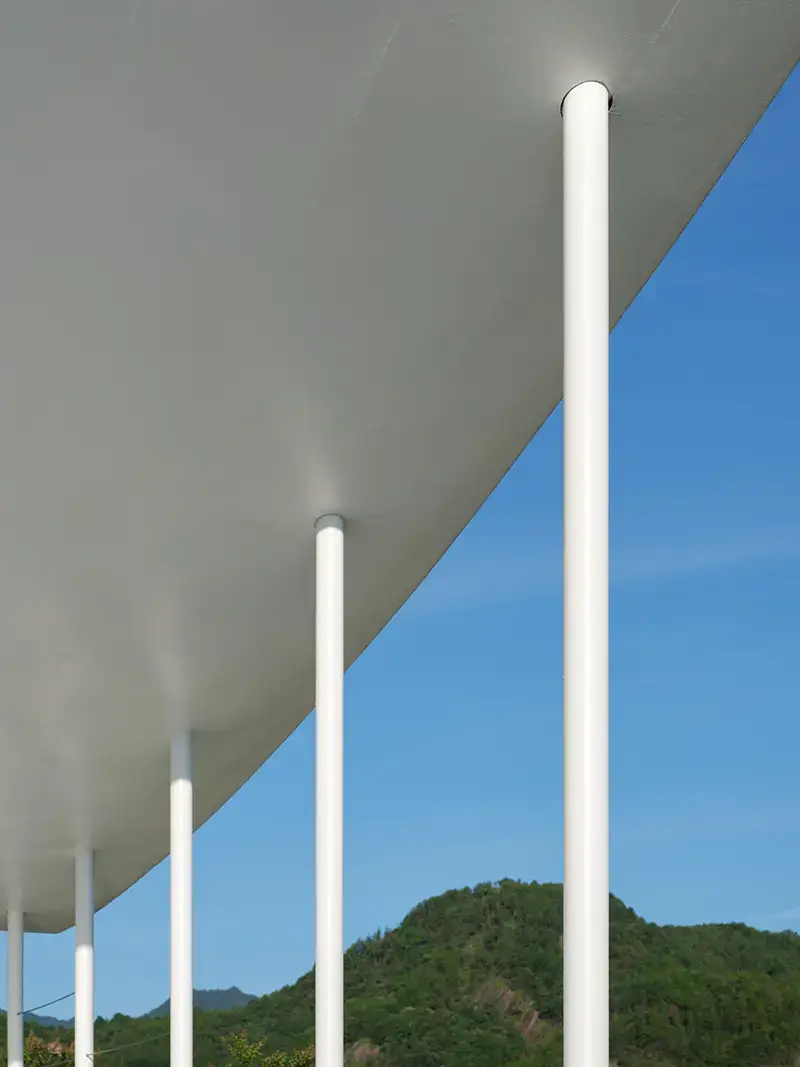
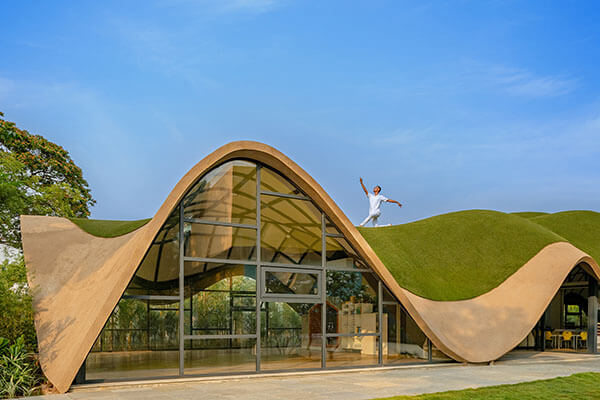
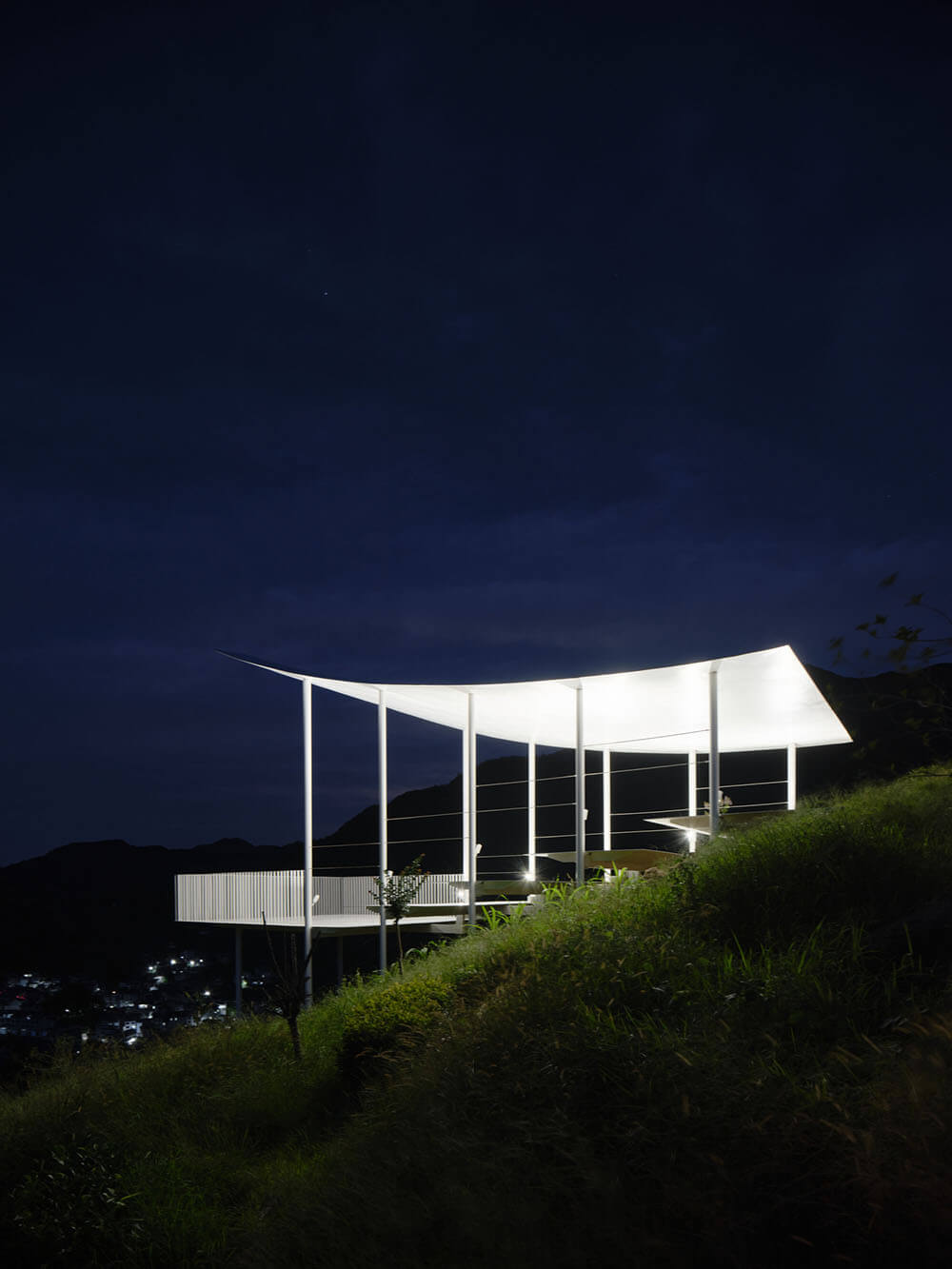
The Floating Pavilion in Songyang, China, demonstrates how a single, floating roof is enough to give a landscape a new dimension: serving as a lookout point, a gathering place, and a rest area all at once.

A Roof as a Landscape
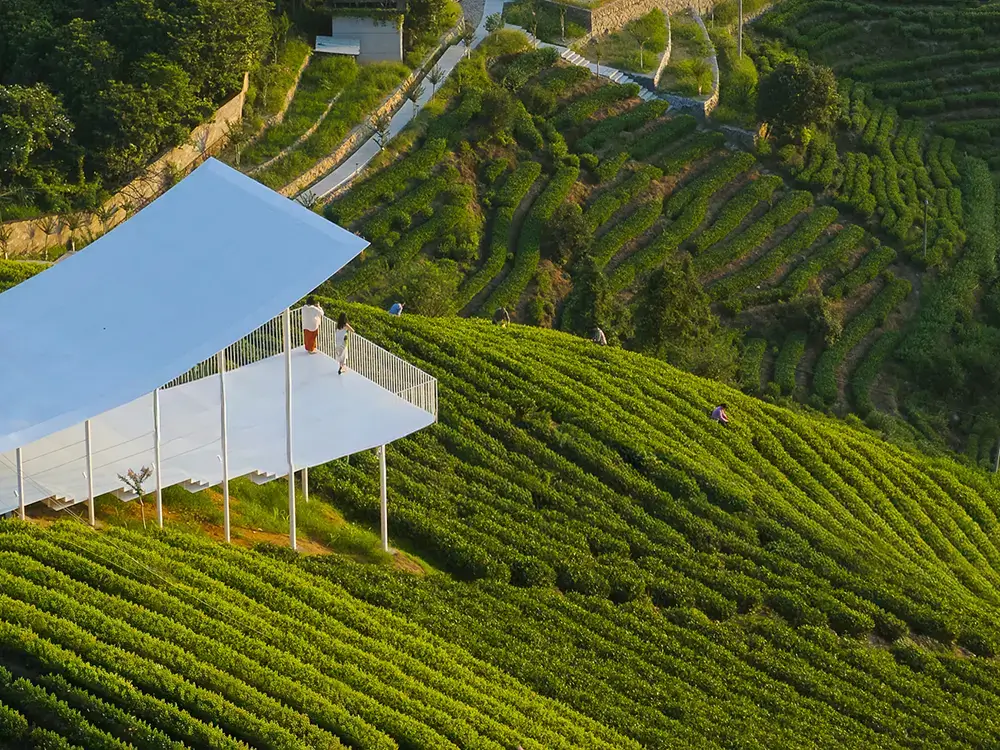
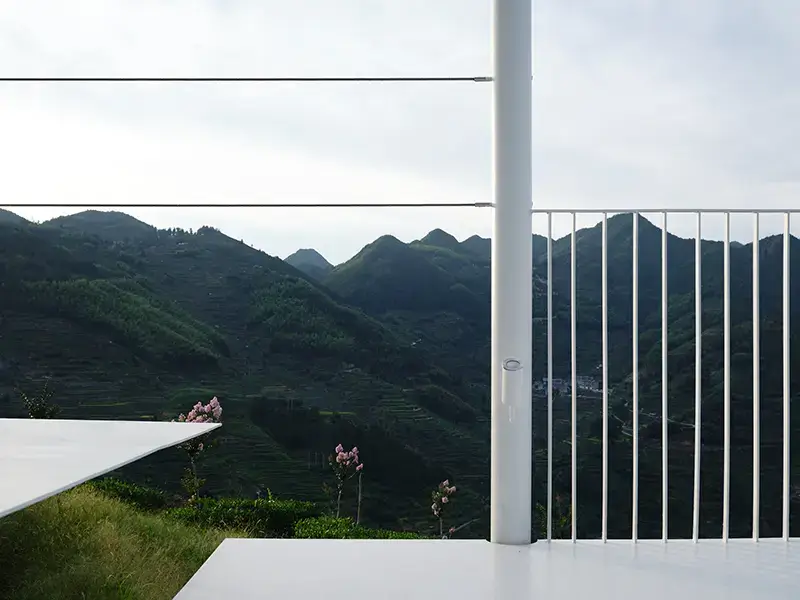
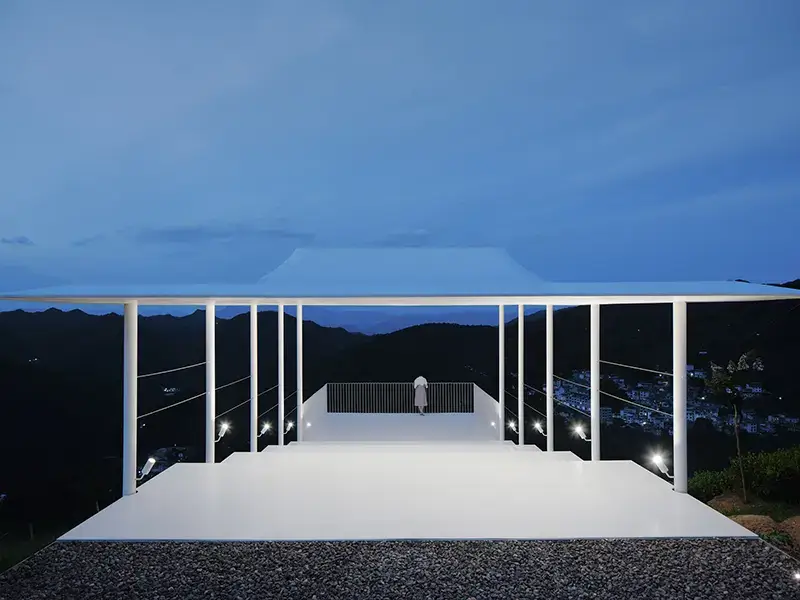
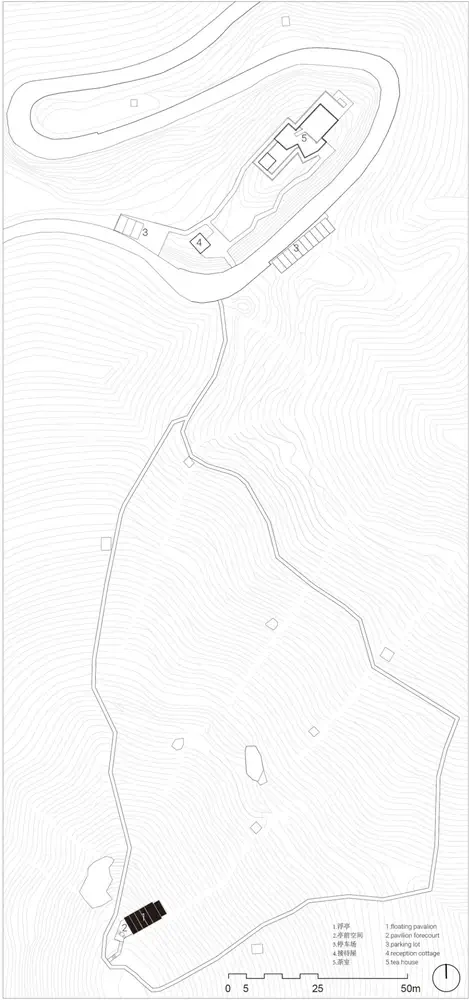
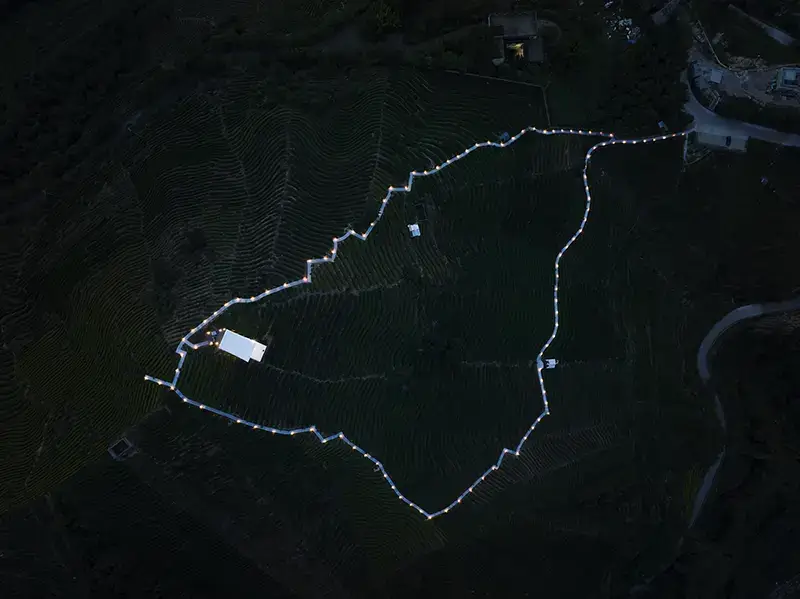
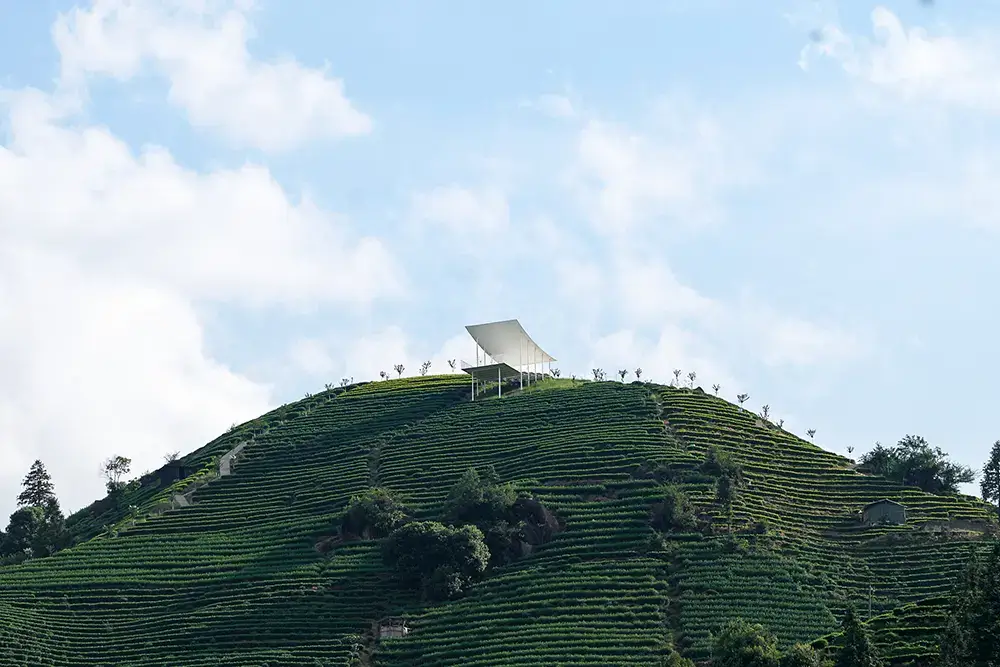
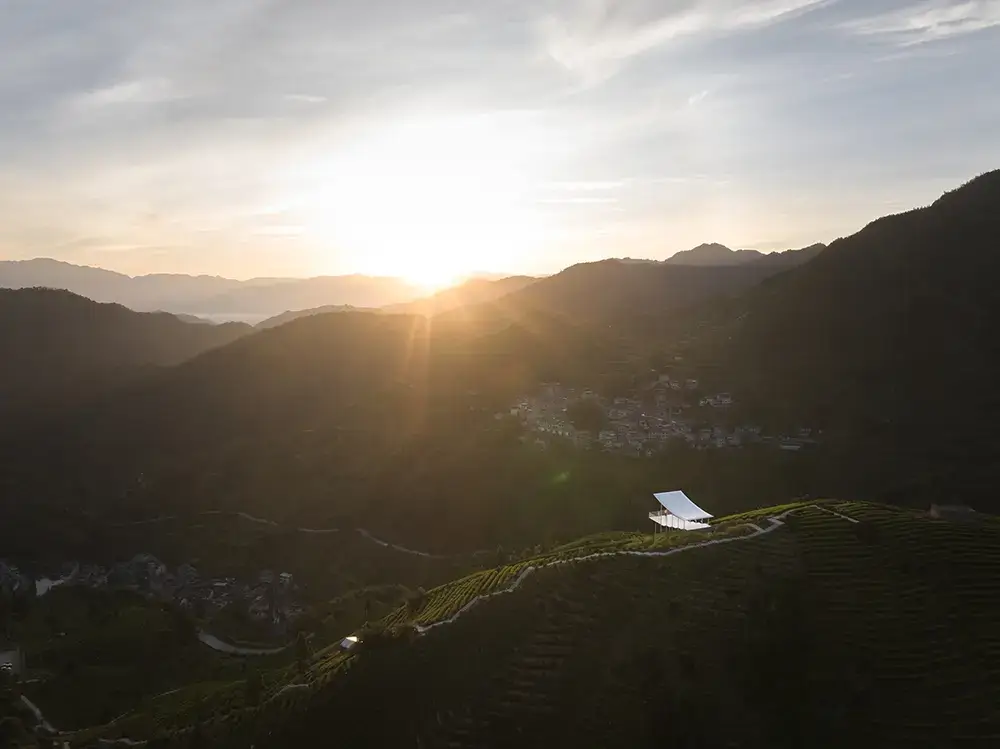
Visitors to the Floating Pavilion do not reach it via a road or a forecourt. The path winds through steep tea plantations up to a mountain ridge about 500 meters above sea level. Only once you’re between the terraces does a narrow white structure gradually come into view, seemingly floating weightlessly above the fields.

What makes it special is not so much the building itself as its relationship to the landscape. Instead of creating a dominant vantage point, Studio RE+N has limited itself to a single, precisely shaped roof that defines the site without altering it. It is precisely this restraint that makes the pavilion an exciting example of covered open spaces.
A Roof Creates Space
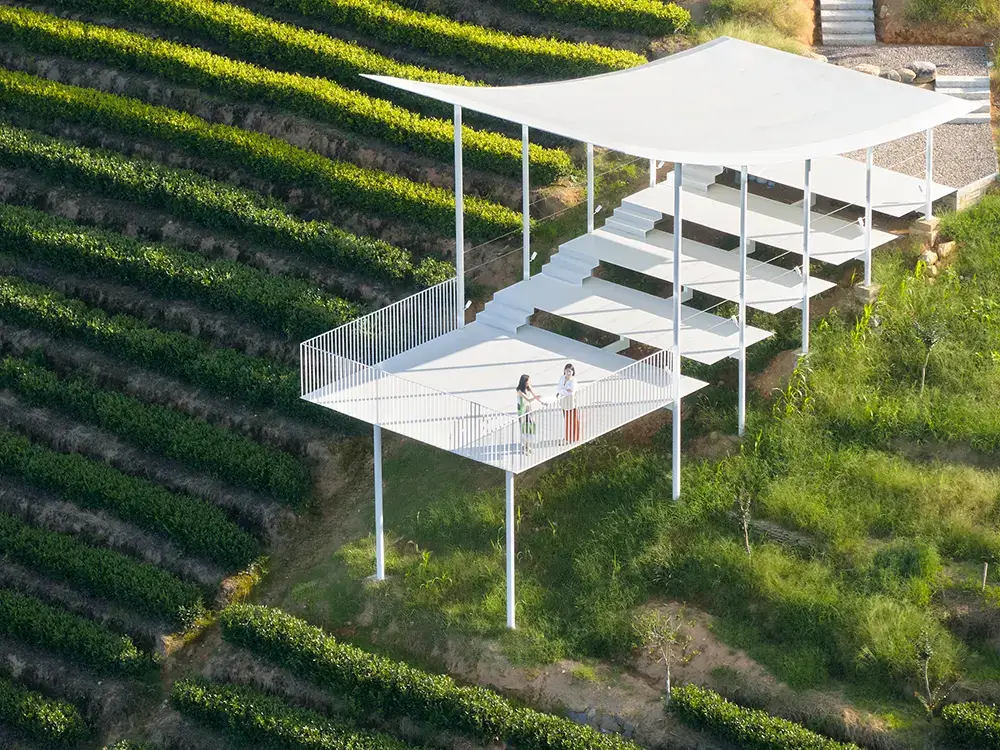
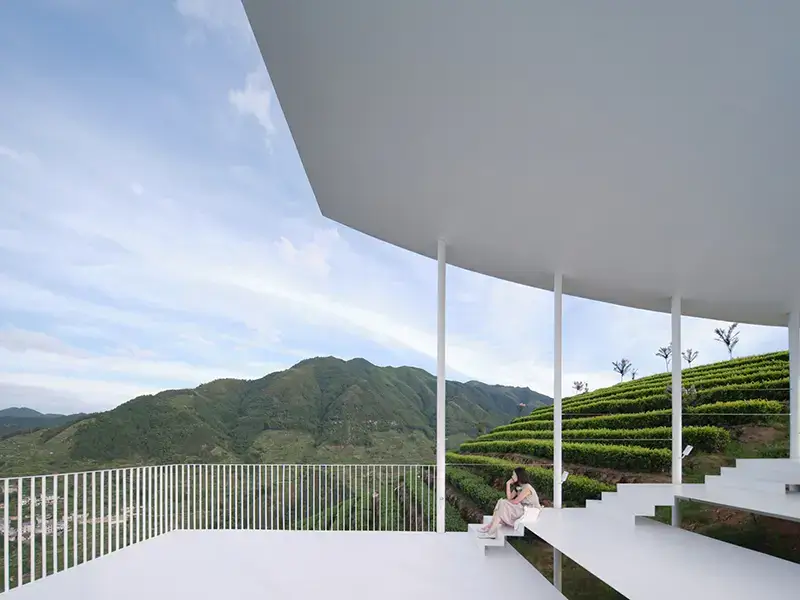
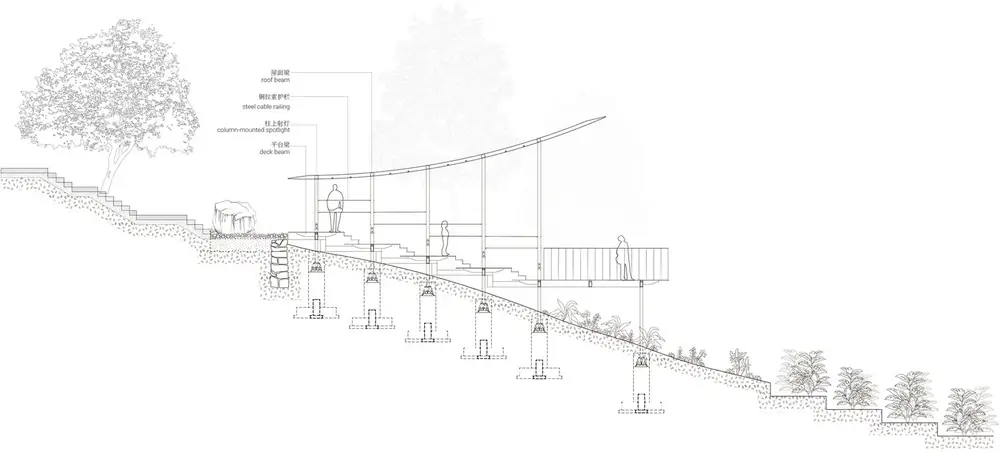
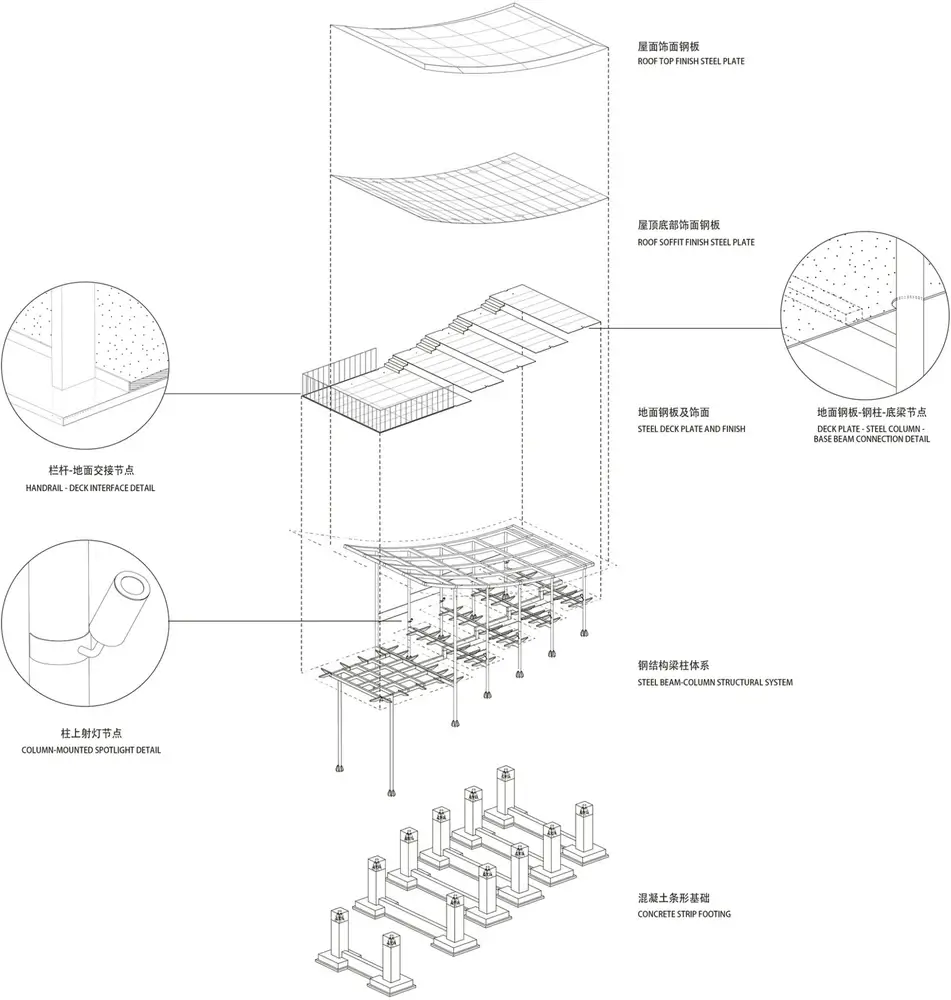
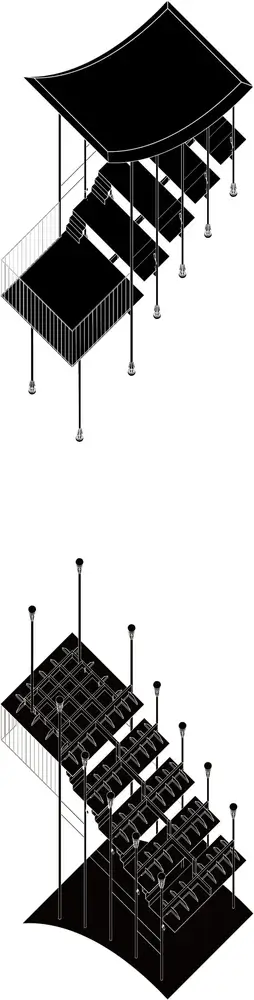
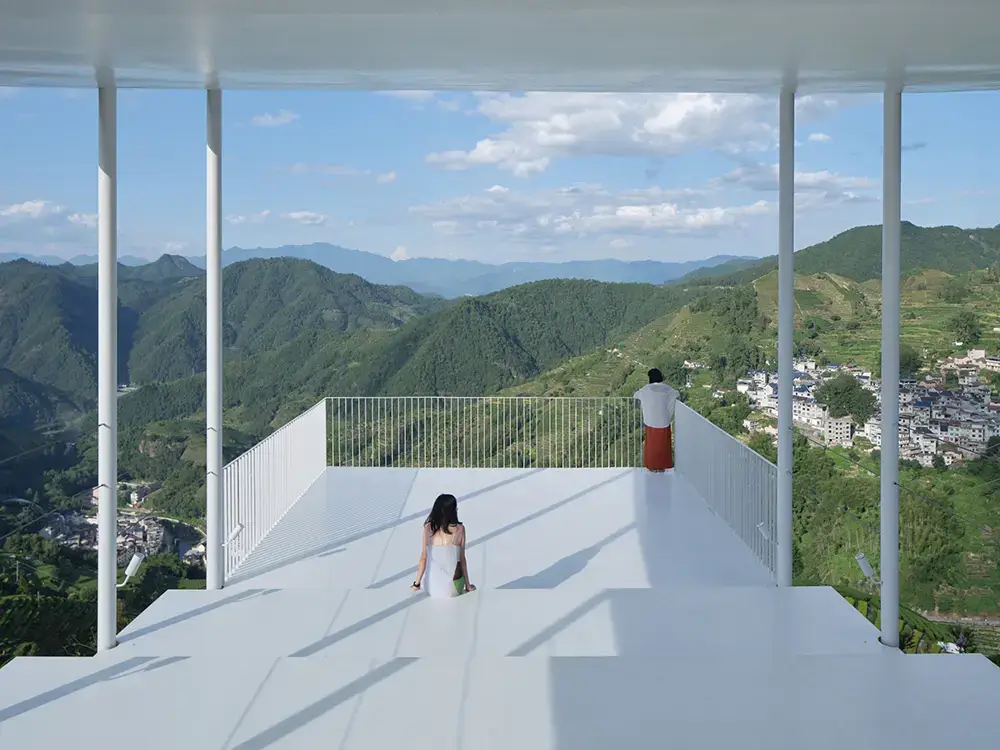
The structure consists of an extremely slender steel sandwich construction supported by just a few columns. As a result, the roof looks almost like a sheet of paper floating above the tea plantations.

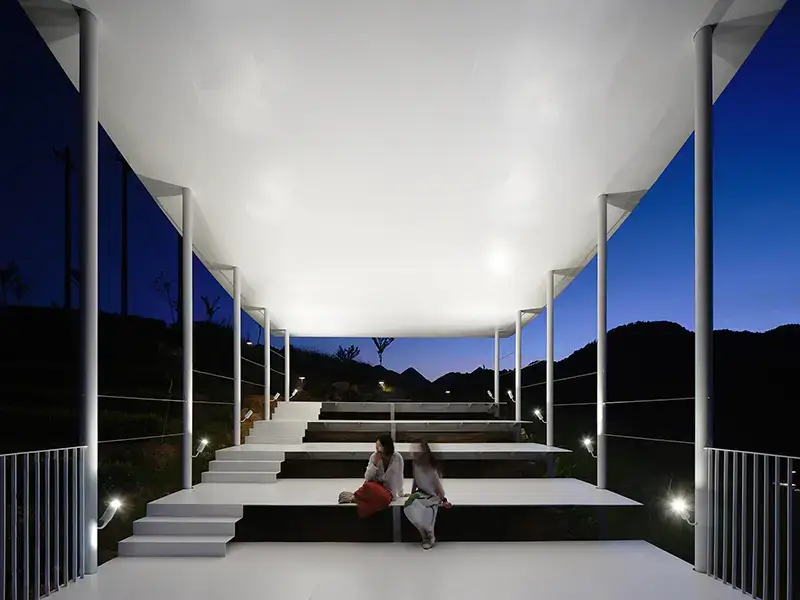
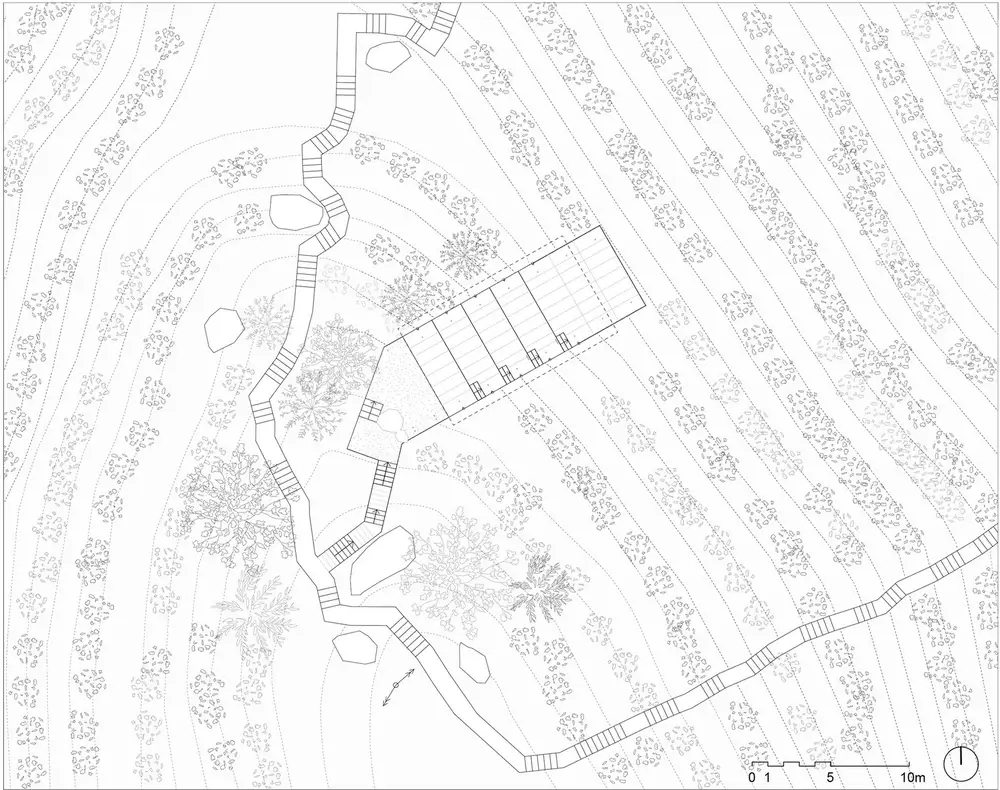
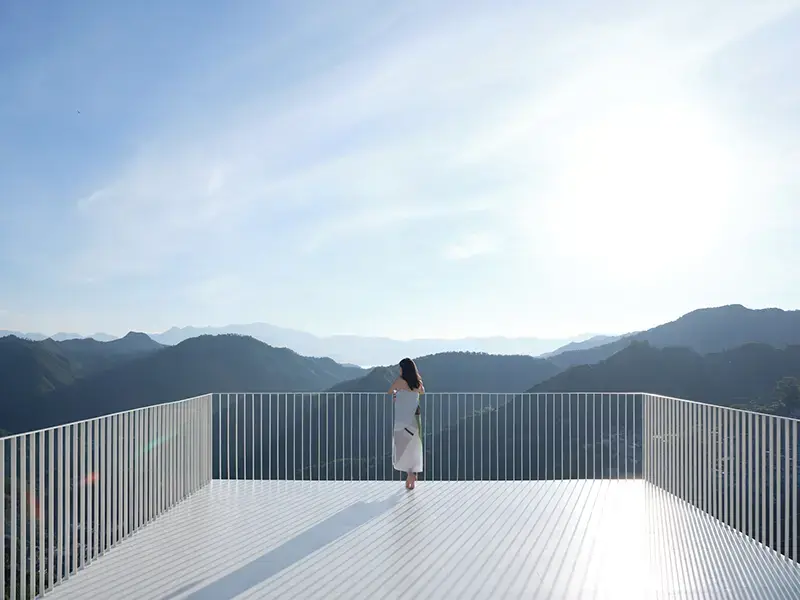
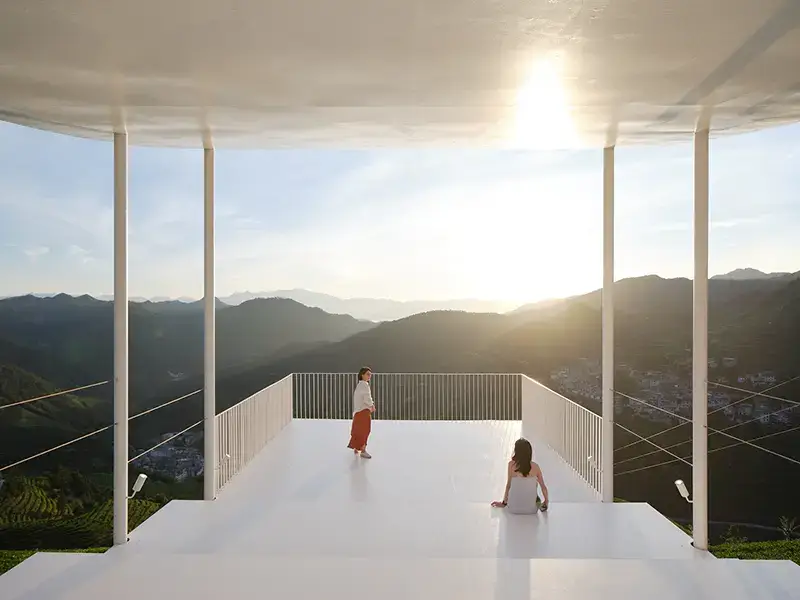
Below, there are seating areas of varying sizes. Steps follow the topography of the terraces and gently lead visitors downward. With each level, the view across the valley expands until, at the lowest point, the entire panorama opens up.

Here, the architecture is defined not by walls or rooms, but solely by the roof, the grounds, and the view.
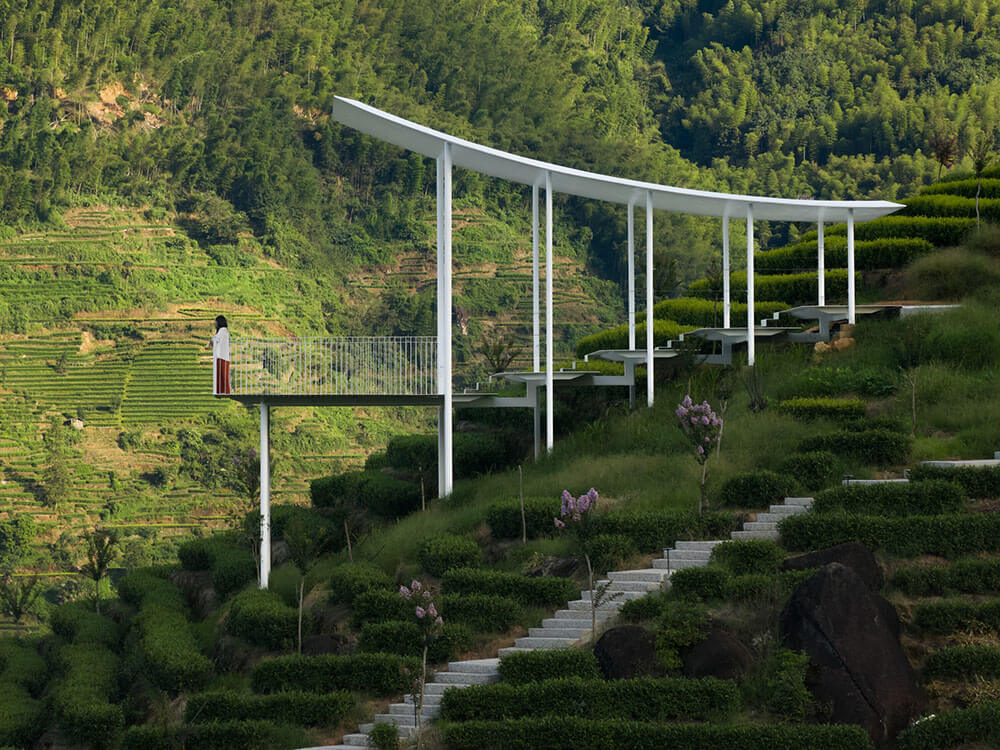
Lightweight construction
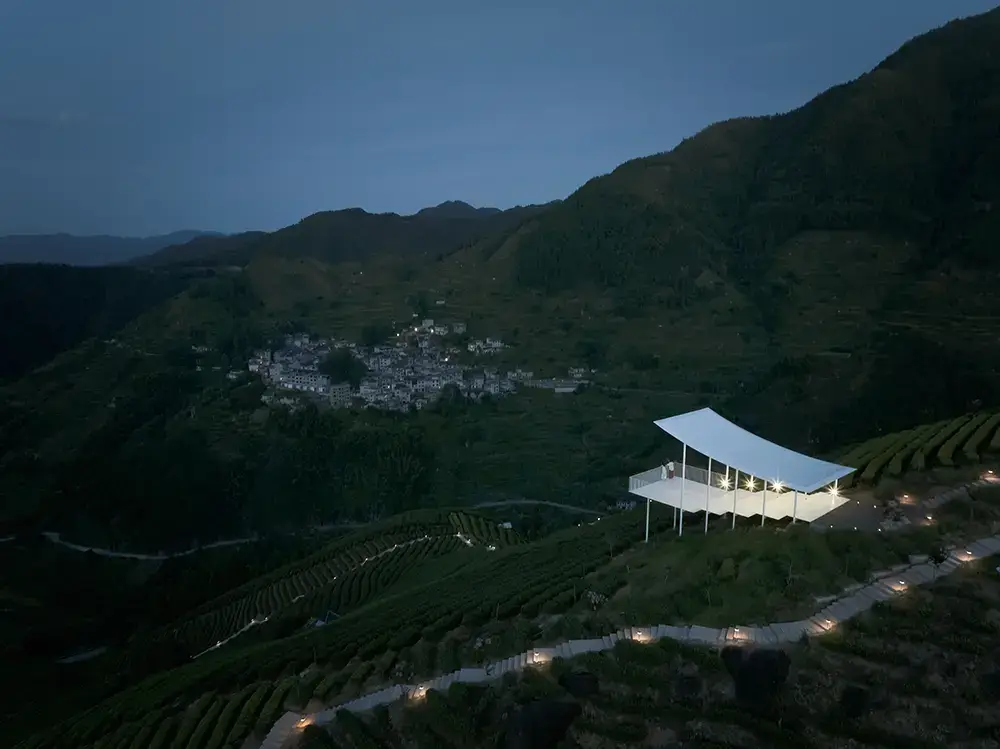
The construction process also followed the principle of minimal impact. Because heavy equipment could not reach the steep slope, all steel components were prefabricated and transported up the mountain using small carts and cable systems. Only a small amount of work had to be done on site.

As a result, the impact on the existing cultural landscape was minimal. At the same time, a sustainable infrastructure was created that is used today by both visitors and tea farmers.
A place for everyday life, too
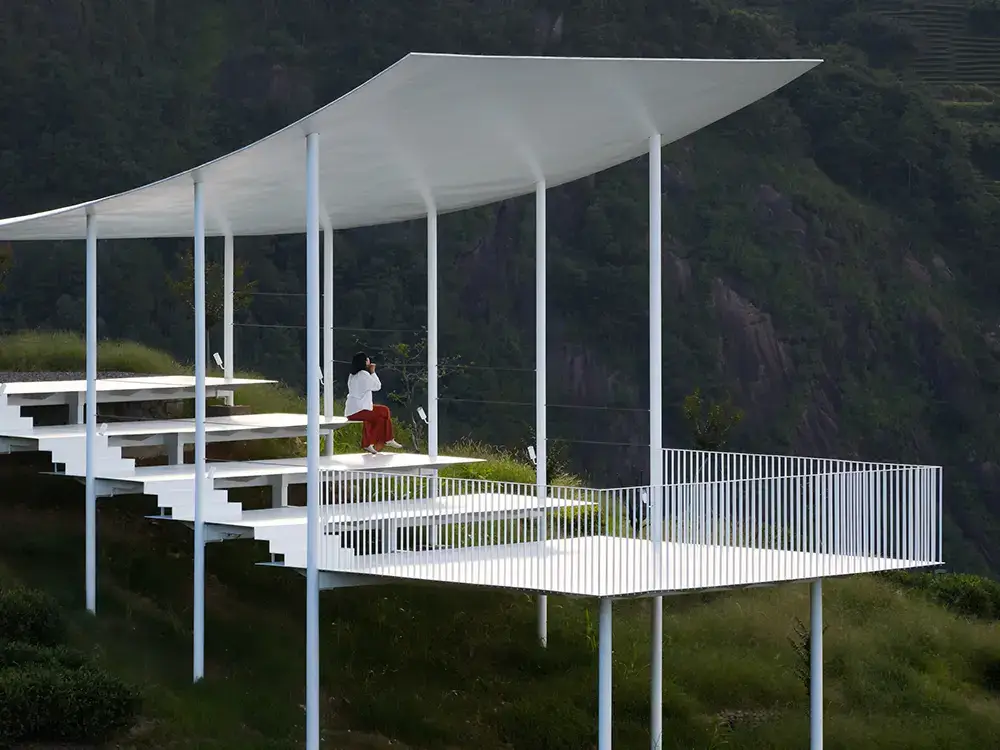
Since its completion, the pavilion has quickly evolved from an architectural landmark into an integral part of the community. Hikers use it as a rest stop, visitors come here to watch the sunrise and sunset, and during harvest season, the new path also provides better access to the tea plantations.

It is precisely this multifunctional use that makes the design interesting. The roof not only creates a viewing platform but also, incidentally, enhances the use of the landscape.
What you'll learn here:

Sometimes you don’t even need a building. A good roof is all it takes. The Floating Pavilion impressively demonstrates just how little architecture is needed to transform a place into an entirely new experience. Perhaps the project’s greatest achievement is that it doesn’t demand attention. It creates a place to linger, improves access to the tea plantations as a side effect, and gives the impression that it has always been there.

With a single, almost weightless-looking roof, a space is created that does not overwhelm the landscape but rather sets the stage for it. Rarely does architecture demonstrate so convincingly that minimalism is not a sacrifice, but rather a special form of quality.
Videos

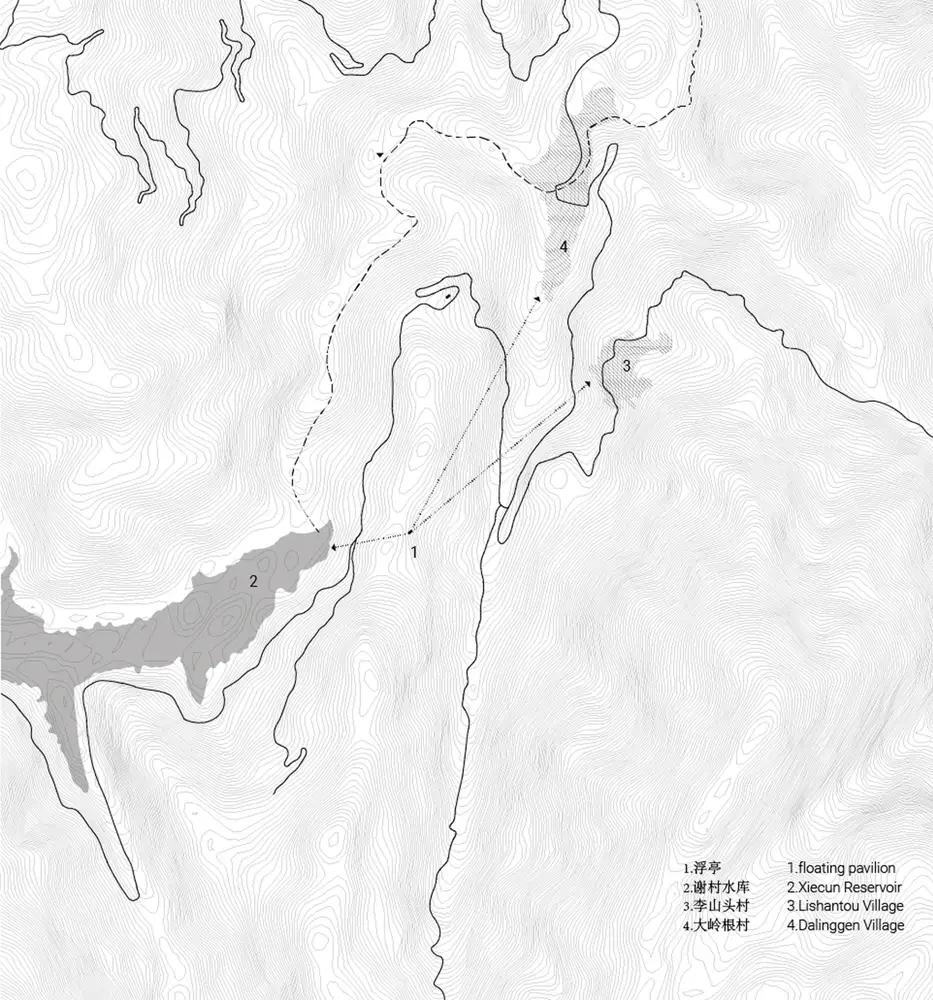
Plans
Subscribe to our newsletter.

Every three weeks, we inform you about new and exemplary projects and products. With heart, drive and expertise.

Blue Insight Cave Space

Blue Insight Cave Space

Architecture as a meeting place


3andwich Design / He Wei Studio

The Blue Insight Cave Space offers a new form of social interaction and leisure facilities: Architecture and landscape as meeting place and message.

3andwich Design / He Wei Studio

Sea caves

The Blue Insight Cave Space in Ningde City, Fujian (China), is a new cultural and tourist meeting place that focuses on the spectacular coastal landscape of Donghai No.1 Road and offers a new form of social interaction and leisure facilities: Architecture and landscape as meeting point and message.

The project is part of the "Zero Carbon Island" initiative for this region and stands out for its environmentally friendly approach. It is fantastically embedded in the landscape, its irregular shape resulting from the existing natural features such as the surrounding reefs and sea caves that are typical of the coastline. By covering and planting large parts of the structure, land consumption is kept to a minimum, while energy efficiency benefits from the resulting stable internal temperature.

Blue Insight Cave Space was designed by 3andwich Design / He Wei Studio.

Sea view

The Blue Insight Cave Space offers a variety of uses, including a lobby, exhibition spaces and a gallery, all with sea views. The main space is open plan and is suitable for events, small gatherings and dining. The interiors follow an organic design reminiscent of landforms eroded by water. The atmosphere could be described as both dramatic and inviting.

Marine life

The roof surface serves as a gigantic viewing platform and attracts visitors with its unique openings for ventilation and lighting in the form of marine life. A wonderful aspect of this project is that such elements are always both attractive and functional.

On the sea side, a continuous glass façade provides uninterrupted views of Bijia Mountain Island and the surrounding coastal landscapes.

Light tubes

The choice of materials and construction method of the Blue Insight Cave Space are committed to sustainability. Exterior walls made of textured concrete give the building a rock-like appearance, while the roof-penetration-free construction contributes to energy efficiency.

The sculptural light tubes on the roof provide soft, natural light, while the ventilation ducts ensure a pleasant climate and fresh air, even when people are visiting.

Close up

The Blue Insight Cave Space is not only an architectural highlight, but has also been a cultural landmark for the region since its completion in September 2024.

The result is a previously lacking high-quality public space along this busy coastal road. Its impressively simple design is helping to boost tourism. The Blue Insight Cave Space is close to the fusion of nature, culture and sustainability and shows how architecture can contribute to the promotion of environmentally conscious and community-oriented development.

Project data

Architect

3andwich design
He Wei Studio

Building owner

Fujian Jinhai Tourism Investment and Development Co., Ltd.

Opening

2024

Address

Danwan View Platform
Xiapu County
Ningde City
Fujian Province
China

Photos

DONG Image

Text

Johannes Bühlbecker
More Sports Media

Drawings

Video

More projects like this?

Your project here.

DO YOU WANT TO PUBLISH YOUR PROJECT OR PRODUCT?

Your stage

Spinning top

The KUFA traffic circle in Lyss

From 0 to 1


Kulturfabrik KUFA Lyss

The simplest ideas are often the best. The turntable is as circular as a traffic circle and vinyl creates a coherent and emotional connection to music in general and to the KUFA in particular.

Kulturfabrik KUFA Lyss

Influencer

A giant record player has turned a small traffic circle in the Swiss town of Lyss (located between Biel and Bern) into an internationally renowned attraction.

The initiators of the project were the neighboring concert organizer KUFA and the entrepreneur Marc Gehri. The record player is therefore not only very suitable due to its round shape, it also creates a symbolic and witty proximity to its surroundings.

LP of the week

The simplest ideas are often the best. The turntable is as circular as a traffic circle and vinyl creates a coherent and emotional connection to music in general and to the KUFA in particular.

And yet it was a long way from the idea to implementation. KUFA, the construction company Gehri Aarberg, the municipality of Lysss and the civil engineering office needed four years of patience to finally implement their plans.

In addition to planning and approval, the construction itself was not easy. Volunteers spent a whole week attaching the 800 or so metal plates to the turntable.

33 ⅓

Since its inauguration, the KUFA traffic circle has been celebrated on social media. The drone video has been viewed more than 150,000 times in a short space of time - what traffic planner can compete with that?

At the same time, you can assume that the "Sexiest Traffic Roundabout on Earth" can also make drivers smile.

So you could say that the KUFA traffic circle is a successful blend of function, design and recognition value. This benefits the community and sponsors alike.

What the KUFA traffic circle is still missing is a tonearm. This has not (yet) been realized for reasons of safety and scarce financial resources. Perhaps this will come when the speed is reduced to 33 ⅓ at the same time.

Project data

Idea & Design

Kulturfabrik KUFA Lyss
Werdtstrasse 17
CH - 3250 Lyss

Gehri AG Aarberg
Seidengasse 7
CH - 3270 Aarberg

Building owner

Municipality of Lyss
Maarktplatz 6
CH - 3250 Lyss

Opening

2019

Address

Lyss turntable roundabout
Bielstrasse 90
3250 Lyss
Switzerland

Photos

Kulturfabrik KUFA Lyss, Thomas Hässig (drone)
Gehri AG, Marc Gehri

Text

Johannes Bühlbecker
More Sports Media

Video

More projects like this?

Your project here.

DO YOU WANT TO PUBLISH YOUR PROJECT OR PRODUCT?

Your stage

KLABU Clubhouse

KLABU Clubhouse

Gimme shelter


MVRDV

A small project with a big impact: the KLABU clubhouses made from converted shipping containers give refugees around the world the chance to enjoy sport and togetherness.

MVRDV

KLABU Clubhouse

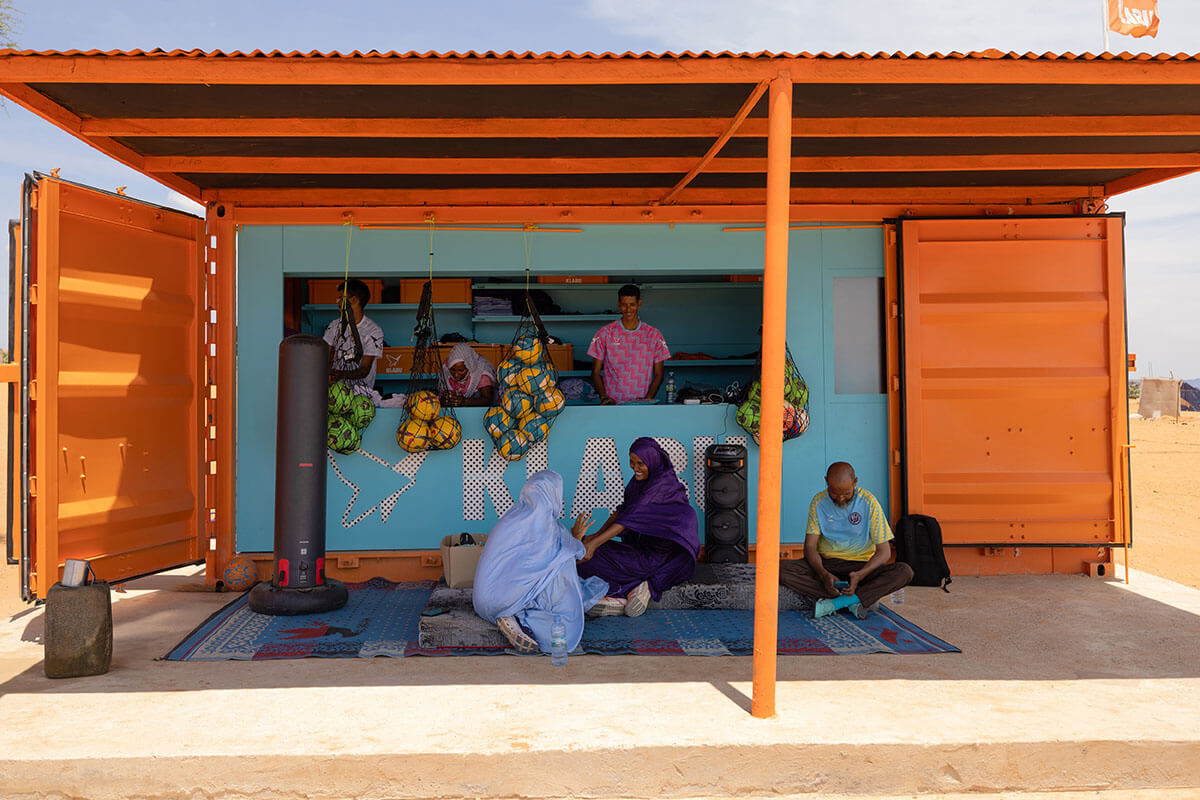
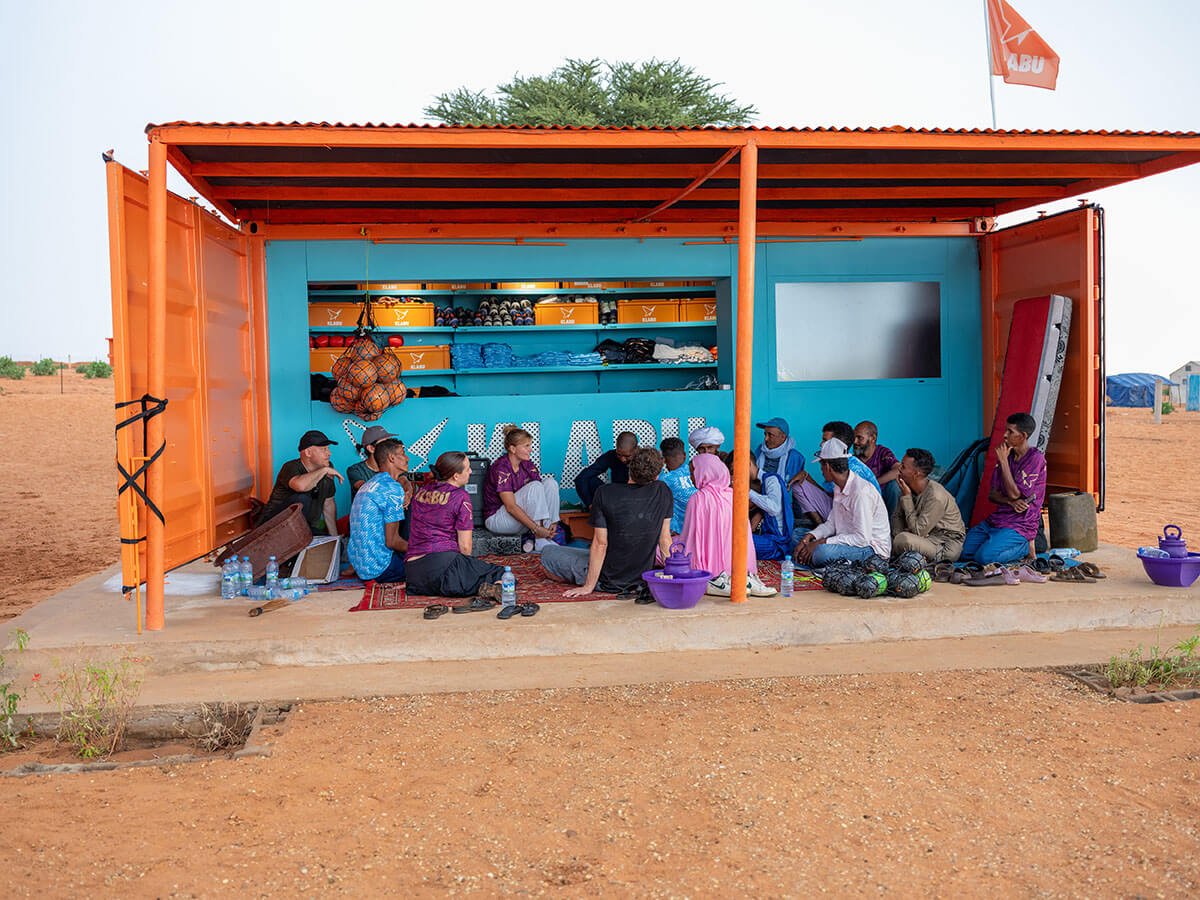
MVRDV has designed an innovative and flexible "Clubhouse" that fits into a converted shipping container and can therefore be used anywhere in the world. The project was developed in collaboration with KLABU, a globally active aid organization based in Amsterdam. KLABU is committed to bringing joy, hope and pride to refugees through sport.

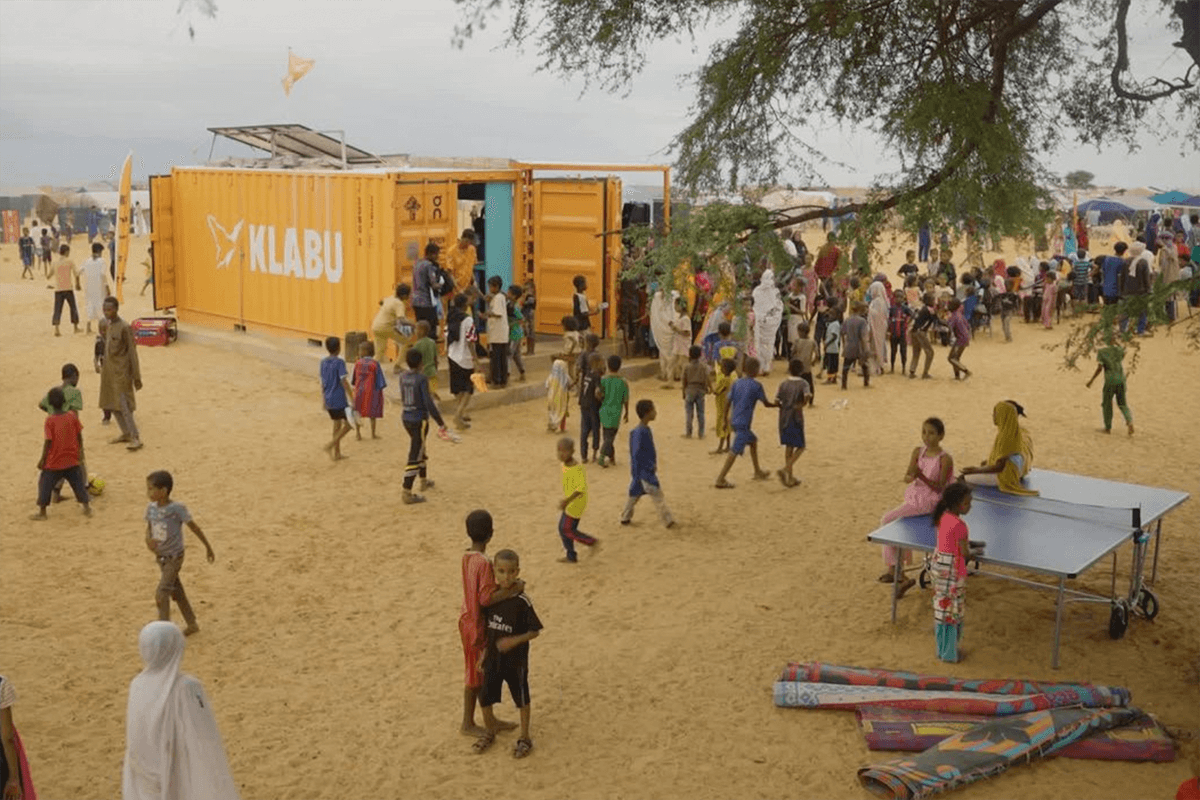
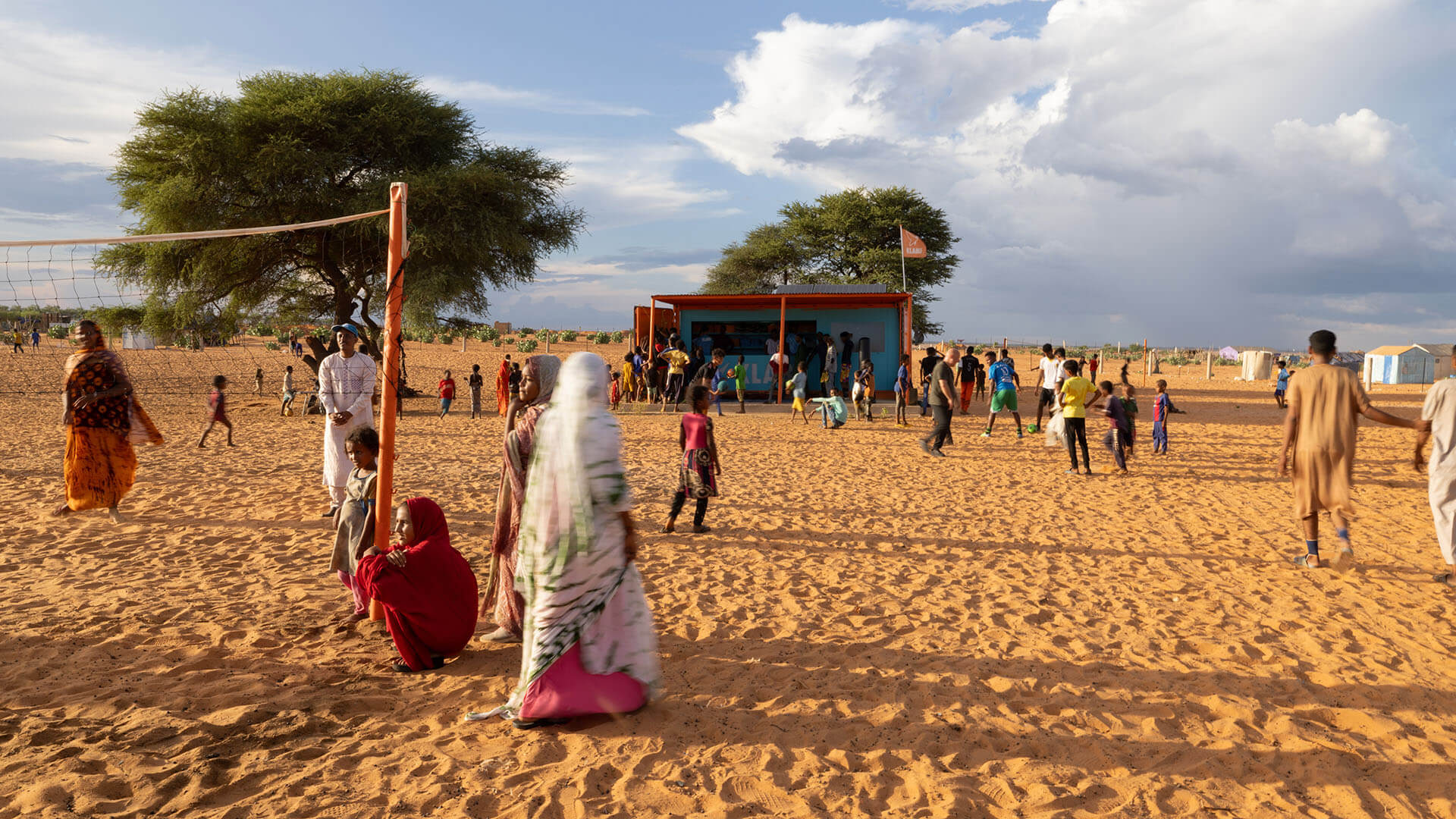
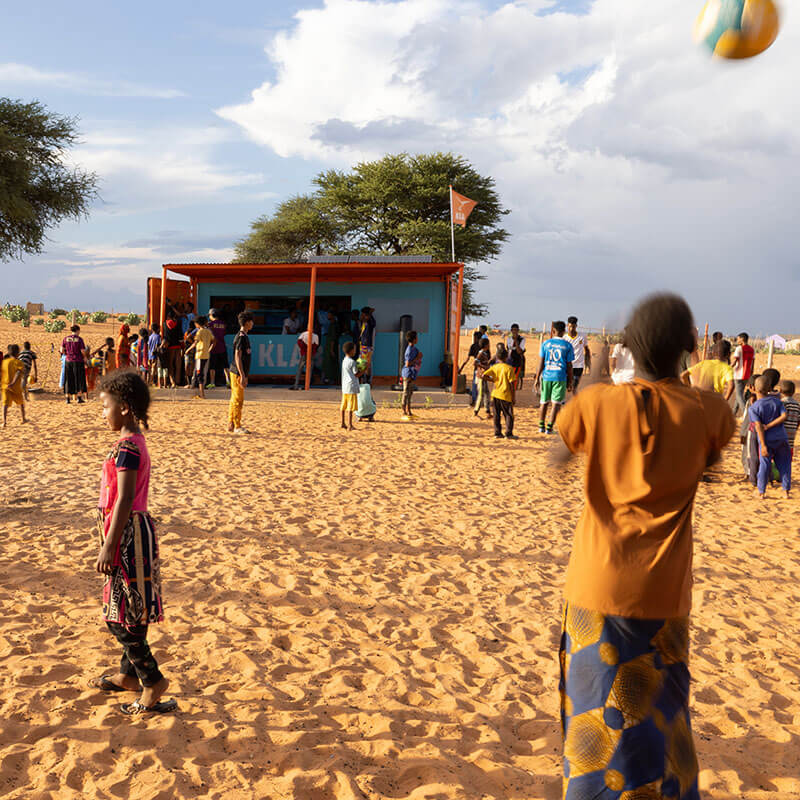
KLABU's clubhouses provide access to sports equipment, activities, TV broadcasts and the internet in refugee camps and settlements around the world, creating welcoming and inclusive community spaces.

Design

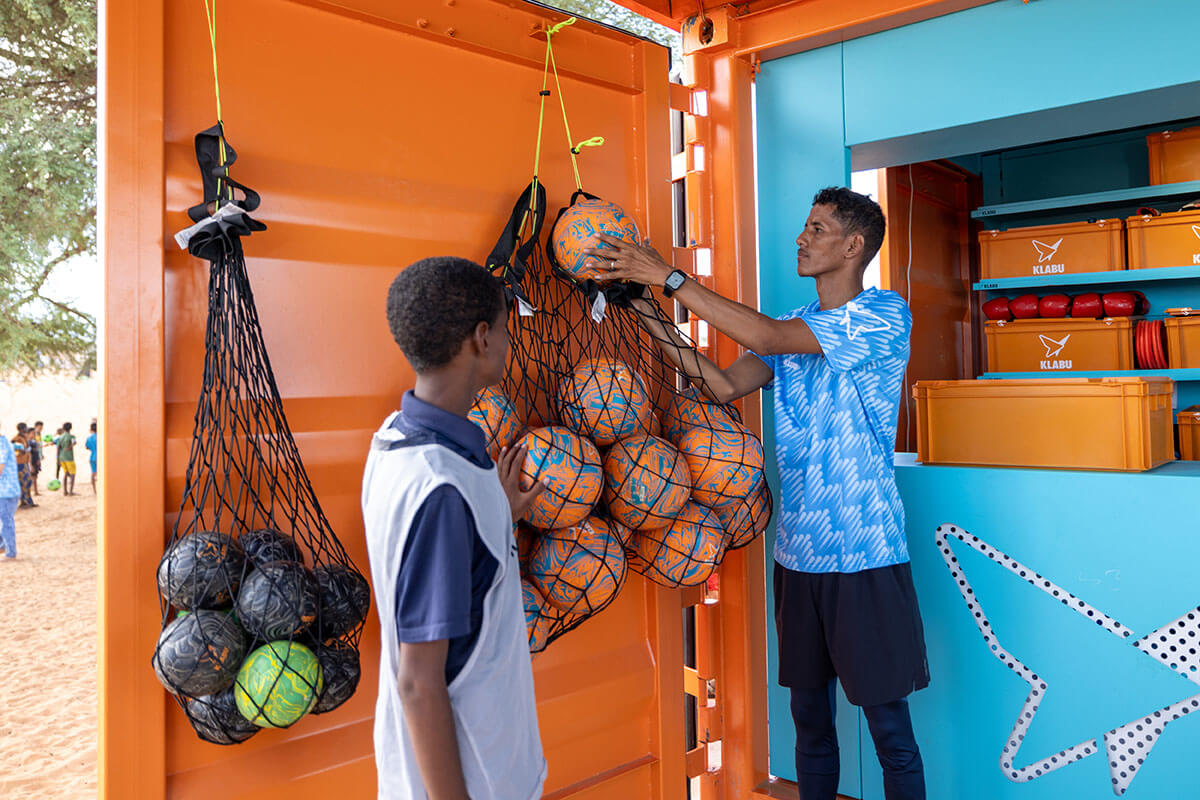
The design of the KLABU clubhouse is based on a modified ISO shipping container, which was chosen for its robustness, safety and ease of transportation. The container approach means that both the physical structure of the clubhouse and the necessary sports materials can be delivered in a single transportation operation. This makes the Clubhouse a flexible and scalable model that can be easily replicated in different locations to support the needs for sport, exercise and community of more than 120 million displaced people worldwide.

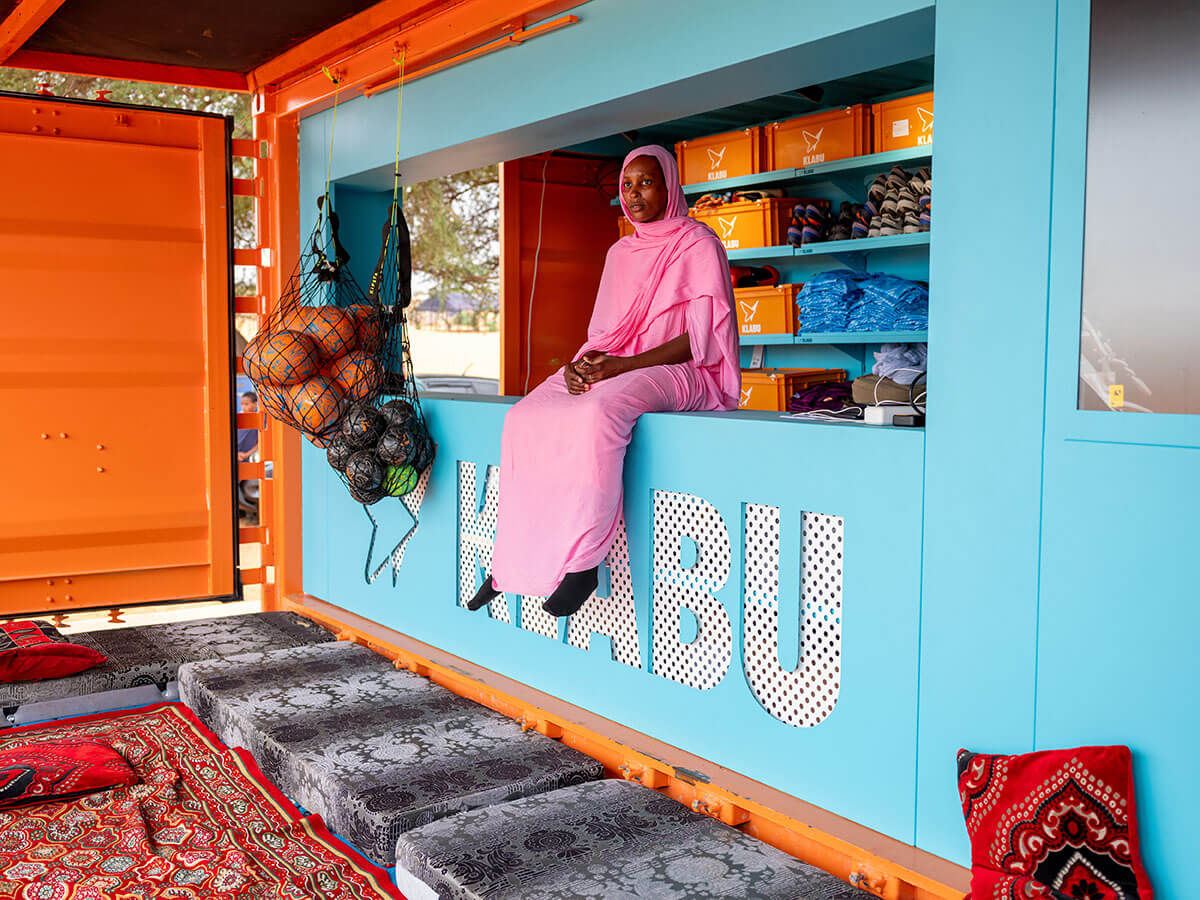
The exterior of the container is an eye-catching orange and features a die-cut KLABU logo, making it easily recognizable. The interior contrasts with a striking sky blue. The interior consists of compact and modular installations that provide both storage space and facilitate transportation.

These design elements ensure that all the necessary materials are stowed in the container before delivery and are easily accessible on arrival on site.

Further development

The latest, third version of the KLABU clubhouse, which is being installed in the Azraq refugee camp in Jordan, features a number of further developments. In addition to the doors at the ends, the container has a long side that can be fully opened and is equipped with a large window, a canopy to provide shade and an outdoor TV screen.

These functions increase the visibility, flexibility and usability of the clubhouse, for example for social and sporting activities.

Sustainability

The architecture of the clubhouse places great emphasis on sustainability and versatility. For example, the roof is equipped with solar cells that provide renewable energy to power electrical connections, charging stations and Wi-Fi. These features also allow the clubhouse to be used for educational activities and other purposes.

The structure of the container is robust and can withstand the climatic challenges that can occur in refugee camps around the world.

The future

Even simple concepts can have a big impact, as the KLABU clubhouse shows. The transformation of an everyday object into a vibrant, multifunctional space is an impressive example of creative and purpose-driven design. The clubhouses are designed for easy assembly, disassembly and transportation, making them particularly adaptable to different locations and contexts.

So far, clubhouses have been set up in seven locations, including the Waraotuma-a-Tuaranoko refugee camp in Brazil and the M'bera refugee camp in Mauritania. KLABU plans to replicate this model in over 50 other locations over the next ten years to create a network of safe and vibrant spaces for refugees.

Project data

Architect

MVRDV

Stefan de Koning, Gideon Maasland, Valentina Chiappa Nunez, Jose Manuel , Garcia Garcia, Herman Gaarman, Sruti Thakrar

Building owner

KALBU

Amsterdam

Opening

since 2022

Address

Ter Apel, Netherlands
Boa Vista, Brazil
M'bera, Mauritania
Azraq, Jordan

Text

Johannes Bühlbecker
More Sports Media

Videos

More projects like this?

Your project here.

DO YOU WANT TO PUBLISH YOUR PROJECT OR PRODUCT?

Your stage

Chicken Hero Pavilion

The Chicken Hero Pavilion

Glocalization


RAD+AR

The Chicken Hero Pavilion is neither a sports nor a leisure facility, but a beautiful and important contribution to sustainability and togetherness.

Urban Forest Jakarta

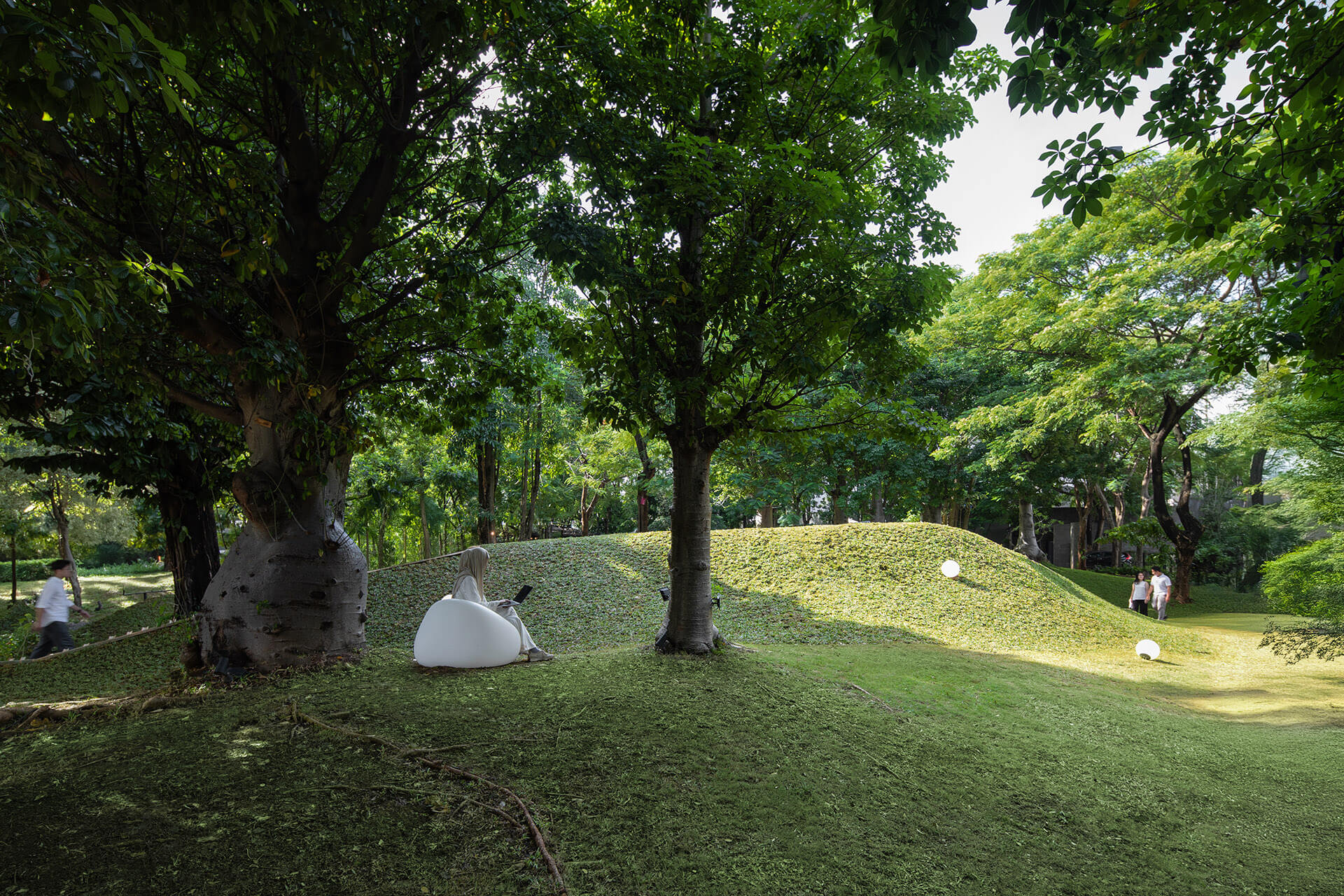
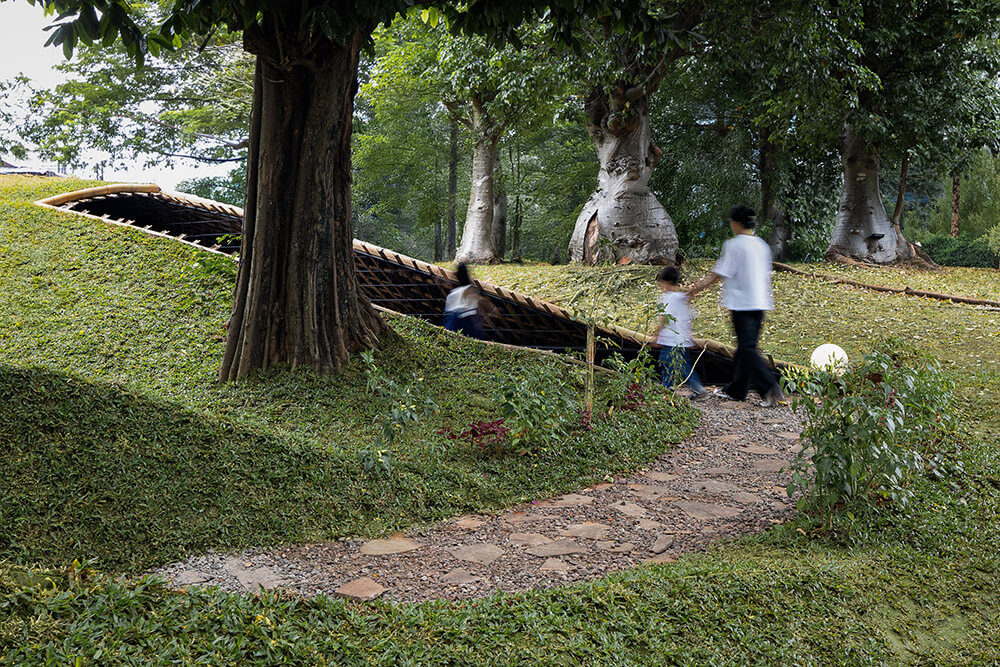
Urban Forest Jakarta is a green, hip leisure destination in the heart of Jakarta. In addition to many other attractions, there are always temporary installations to be seen here, such as the Chicken Hero Pavilion.

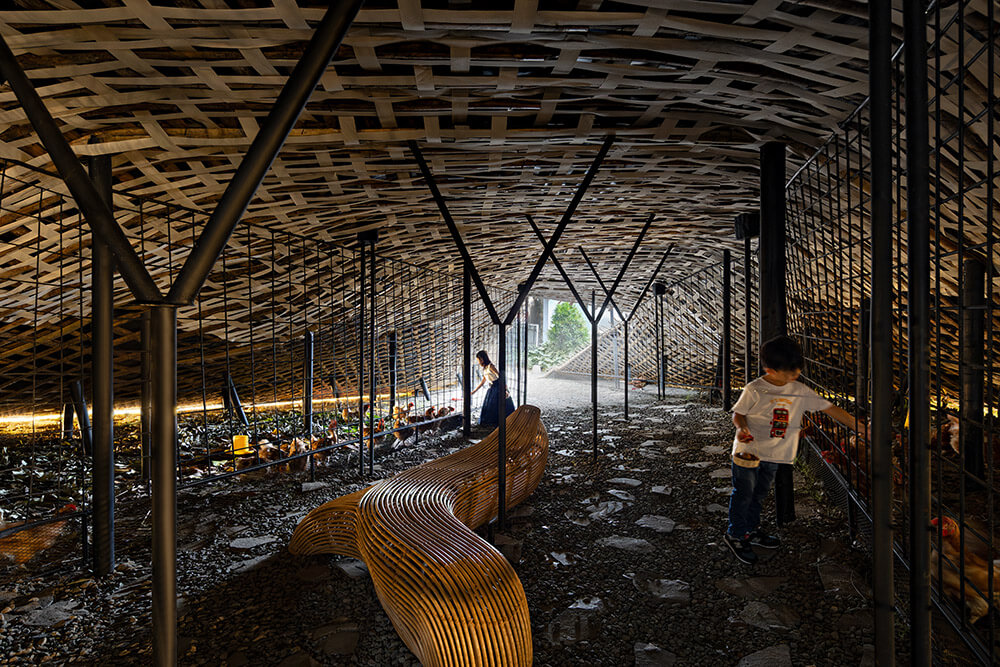
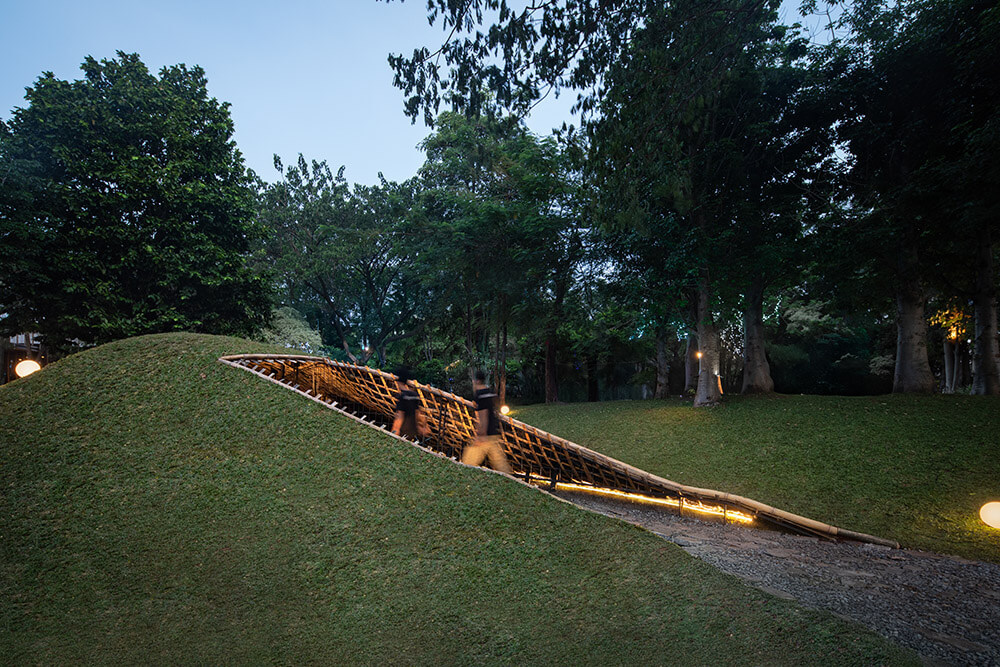
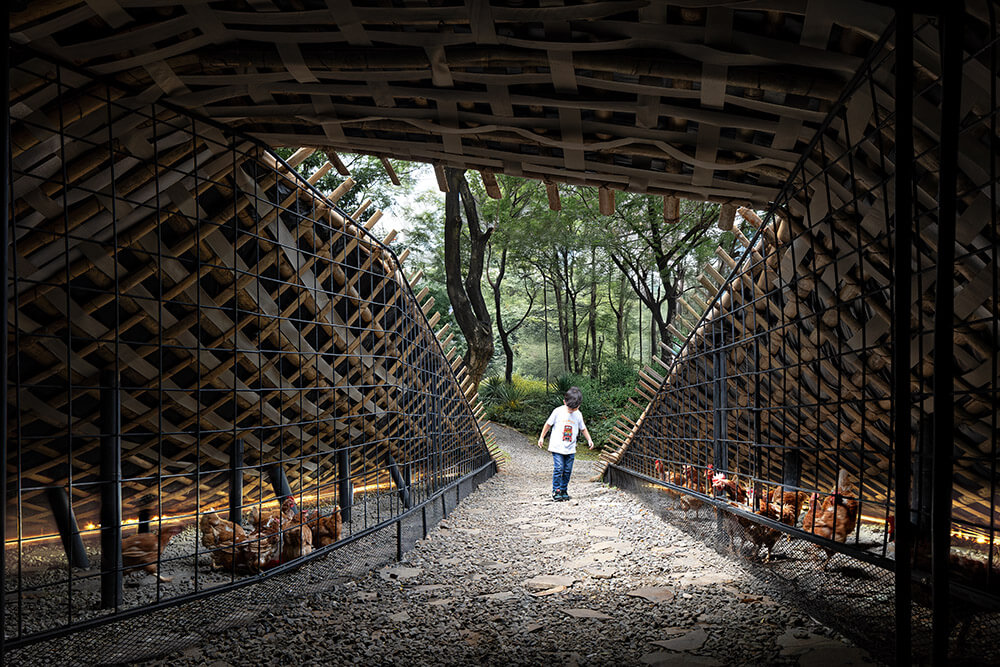
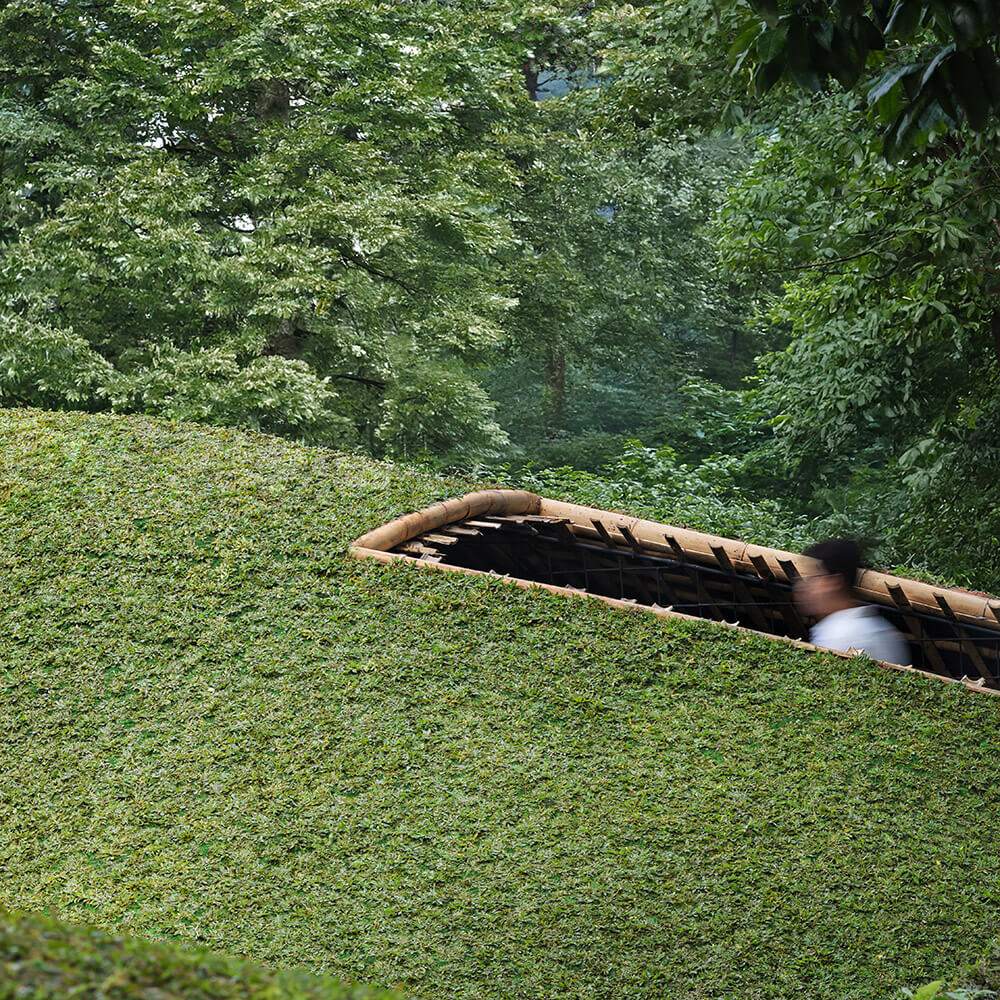
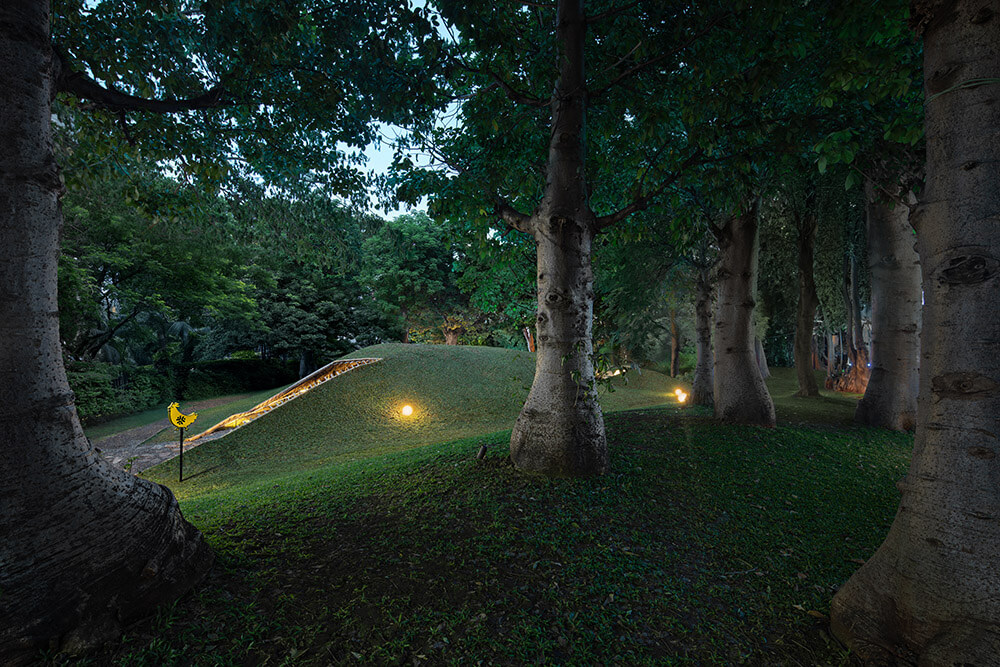
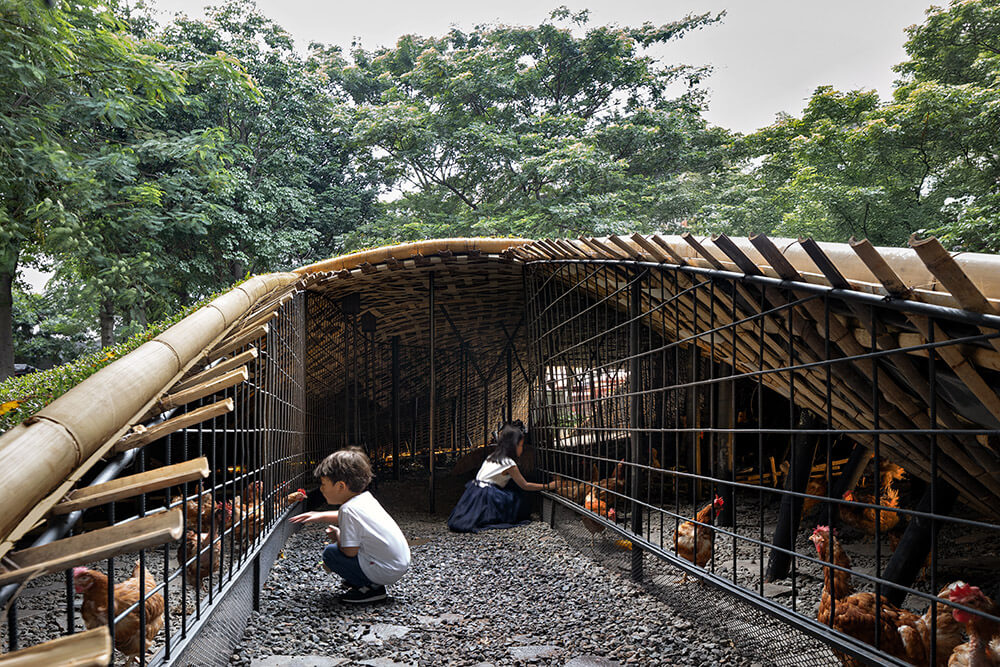
Chicken Hero blends very modestly into the landscape and looks like just another hill in the park. It has a cave-like tunnel that offers free, inclusive education and entertainment under the name Chickencoop.

The project comes from the Indonesian architecture firm RAD+AR, which is committed to provocation as a means of engaging with space, architecture, the environment and "tropical architecture".

Chicken coop

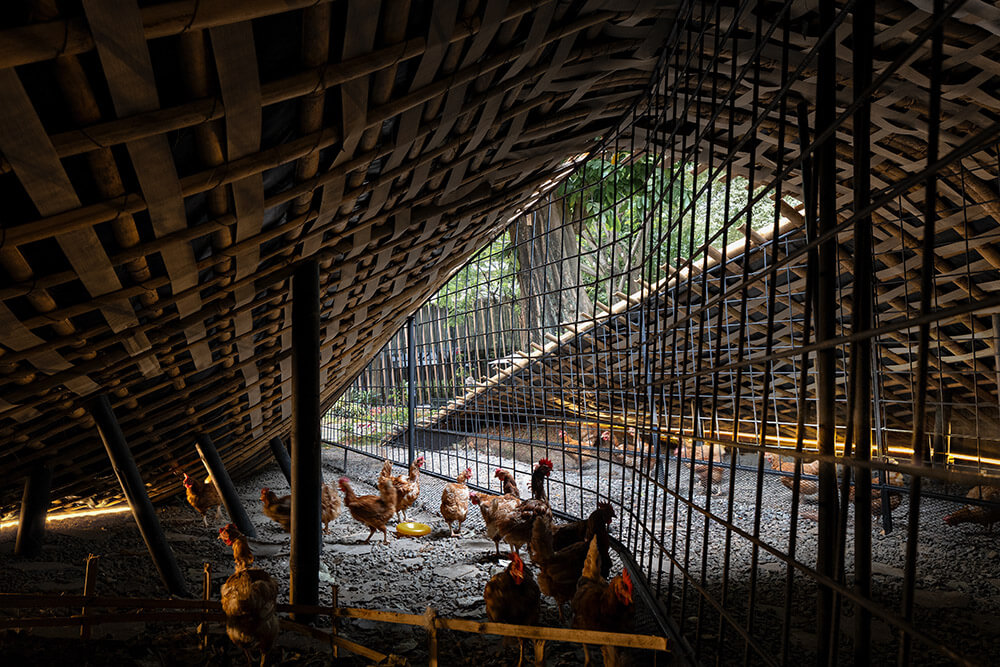
The Chicken Hero Pavilion presents the prototype of an environmentally friendly chicken coop, which was designed according to the principle of upcycling. The aim is to combine respectful livestock farming and sustainability.

The cross-ventilated interior provides indirect daylight and is covered with recycled bamboo as the main structure of the horizontal-diagonal green roof. These coops meet the needs of the chickens while ensuring waste disposal and the preservation of green areas, such as rainwater catchment areas - all while maintaining a stable and comfortable thermal environment for the chickens.

Temporary structure

This temporary structure demonstrates an uncomplicated and ecological circular economy in the middle of a metropolitan green space. During the four-week exhibition period, the pavilion actively served as a food waste recycling plant for six restaurants in the neighborhood.

All dried leaves and organic tree waste were used as bedding for the chickens, while also helping to reduce moisture. The composted food waste and dried leaves were then turned into garden and commercial compost, which was harvested every three days. Approximately 40 eggs were returned to the restaurants each day and served as living harvest souvenirs for visitors.

Reciprocity

A central element of the Chicken Hero Pavilion is the reciprocity between visitors and chickens. This is intended to break the stigma of backyard poultry farming and encourage visitors to become agents of change for sustainability in their own households, neighborhoods and communities.

The Chicken Hero Pavilion aims to achieve the (currently) utopian goal of decentralization, sustainability and the promotion of a micro-circular economy within neighbourhood communities - and thus to overcome factory farming. This approach is in line with the current trend of "glocalization" (globalization + localization) in the vast archipelagos of Indonesia.

And not only there. A great project.

Project data

Designer

RAD+AR
Jalur 20 Block 30/19
West Jakarta
Indonesia 11620

Photos

RAD+AR

Opening

2024

Address

Urban Forest Cipete
Kota Jakarta Selatan
Daerah Khusus Ibukota
Jakarta 12430
Indonesia

Text

Johannes Bühlbecker
More Sports Media

Drawings

[dica_divi_carousel item_width_tablet="100%" item_width_phone="100%" item_width_last_edited="on|phone" show_items_desktop="1" show_items_tablet="1" multislide="on" transition_duration="1000" loop="on" autoplay="on" hoverpause="on" autoplay_speed="3500" arrow_nav="on" item_spacing="10" item_vertical_align="flex-start" advanced_effect="1" arrow_nav_color="#5E5C4D" arrow_bg_color="#FFFFFF" dots_color="#FAF4E4" dots_active_color="#5E5C4D" overlay_color_field_bgcolor="rgba(255,255,255,0.85)" carousel_container_margin="||50px||false|false" _builder_version="4.27.4" _module_preset="default" title_font="Roboto Condensed||||||||" body_font="Roboto Condensed||||||||" custom_margin="|50px||30px|false|false" custom_margin_tablet="|50px||30px|false|false" custom_margin_phone="|0px|0px|0px|false|false" custom_margin_last_edited="on|phone" custom_padding_tablet="" custom_padding_phone="||0px||false|false" custom_padding_last_edited="on|phone" global_colors_info="{}"][dica_divi_carouselitem button_url_new_window="1" image="https://moresports.network/wp-content/uploads/2025/04/1200px_002-blockplan.jpg" image_lightbox="on" _builder_version="4.27.4" _module_preset="default" global_colors_info="{}"][/dica_divi_carouselitem][dica_divi_carouselitem button_url_new_window="1" image="https://moresports.network/wp-content/uploads/2025/04/1200px_003-Siteplan.jpg" image_lightbox="on" _builder_version="4.27.4" _module_preset="default" global_colors_info="{}"][/dica_divi_carouselitem][dica_divi_carouselitem button_url_new_window="1" image="https://moresports.network/wp-content/uploads/2025/04/1200px_006-axonometric.png" image_lightbox="on" _builder_version="4.27.4" _module_preset="default" global_colors_info="{}"][/dica_divi_carouselitem][dica_divi_carouselitem button_url_new_window="1" image="https://moresports.network/wp-content/uploads/2025/04/1200px_005-section-2.jpg" image_lightbox="on" _builder_version="4.27.4" _module_preset="default" global_colors_info="{}"][/dica_divi_carouselitem][dica_divi_carouselitem button_url_new_window="1" image="https://moresports.network/wp-content/uploads/2025/04/1200px_004-section-1.jpg" image_lightbox="on" _builder_version="4.27.4" _module_preset="default" global_colors_info="{}"][/dica_divi_carouselitem][dica_divi_carouselitem button_url_new_window="1" image="https://moresports.network/wp-content/uploads/2025/04/1200px_000-process.png" image_lightbox="on" _builder_version="4.27.4" _module_preset="default" global_colors_info="{}"][/dica_divi_carouselitem][dica_divi_carouselitem button_url_new_window="1" image="https://moresports.network/wp-content/uploads/2025/04/1200px_000-BACKGROUND.png" image_lightbox="on" _builder_version="4.27.4" _module_preset="default" global_colors_info="{}"][/dica_divi_carouselitem][/dica_divi_carousel]

Video

Our newsletter

Your stage

Publish your project or product here!

New Old Trafford Stadium

New Old Trafford Stadium

If only, then already


Foster + Partners

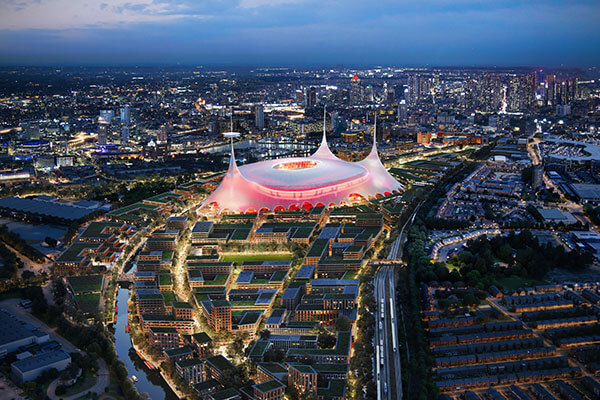
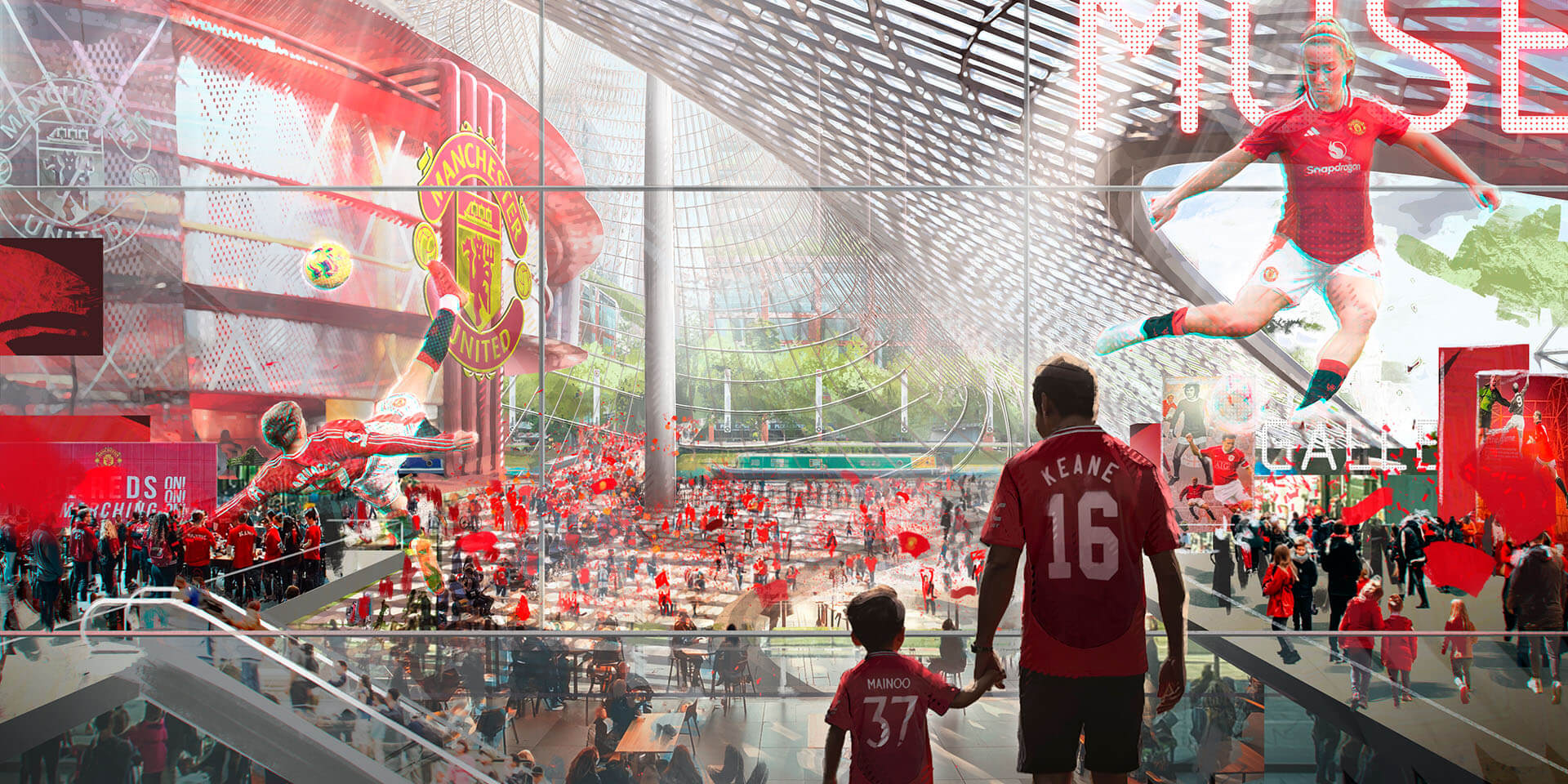
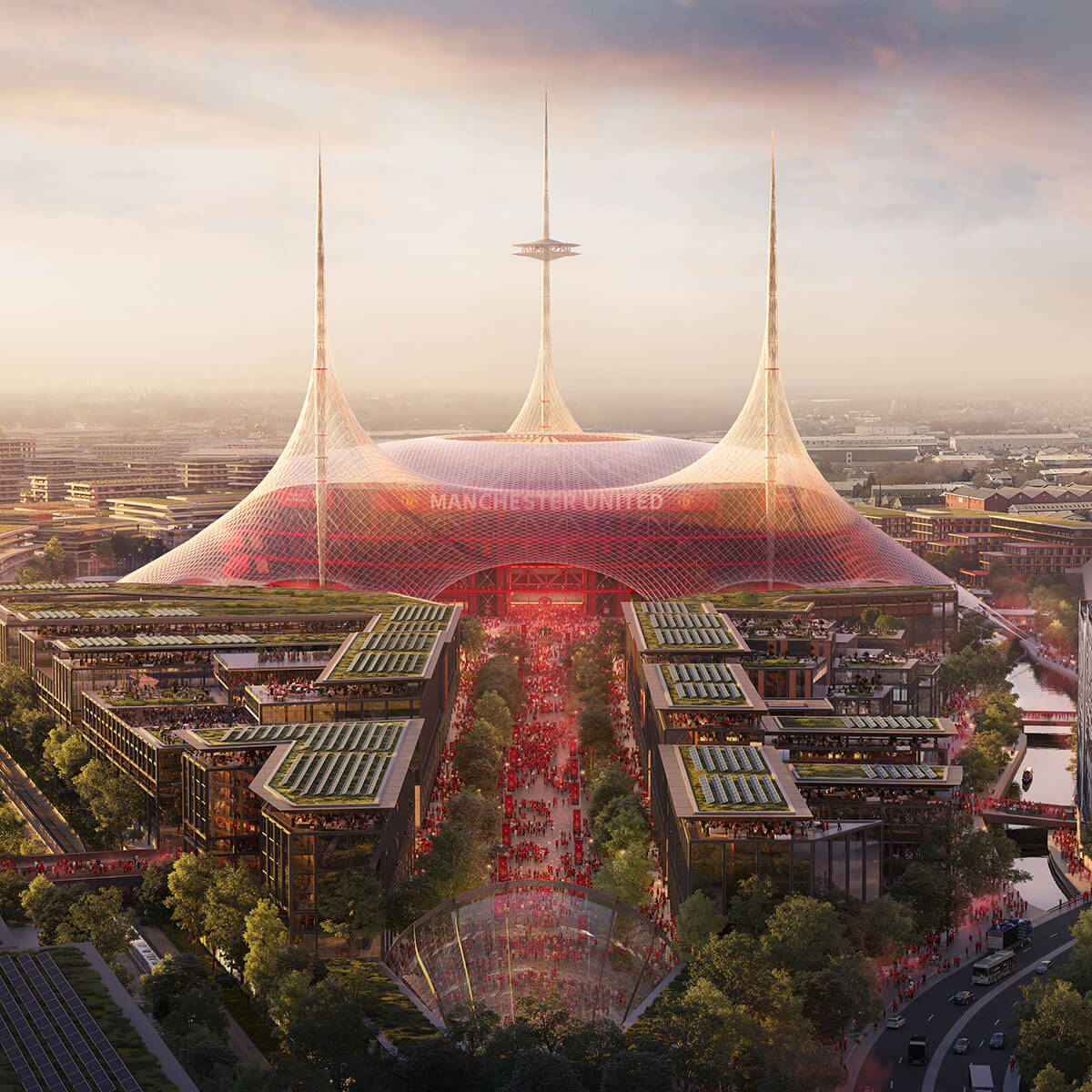
The architecture firm Foster + Partners has presented a master plan for the New Old Trafford Stadium District, the centerpiece of which is a new stadium for Manchester United. The concept envisages a comprehensive mix of sport, housing and leisure, with the stadium being the driving force behind the urban renewal.

The client is Manchester United FC.

MUFC

Manchester United Football Club was founded in 1878, is the English record champion with 20 league titles, has won every European club title and is one of the most popular clubs in the world. MUFC has been at home at Old Trafford stadium since 1910.

In recent years, however, the club has only enjoyed moderate sporting success and is currently languishing in the lower midfield of the Premier League. Although the stadium is a cult site for the fans, it no longer meets today's commercial requirements despite numerous modernizations and expansions.

Perhaps this development was one more reason for the club's owners to renovate the entire district with the new stadium.

Plaza of dreams

Old Trafford was called the "theater of dreams" because it was a secluded space outside of the everyday life outside - a world of its own.

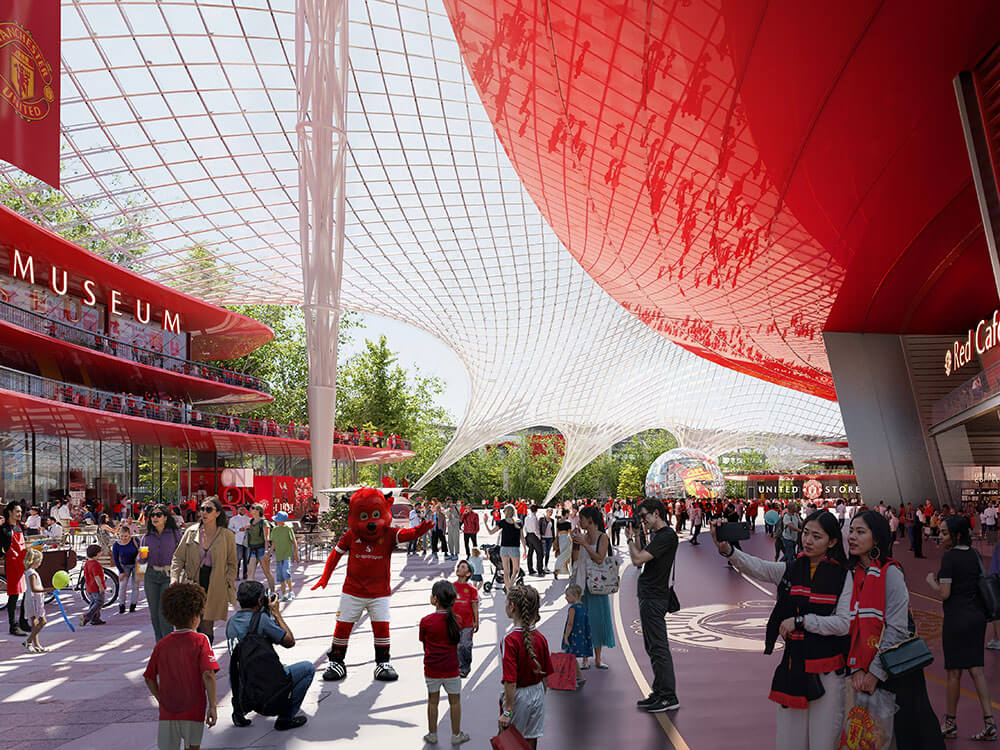
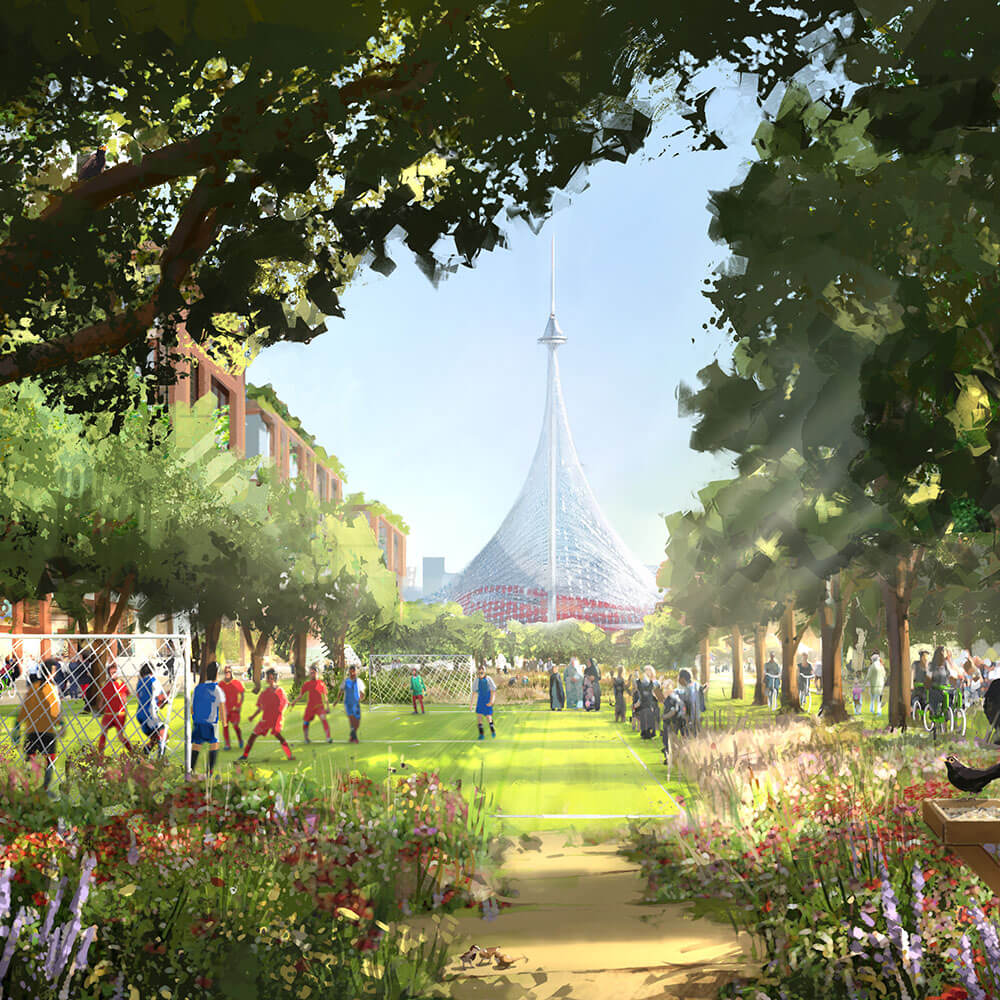
The design for the New Old Trafford Stadium now breaks with such traditional stadium concepts: instead of a closed arena, an open, inviting design is proposed that opens up to the surrounding area. Circumferential "balconies" offer views into the new district and make the stadium an integral part of the city.

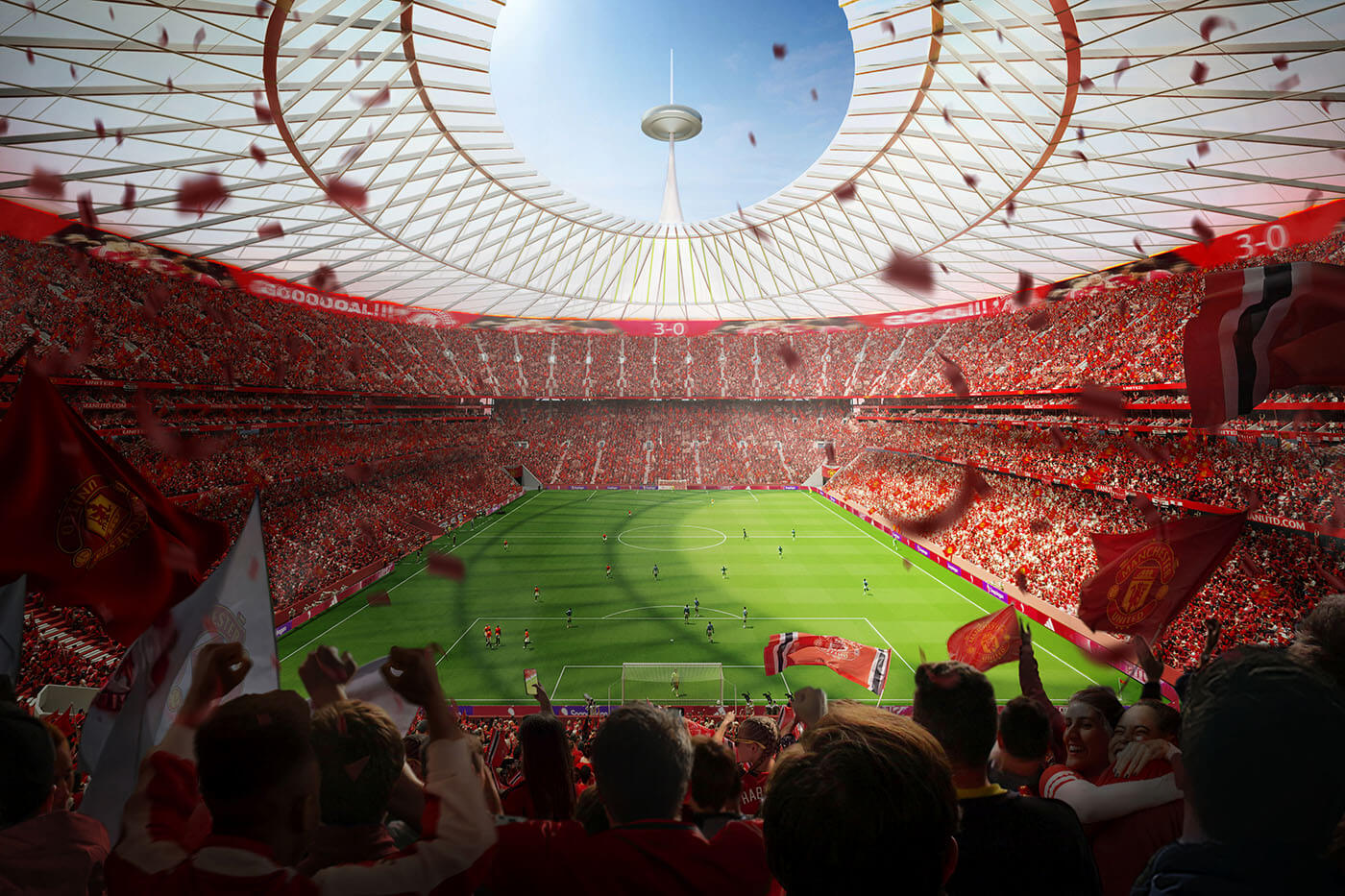
The new Stasdion offers space for 100,000 spectators. It is spanned by an extensive roof that collects energy and rainwater and at the same time protects a huge public plaza. This plaza is to become a meeting place, not just on match days. The aim is to create a sustainable, pedestrian-friendly stadium landscape that is easily accessible thanks to the expansion of public transportation.

The architectural concept picks up on the history of Manchester United and also aims to offer fans a sense of identification. Three striking masts, inspired by the club's trident emblem, support the roof and create a new silhouette in the Manchester skyline.

Theatre of dreams

The entire New Old Trafford Stadium district is part of a gigantic urban development project. It includes a network of public green spaces, roads, bridges and water features along the Manchester Ship Canal. The sustainable design provides for direct connections to existing city districts and transport networks. Renewable energies, rainwater harvesting and innovative construction methods are to play a central role.

There is not yet a timetable for the implementation of the project.


Project data

Designer

Foster + Partners
Riverside
22 Hester Road
London
SW11 4AN
United Kingdom

Building owner

Manchester United FC

Illustrations

Foster + Partners

Text

Johannes Bühlbecker
More Sports Media

Address

Old Trafford
Stretford
Manchester M16 0RA
United Kingdom

Videos

Our newsletter

Your stage

Publish your project or product here!

Miami Floating Padel Court

Miami Floating Padel Court

Paddling to padel


Yntegra Group

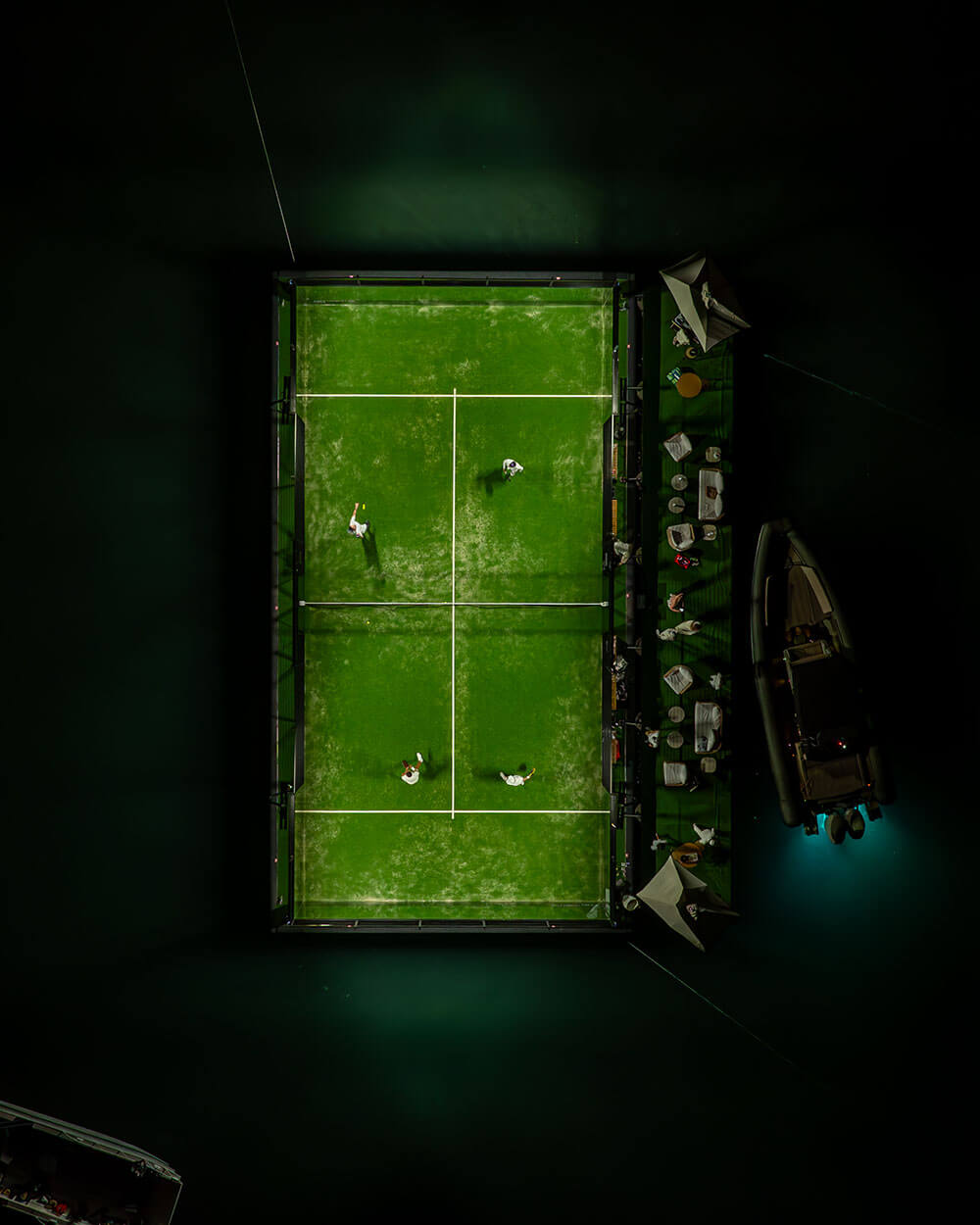
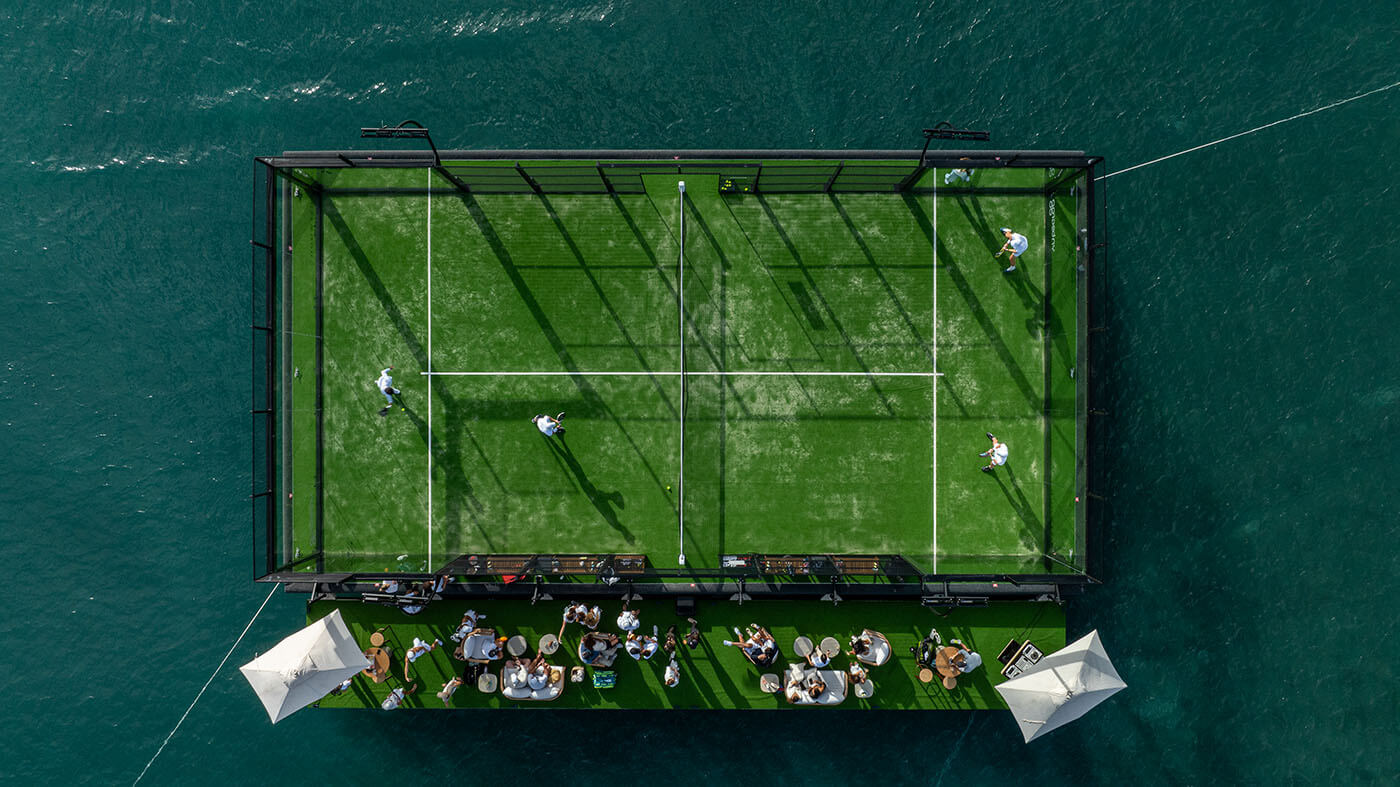
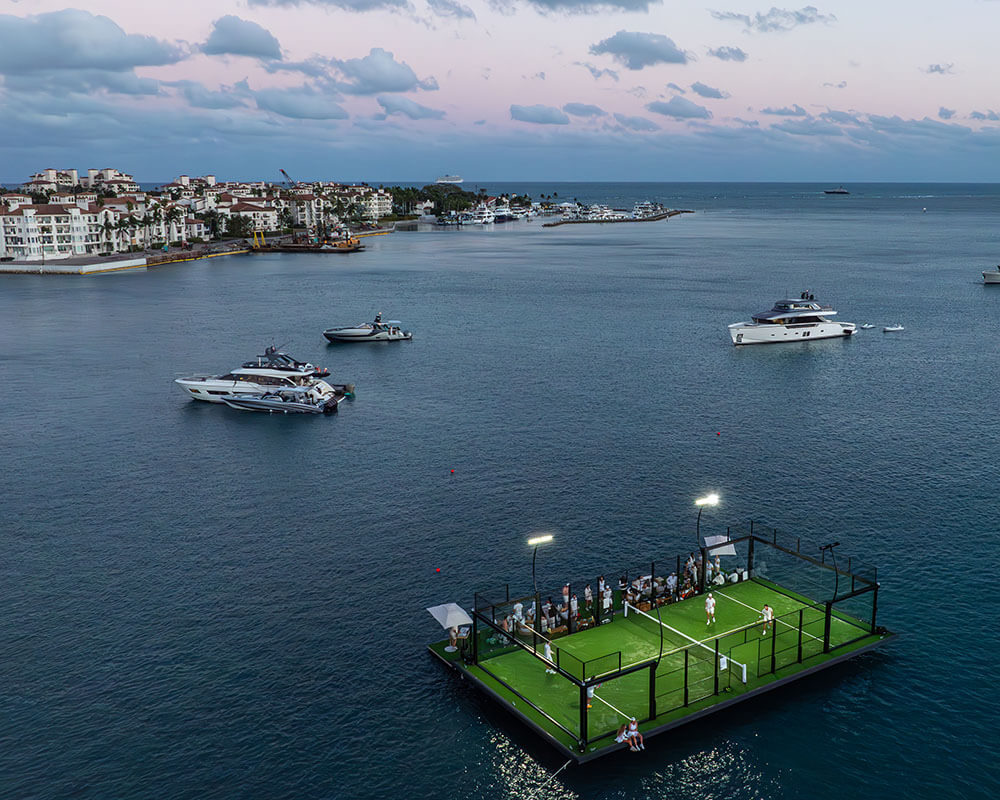
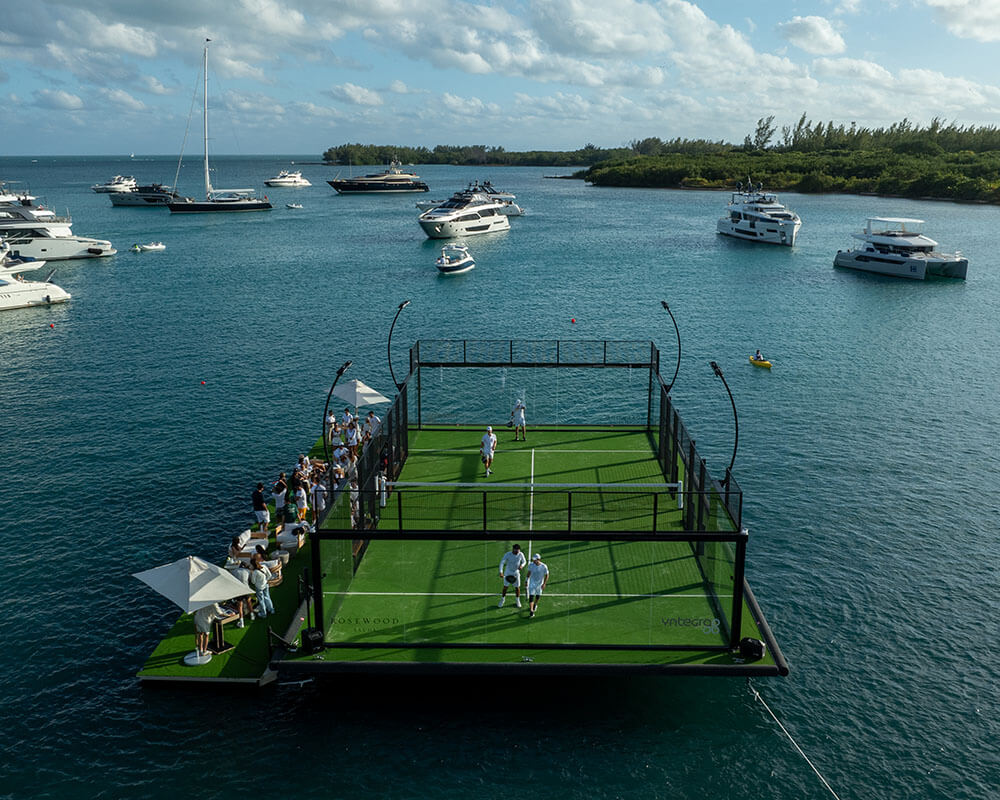
In early December 2024, during Miami Art Week, the world's first floating padel court was unveiled and anchored off the coast of Fisher Island.

This spectacle raises the question: What's the point?

Padel

Padel is a game related to tennis that is widely played in the USA, Spain and South America and is also becoming increasingly popular in Europe, especially in Germany.

A special kind of padel court has now anchored in the port of Miami: the Miami Floating Padel Court.

Flagship

The planner and investor of the project is the Yntegra Group, a private investment company based in Miami. The Miami Floating Padel Court is intended to promote another investor project, namely the construction of luxury residences and resorts in the Bahamas, where the court will be anchored around 2028 following the completion of the superyacht harbor there.

Popular sport is different, but that's not the point here. This is about "unique, unconventional experiences", and not everyone will be able to afford them.

Figures

The Miami Floating Padel Court cost 1 million dollars to build. It is made of recycled steel from old shipyard materials.

The whole thing is more like a boat than a ship. At least it manages without an engine and battery and can be towed from one location to the next as required. The Court measures around 5 meters in width, 11 meters in length and 21 meters in height. The entire construction weighs around 84 tons.

Conclusion

The Court is now docked in the port of Miami until May 2025. Its next destinations are still unclear, but its destination port will be the island of Exuma in the Bahamas - as a luxurious additional offer.

The ball catching devices are important.

Project data

Planner & Investor

Yntegra Group

Address 2025

Fisher Island
Florida 33109
USA

Address 2028

Rosewood
Exuma
Bahamas

Pictures

Yntegra Group

Text

Johannes Bühlbecker
More Sports Media

Video

Our newsletter

Your stage

Publish your project or product here!

The Blue Square

The Blue Court in Balzers

The blue wonder


Wegmüller Design Studio

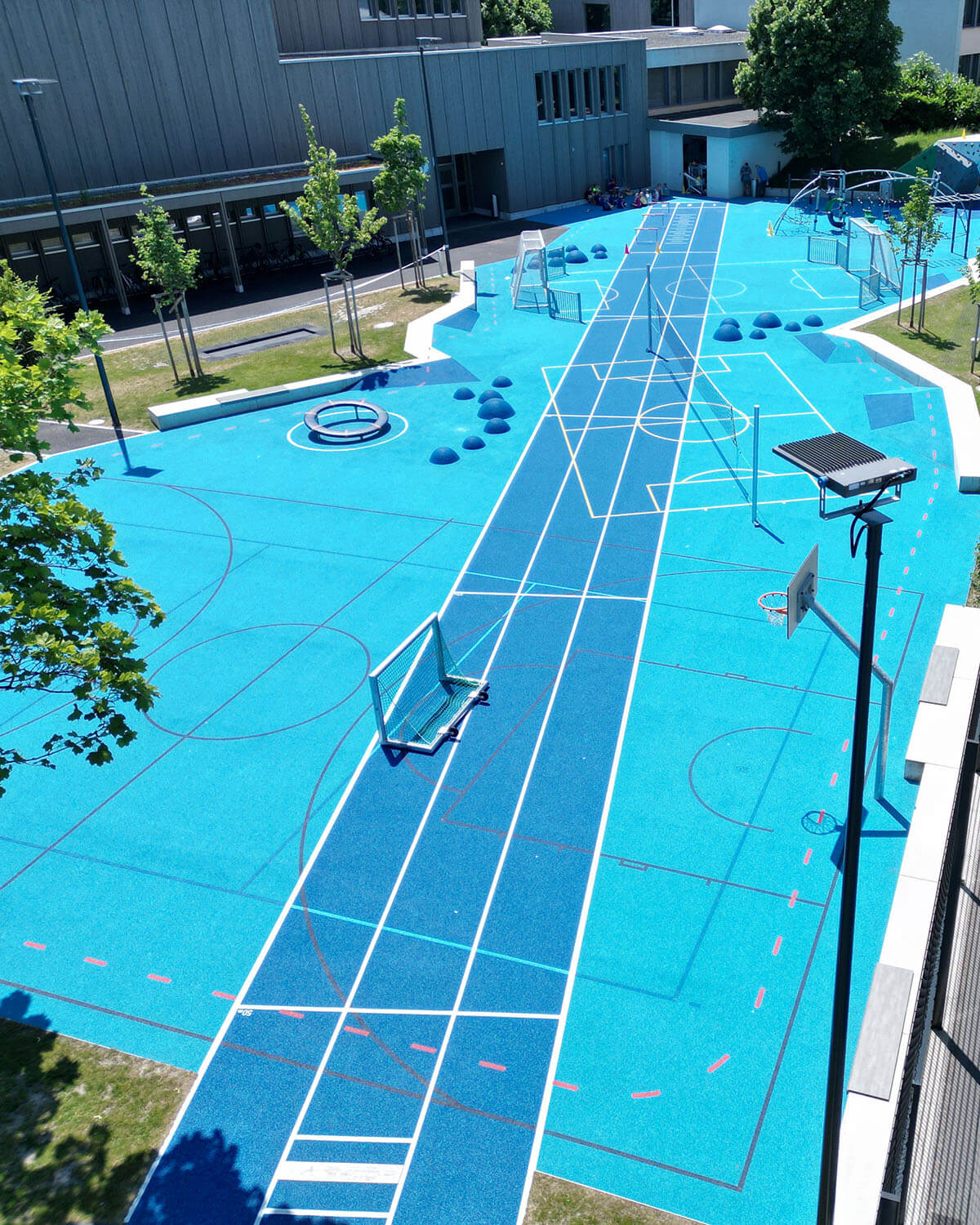
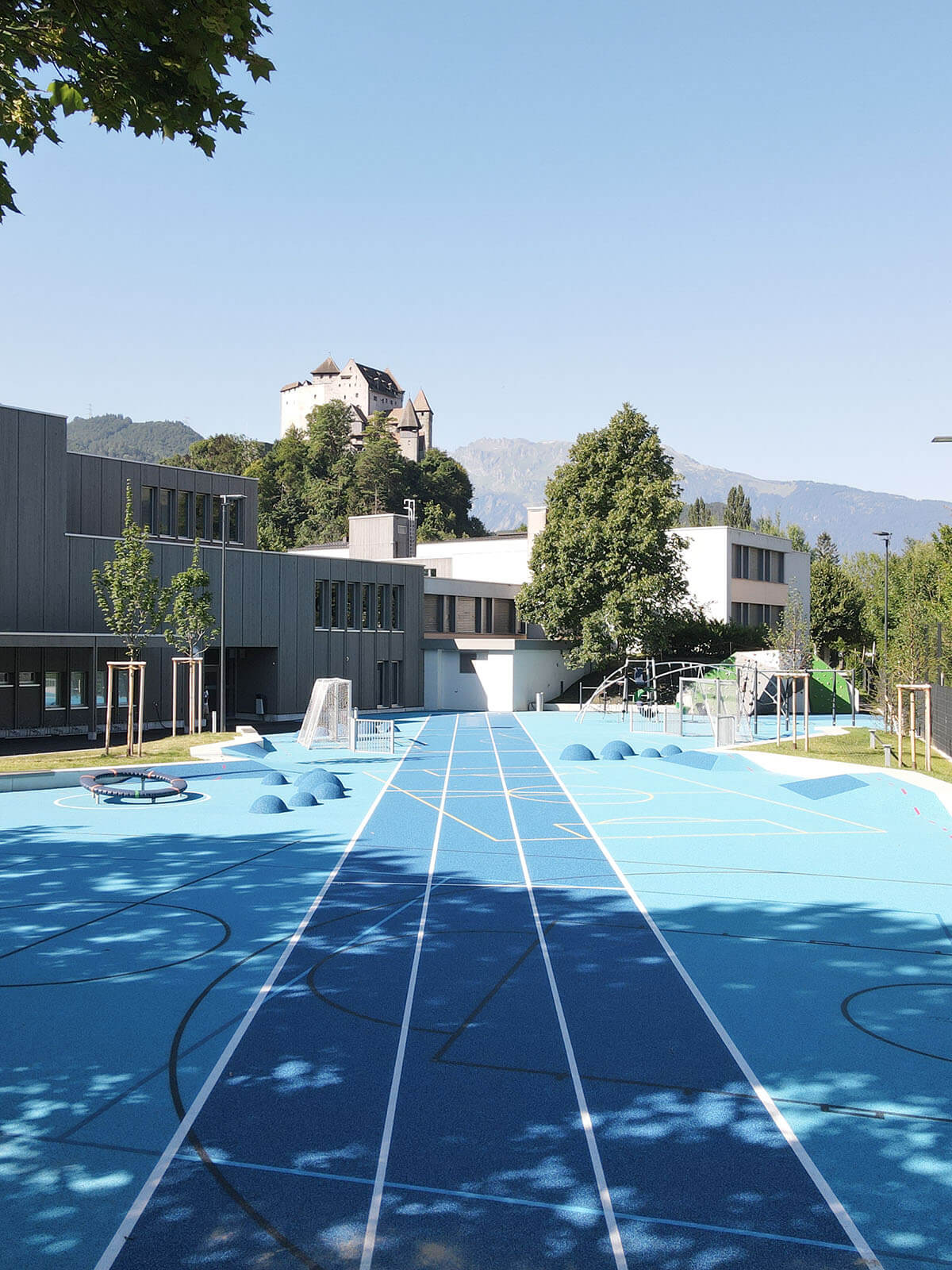
When you enter the Blue Square at the Balzers school building, you immediately sense that this is not about norms, but about possibilities. Around 1,000 m² of space invite you to exercise and socialise – and enjoy plenty of playful freedom. Instead of a classic rectangular sports field, an organically shaped adventure landscape opens up, bordered by concrete elements, interspersed with green islands and designed to be barrier-free.
A space that welcomes everyone.

What's up?

In the municipality of Balzers in the Principality of Liechtenstein, a versatile all-weather pitch was created in the immediate vicinity of a primary and secondary school to replace a rather monofunctional red plastic pitch: the Blue Pitch.
Whether ball games, climbing adventures, balancing acts, sports lessons or deep breathing: the Blue Pitch focuses on maximum versatility. Three differently equipped playing fields offer space for football, basketball and numerous other games. In between, open spaces have been created for spontaneous forms of exercise. Athletics facilities, bouldering elements, a slackline, ground trampolines and the dynamic balance game Super Nova make exercise an experience for all abilities.

The facilities in detail:

  • Two multifunctional pitches measuring 11m x 6.5m with small goals, one of which has a net system
  • One multifunctional pitch (20m x 13m) with fixed basketball hoops
  • 50m running track and long jump facility
  • Climbing course, 3-bar horizontal bar, hanging course and bouldering facility
  • Super Nova
  • Trampoline track and slackline
  • Circular running track
  • Running school, balance, jumping and coordination games

The design was created by the Swiss planning office Wegmüller.

Whatever you want

The Blue Square is both a meeting place and a training ground.

  • Schoolchildren use it during lessons, at break time and after school.
  • Sports clubs benefit from the varied outdoor training opportunities.
  • Families enjoy a range of activities together that even small children can intuitively use.
  • Individual athletes find plenty of space for working out, jogging or chilling out under the newly planted trees.

The design consistently follows the principle of inclusion. All paths, access points and play areas are designed so that they can also be used by people with disabilities. The overlapping markings, free-form design and varying shades of blue of the PU-bound sports surface create an inviting, intuitive environment that does not dictate how you have to move, but inspires you to move however you want.

The low-emission LED lighting can be activated at the touch of a button until 10 p.m., allowing the space to be used in the evening as well.

How it works

Although the actual sports area is now smaller than before the renovation, the range of activities on offer to the diverse user groups, from primary school children to senior citizens, has multiplied.

The Blue Square is not a sports field in the traditional sense, but a lively exercise area for the entire community: a place to burn off energy, try things out, play, train, meet and linger. It is an example of what open space design can look like today: diverse, inclusive and full of joy in movement.

Thanks to courage in planning and quality in execution.

Floor areas: The top layer

Coloured GEZOFLEX EPDM granulate from GEZOLAN AG was used for the top layer of the elastic flooring in the new, multifunctional exercise room in Balzers, as well as for the hemispherical 3D elements. The rubber granulate from the Swiss manufacturer is characterised by consistently high material quality, good UV and weather resistance, and reliable colour fastness. These properties help to ensure that the surfaces can withstand the various usage requirements of the open exercise area on a long-term basis.

For the Blue Square, the colours 054 dark blue and 084 bright blue were used both as individual colours and in coordinated mixtures. The material thus makes a significant contribution to the overall appearance of the project, not only in terms of functionality but also in terms of design. In combination with the freely formed square design and the wide range of exercise options, the flooring supports the idea of an inclusive and flexible outdoor space.

Floor surfaces: Binding agents

A CONICA binding agent system, specially developed for elastic and durable outdoor surfaces, was used to construct the sports flooring on the Blue Square. The high-quality polyurethane binders ensure a reliable bond between the EPDM granules and contribute significantly to the longevity and functionality of the entire surface. They are designed for stable performance under changing weather conditions and support the elasticity, shock absorption and structural stability of the surface.

In Balzers, a binder was used that reliably retains its properties both during intensive sporting use and in everyday operation. It thus makes an important technical contribution to the implementation of the project: the freely designed exercise landscape should not only be visually appealing, but also remain safe, robust and easy to maintain in the long term.

The CONICA binder system used helps to ensure that the Blue Square meets the diverse requirements of an open, inclusive and heavily frequented exercise area.

Project data

Planer

Planungsbüro Wegmüller
7250 Klosters
Schweiz

Client

Gemeinde Balzers
FL 9496 Balzers
Liechtenstein

User

Gemeindeschulen Balzers

Granulate

GEZOLAN AG
Werkstrasse 30
6252 Dagmersellen
Schweiz

Binder

CONICA AG
Industriestrasse 26
8207 Schaffhausen
schweiz

Opening

2022

Address

Schulhaus Balzers
Schulstrasse 2
9496 Balzers
Liechtenstein

Photos

Hitsch Photography
Planungsbüro Wegmüller

Text

Johannes Bühlbecker
More Sports Media

Videos

Subscribe to our newsletter.

Every three weeks, we provide information about new and exemplary projects and products. With heart, enthusiasm and expertise.

Skatepark in a Box

Skatepark in a Box

Fits everywhere

"Skatepark in a Box" can be set up almost anywhere in the world – even in crisis areas.

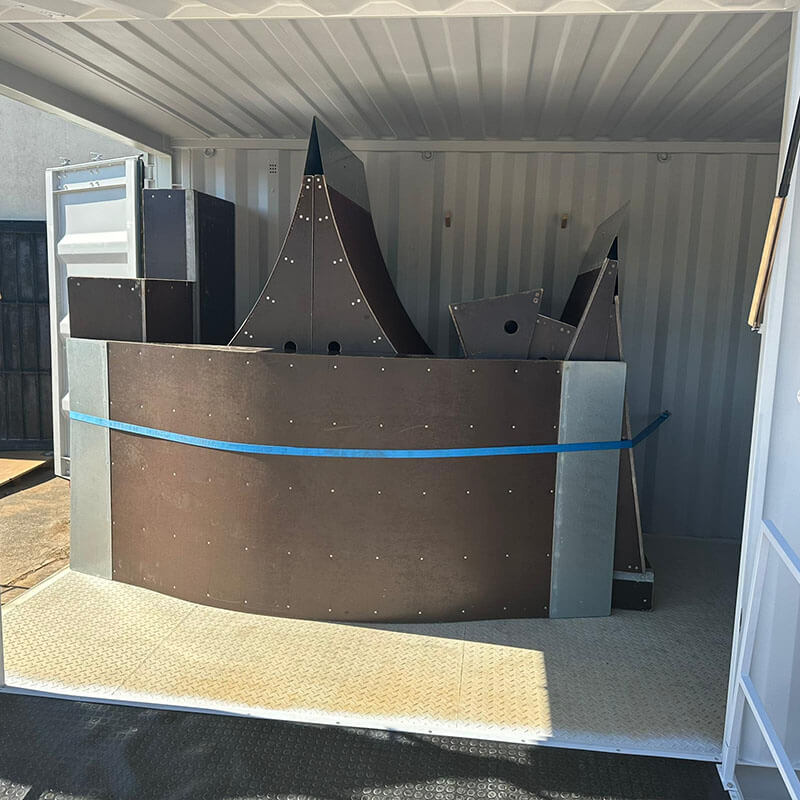
The containers are the decisive stage of development, because on the one hand they expand the range of opportunities, and on the other hand they create secure storage facilities.

"Skatepark in a Box" is a new concept, flexible and sustainable at the same time, for the further development of mobile skateparks all over the world.

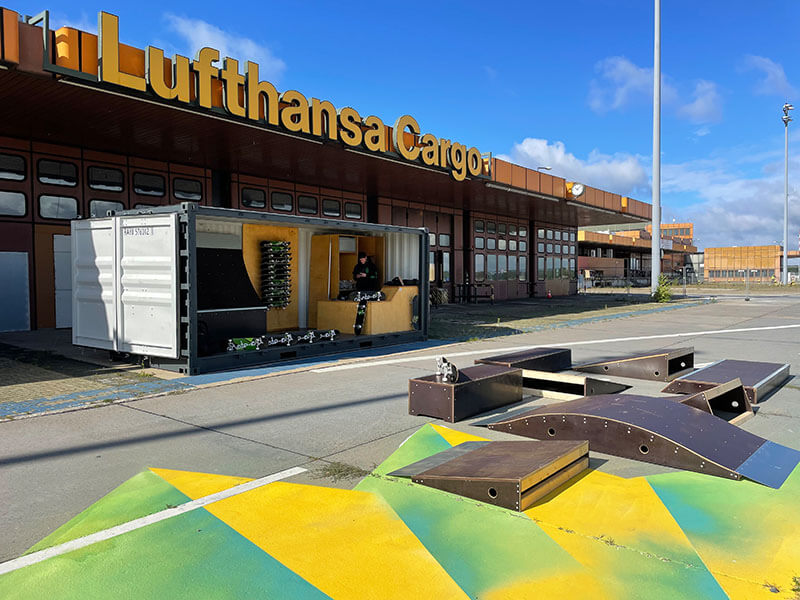
As its name suggests, the project consists of a skatepark and a box. The skatepark is tailored to the on-site conditions by the Cologne landscape architect and skatepark specialist Ralf Maier. The box is made from an overseas shipping container, which the Stuttgart company KuKuk Box transforms into a versatile sports and leisure facility.

The containers are the decisive stage of development, because on the one hand they expand the range of opportunities, and on the other hand they create secure storage facilities (especially for the sports equipment).

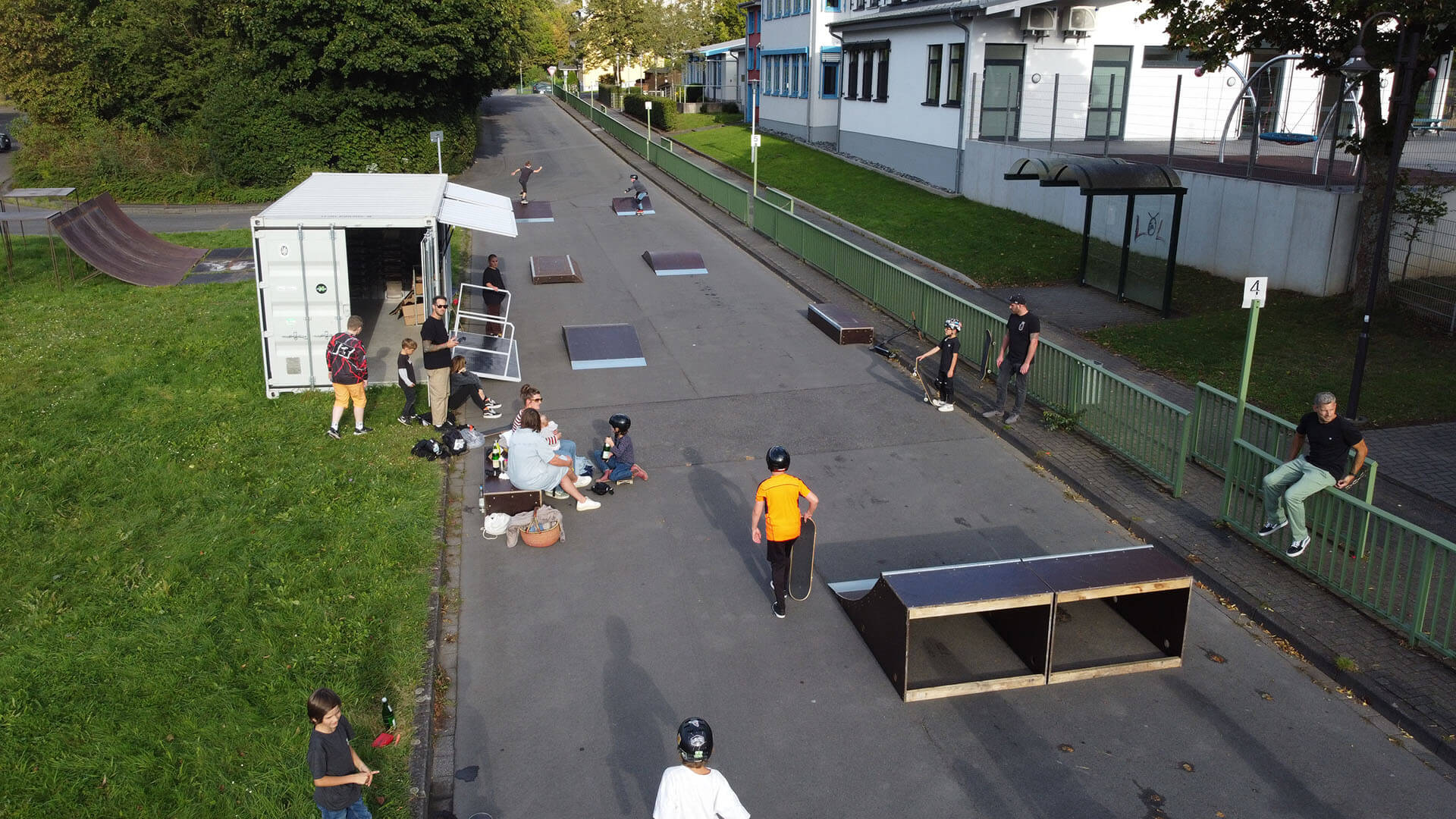
This means that "Skatepark in a Box" can be set up almost anywhere in the world: in large inner-city squares, in the countryside, in niches and alcoves - but also in crisis areas, where opportunities like this are perhaps even more important than anywhere else.

The sponsor of this concept, and of many skate facilities worldwide, is the skate-aid foundation.

Designer

maier landschaftsarchitektur

Container

KuKuk Box

Supporter

skate-aid

The concept works just as well as a temporary installation for events as it does for the permanent enrichment of sports and leisure activities.

The converted containers are the crucial constant at "Skatepark in a Box” because the storage facilities in particular guarantee that they can be used safely and securely around the world. As well as a skatepark, the sports and exercise offer can also include a BMX trail, for example.

The containers provide space for all the necessary equipment. The mobile ramps are stored in a space-saving way, the bikes and scooters are anchored to holders, the boards are neatly stacked on rails and the protective equipment, like the helmets and the knee and elbow pads, are sorted by size into boxes under the counter.

There is even a toolbox and a first-aid kit on board.


A folding bench and coat hooks make it easy to move the container, or to turn it into a lounge with seating and recreational facilities, a meeting place for real experts to talk shop and exchange experiences.

The only thing missing is the campfire.

"Skatepark in a Box" is extremely flexible. The concept is just as suitable as a temporary installation for events or during renovation work as it is as a permanent addition to sports and leisure facilities.

As the containers are delivered prefabricated by lorry to their destination and require no further design or foundations, assembly and possible dismantling are also very easy to implement.

"Skatepark in a Box" promotes not only athletic development, but also individual and social development.


The combination of sports facilities and containers has great potential, especially for social projects. As soon as the facilities have been set up, a programme with free skateboarding workshops, including providing sports equipment, can be started on site.

The skate-aid foundation has a lot of experience in training local coaches who run the skate parks independently and supervise skaters.


In this way, "Skatepark in a Box" promotes not only athletic development, but also individual and social development – for children and young people as well as for coaches.

"Skatepark in a Box" has already been set up at several locations, including Cologne-Ehrenfeld, Bad Neuenahr-Ahrweiler, Westerwald, Berlin and in a refugee camp in Pirlita/Balti (Moldova).

There are two variants of the KuKuk box:

One variant can be transported by truck, while the other is also suitable for shipping - for example, for use in crisis regions.

During the FSB 2023 there will be plenty of opportunities to experience and try out the "Skatepark in a Box" concept.

During the FSB 2023 there will be plenty of opportunities to experience and try out the "Skatepark in a Box" concept – for example in the outdoor area of Hall 9. In addition, Ralf Maier will present his projects through lectures and an exhibition.

KuKuk Box has been building artistically designed, innovative and style-defining play and outdoor spaces throughout the world for over 15 years. KuKuk's experienced team is made up of artists, architects, carpenters, joiners, metalworkers and educators – and will also be on site during the FSB.

Photos

skate-aid / KuKuk Box

Text

Johannes Bühlbecker
More Sports Media

FSB

planerFORUM2023

skate-aid was founded in 2009 by skateboard pioneer Titus Dittmann to realise social skatepark projects for disadvantaged children and young people worldwide.

Maier Landschaftsarchitektur/ Betonlandschaften in Cologne have specialised in the worldwide development, designing and construction of skate and bike parks for many years.

KuKuk Box is the inventor of mobile public playground facilities. The innovative play, sports and lounge concepts are based on standardised freight containers.

Video

Subscribe to our 

Social Media

Follow us!

Hotspot Sauna

Hotspot Sauna in Norway

Imagination and building permission

Cabin cool, purpose hot, online booking: the Hotspot Sauna from Oslo Works.

The Couch by MVRDVPhoto: ©Daria Scagliola & Stijn Brakkee

Community

A sauna is best enjoyed together. This may be the reason why sauna community culture has been rising in Scandinavia the last few years. People are putting their forces together in order to finance, build and share hothouses all along the shore.

The neighborhood community on Nesodden peninsula, a short ferry ride from the Norwegian capital, Oslo, wanted to increase their already growing number of common saunas.

They wanted an eco-friendly and social sauna with a breathtaking view. In this case Oslo Works has designed a Hotspot that really takes care of that.   

Rules

Constructing a sauna has very few rules.

It needs to be fairly insulated in order to heat up without using too much energy. It needs access to cooling water (or snow), and it needs a heating device. The rest is up to imagination and building permits.

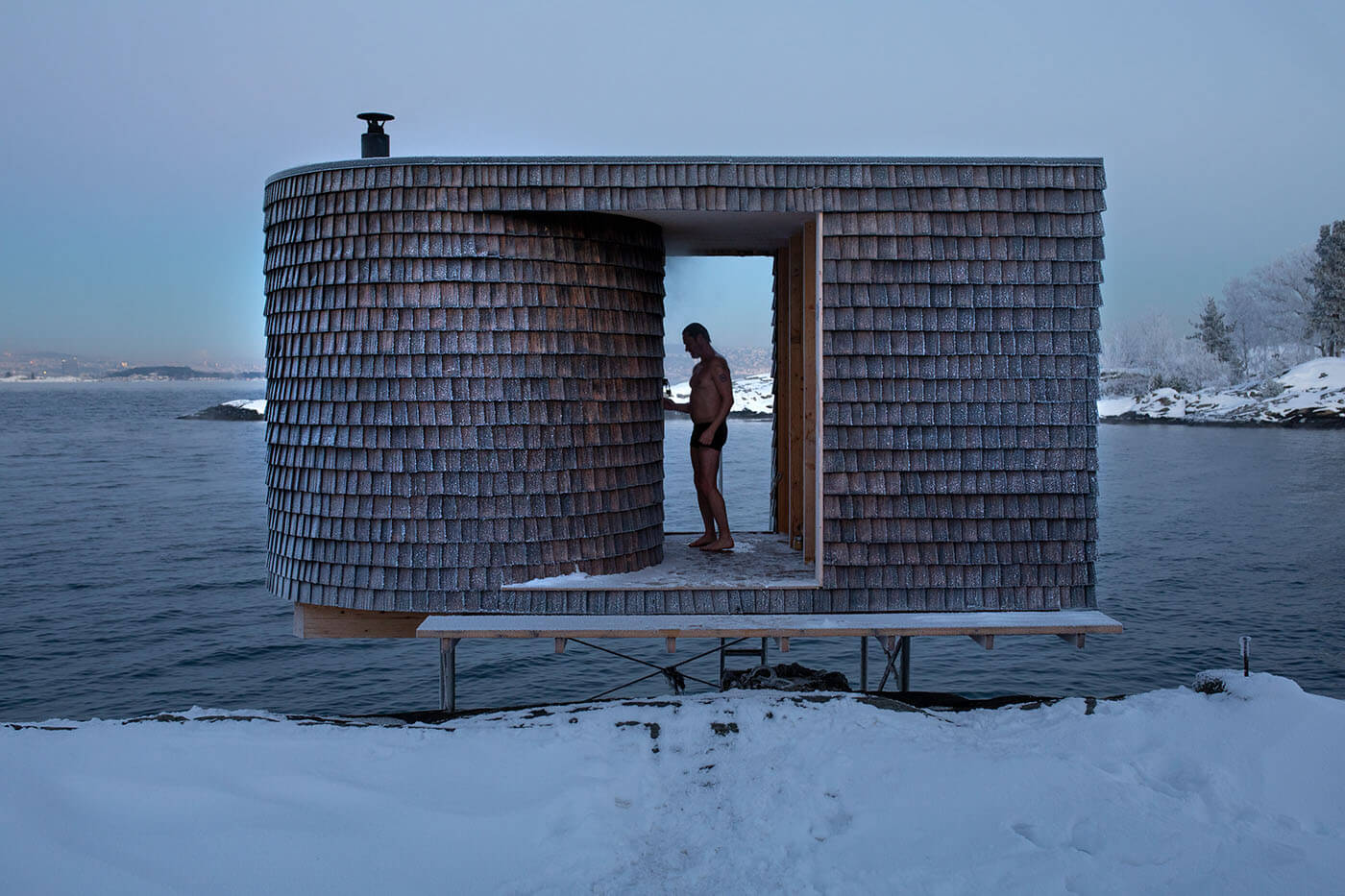
Oslo Works wanted to minimize the climate footprint, as well as the visual dominance and maintenance requirements. Hence, the cabin was constructed of massive wood modules and clad with burnt and oiled ore pine shingles. The modules could easily be transported to the not so accessible lot on the edge of the smooth seaside rock.

Moduls

This version of the sauna concept consists of two parts, divided by an open narrow passage towards the water and the bathing ladder.

To the right, a section with two small changing rooms and storage for necessities. To the left, a hot room with a wood fired oven, a rounded, socially inviting back wall, and a panoramic window towards the big city skyline.

Hotspot is a basic module that can be extended with several add-ons, such as diving board, shower, roof terrace, solar cell panels or connected to other Hotspots in a row.

Photos

image-slider-with-thumbnail1.jpeg
image-slider-with-thumbnail3.jpeg
image-slider-with-thumbnail4.jpeg
image-slider-with-thumbnail5.jpeg
previous arrow
next arrow
image-slider-with-thumbnail1.jpeg
previous arrow
previous arrow
next arrow
next arrow

More photos

image-slider-with-thumbnail1.jpeg
image-slider-with-thumbnail3.jpeg
image-slider-with-thumbnail4.jpeg
previous arrow
next arrow
image-slider-with-thumbnail1.jpeg
previous arrow
previous arrow
next arrow
next arrow

Online

The freezing cold Scandinavian weather conditions that make the sauna experience on the Norwegian shore, is of course optional. Nevertheless, it is quite easy to imagine this hotspot in warmer climates.

 The hotspot sauna can be booked online from summer 2024.

Project data

Architect

Oslo Works AS
Gøteborggata 27B
0566, Oslo
Norway

Client

Nesodden Velforbund
Postboks 18
1451 Nesoddtangen
Norway

Opening

2024

Addess

Tangenveien 2
1450 Nesoddtangen
Norway

Photos

Marte Garmann 

Text

OSLO WORKS AS

Plans

[dica_divi_carousel item_width_tablet="100%" item_width_phone="100%" item_width_last_edited="on|phone" show_items_desktop="3" show_items_tablet="1" multislide="on" transition_duration="1000" loop="on" autoplay="on" autoplay_speed="2500" arrow_nav="on" item_spacing="10" item_vertical_align="flex-start" advanced_effect="1" arrow_nav_color="#5E5C4D" arrow_bg_color="#FFFFFF" dots_color="#FAF4E4" dots_active_color="#5E5C4D" overlay_color_field_bgcolor="rgba(255,255,255,0.85)" carousel_container_margin="||50px||false|false" _builder_version="4.24.1" _module_preset="default" custom_margin="|50px||30px|false|false" global_colors_info="{}"][dica_divi_carouselitem button_url_new_window="1" image="https://moresports.network/wp-content/uploads/2024/02/800px_A.20.100-Plan-Hotspot-OsloWorks.jpg" _builder_version="4.24.1" _module_preset="default" global_colors_info="{}"][/dica_divi_carouselitem][dica_divi_carouselitem button_url_new_window="1" image="https://moresports.network/wp-content/uploads/2024/02/800px_A.40.000-Fasader_Hotspot-OsloWorks.jpg" _builder_version="4.24.1" _module_preset="default" global_colors_info="{}"][/dica_divi_carouselitem][dica_divi_carouselitem button_url_new_window="1" image="https://moresports.network/wp-content/uploads/2024/02/800px_A.41.100-Snitt-A_Hotspot-OsloWorks.jpg" _builder_version="4.24.1" _module_preset="default" global_colors_info="{}"][/dica_divi_carouselitem][dica_divi_carouselitem button_url_new_window="1" image="https://moresports.network/wp-content/uploads/2024/02/800px_A.41.300-Snitt-C_Hotspot-OsloWorks.jpg" _builder_version="4.24.1" _module_preset="default" global_colors_info="{}"][/dica_divi_carouselitem][/dica_divi_carousel]

Do you want more?

Your turn.

Introduce yourself

Your stage

DO YOU WANT TO PUBLISH YOUR PROJECT OR PRODUCT?

Melos Stylemaker

Melos Stylemaker

As you like

With EPDM granules, you can realise your own ideas for playground flooring – even online.

Now designers and builders can design their own floor coverings online instead of buying "off the shelf" as before.

It's spring, the open-air season in kindergartens and day care centres as well as on our playgrounds and schoolyards has begun. Children love bright and colourful environments where they can play, romp, climb, run and try things out.
Fall protection floor coverings literally play a supporting role in this.

EPDM granules can be used to produce not only colourful but also creative floor coverings for playgrounds and other surfaces.
Now designers and builders can design their own floor coverings online instead of buying "off the shelf" as before.
This is made possible by the Melos Stylemaker app.

Supplier

Melos GmbH
Bismarckstrasse 4-10
49324 Melle, Germany

The app provides a large selection of motifs and colours to choose from. Another very popular feature is the option to upload and implement your own motifs to the app.

The Melos Stylemaker App offers a simple way to design colourful and creative fall protection floor coverings. It can be used to design entire themed worlds such as a land of dinosaurs, a bobby car racetrack or an alien galaxy.
The app provides a large selection of motifs and colours to choose from. Another very popular feature is the option to upload and implement your own motifs to the app.

The design process is fully automated and therefore very cost-effective. The motifs, whether from the templates or uploaded by the user, are cut out of EPDM sheets with a water jet and then delivered as a complete, finished product.

After applying a polyurethane adhesive, they are glued to the substrate. When the adhesive has dried, the surrounding area is levelled with EPDM granules to create a flat surface into which the motifs are integrated.

The PU bonding agent is included in the scope of delivery, as are the floor motifs made of coloured EPDM granules.

What used to be very time-consuming is now a fully automated process that leads to decidedly individual and popular results.

The Melos Stylemaker App offers architects and builders, as well as playschool management teams, the chance to choose between the many options – or to design a unique floor covering for themselves, for example in workshops with the children.
Ordering the desired motif via the app is simple and straightforward. Experts are available to advise on the planning of individual floor coverings.
What used to be very time-consuming is now a fully automated process that leads to decidedly individual and popular results.

Images

Melos

Text

Johannes Bühlbecker
More Sports Media

Videos

You may have more of this.

Social Media

Follow us!

Play containers in Wolfsburg

The attractivisation of the Wolfsburg city centre

Plug and play

How the city of Wolfsburg is invigorating its city centre with mobile greenery and mobile play equipment.

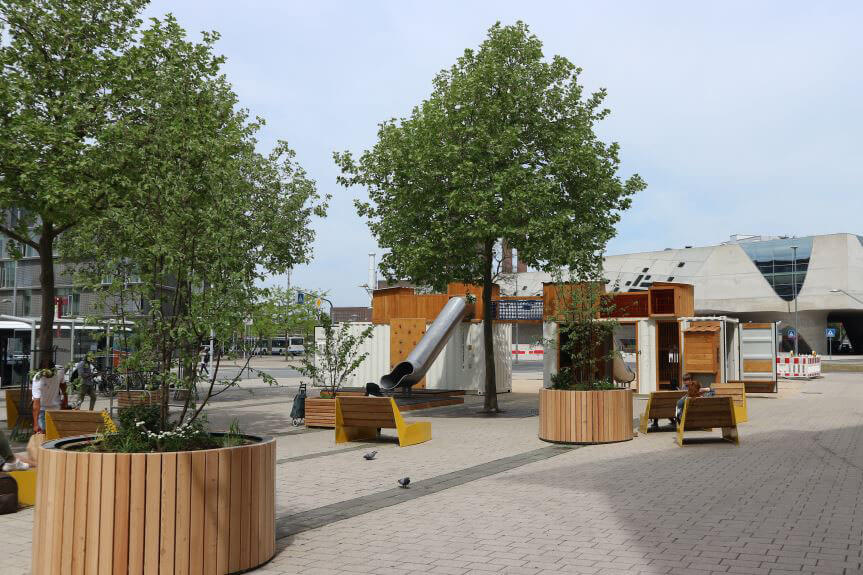
Play containers are an increasingly popular way to create a DIN-certified, high-quality and versatile range of play options in a short time and with little effort.

The starting point of this project was the city of Wolfsburg's desire for "more people to spend more time in the Wolfsburg city centre". In order to increase the quality and the length of stay, additional play, rest and recreation zones should be created at suitable locations - initially temporarily.

In order to offer the younger generation and their parents further incentives in the city centre and to complement the existing play offers in a targeted manner, a mobile ensemble of playground equipment became the project's main attraction.

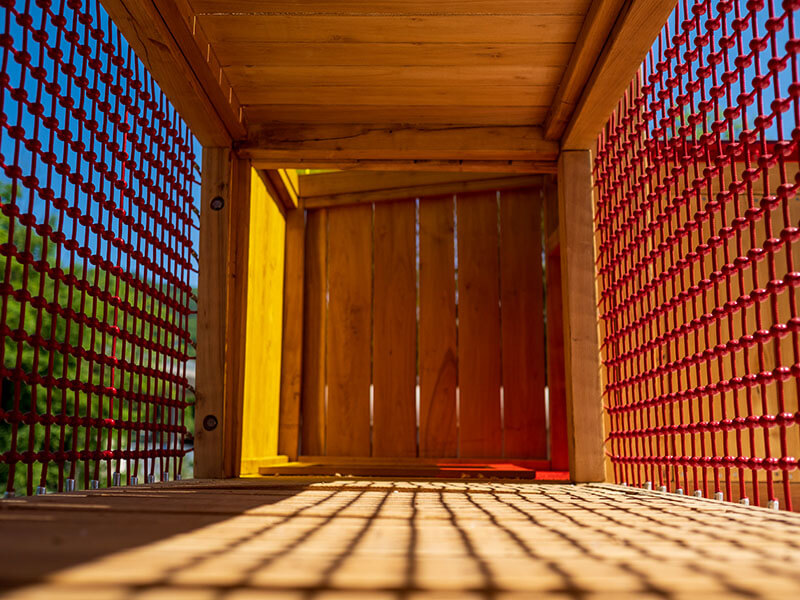
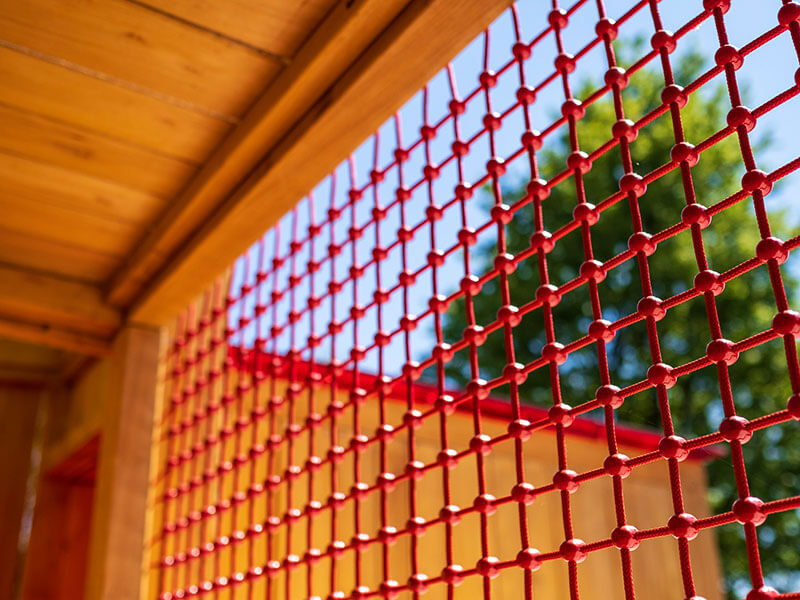
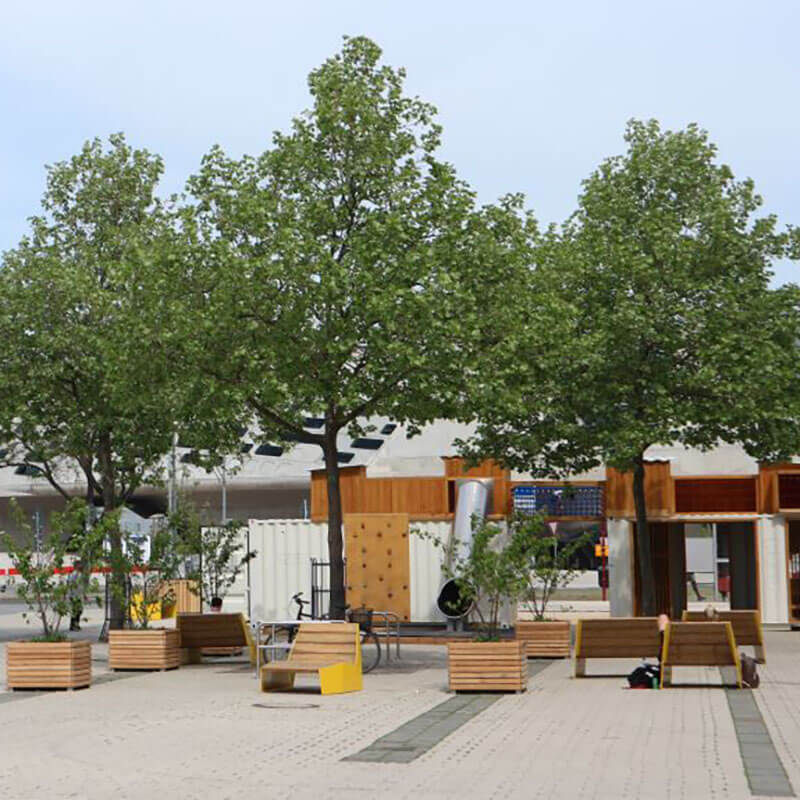
These pieces of playground equipment consist of overseas containers made from steel which, thanks to built-ins made from durable robinia wood, stainless steel, plexiglass and nets, as well as creative handicraft design, are transformed into game containers with openings of different sizes in the roof and walls, slides, attachments and superstructures.

With play containers, DIN-certified, high-quality and versatile play offers can be created in a short time and with little effort - and not only for schools or kindergartens, but also for public spaces.

The planner and manufacturer of the play containers is the company Kukuk Box from Stuttgart.

Client

City of Wolfsburg

Play containers

KuKuk Box GmbH
Rosenwiesstraße 17
D – 70567 Stuttgart

With the play containers and the additional greenery, it's not only the quality of stay in the city centre which was increased, but the microclimate was also improved.

All the measures to increase the quality of stay in the inner city were accompanied by mobile greenery. Depending on the location and type of use, planters with trees, shrubs or planting columns were combined with the seating and play offers. The selection of plants also takes climate change and the desire for bee and insect friendliness into account.

Several small locations have been created which invite all age groups to play and get together. With the additional greenery, it's not only the quality of stay in the city centre which was increased, but the microclimate was also improved.

The project was financially supported by the European Union. The total cost was 220,000 euros. The client was the Green Division of the city of Wolfsburg.

Address

Porschestraße
D - 38440 Wolfsburg

Opening

2021

For the installation of a game container in public space, a free, paved area is sufficient – but the installation can also be done quickly on grass or in a sandy area.

In the simplest case, a free, paved area is sufficient for setting up a game container in a public space – for example in a pedestrian zone, on a market square or in a schoolyard. The game containers are designed in such a way that a fall protection floor according to DIN is only required for the slide run.

Prefabricated rubber fall protection elements are supplied and placed together on site, connected to each other and bordered by a wooden frame. The slide is then simply placed on the pedestal or anchored in it. In this way, the play device can be set up and made ready for use in one day.

If the play container is intended to be set up on grass or in a sandy area, a 30 cm-thick gravel support layer the size of the container set-up area first has to be created. In this version, the slide feet are set up in a concrete foundation. The subsequent construction of the play container then also only takes one day. What takes the most time is the hardening of the concrete.

Photos

City of Wolfsburg
KuKuk Box

Text

Johannes Bühlbecker
More Sports Media

Meanwhile, the city of Wolfsburg has 13 play containers in different sizes and for variable installation sites.

The cooperation between the city of Wolfsburg and the company KuKuk began in 2016. The first play container was intended to make the outdoor areas of residential buildings more attractive for refugees.

Since the length of the measure was unclear, the KuKuk Box was a very easy choice. It consists of modules and does not require any foundations. Therefore, it can be assembled and disassembled very quickly and transported to the next place of use.

The play boxes have proven to be a suitable solution for special requirements.

In the meantime, the city of Wolfsburg has 13 play containers in different sizes and for changing parking spaces in schoolyards, daycare areas and public playgrounds throughout the city.

They are not only used as an interim solution for conversions and relocations, but also as seasonal play offers for places which are not usually playgrounds – such as the shopping area in the Wolfsburg city centre.

The play containers are standardised, robust and inexpensive.
They are also ideally suited for permanent use as a public play opportunity, because they are versatile, flexible, inexpensive, easy to care for and sustainable.

A KuKuk box creates spaces and surfaces for climbing, frolicking, playing, sliding on the one hand, and a frame with protected and more private areas on the other.

The frame is formed by the containers; through the installations and extensions a new land of adventure is created from it again and again.

No matter where.

Videos

You may have more of this.

Social Media

Follow us!

WordPress Cookie Notice by Real Cookie Banner