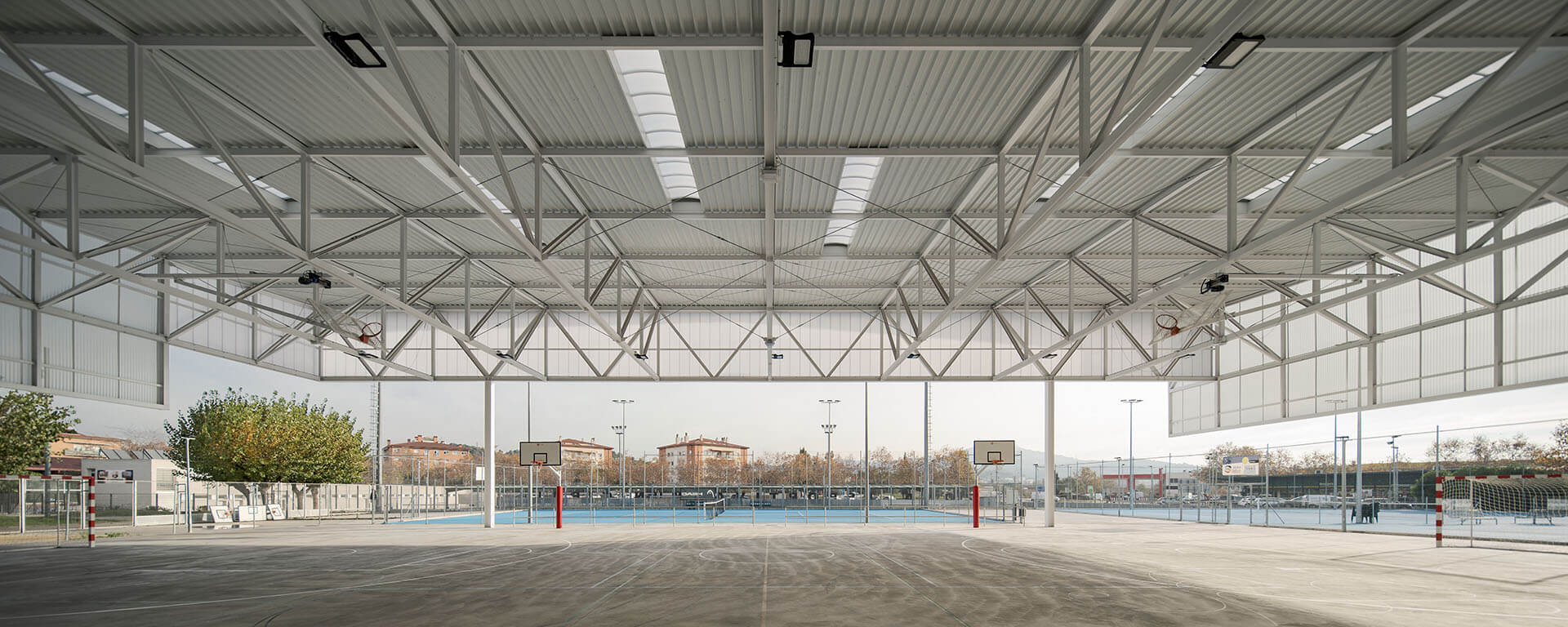
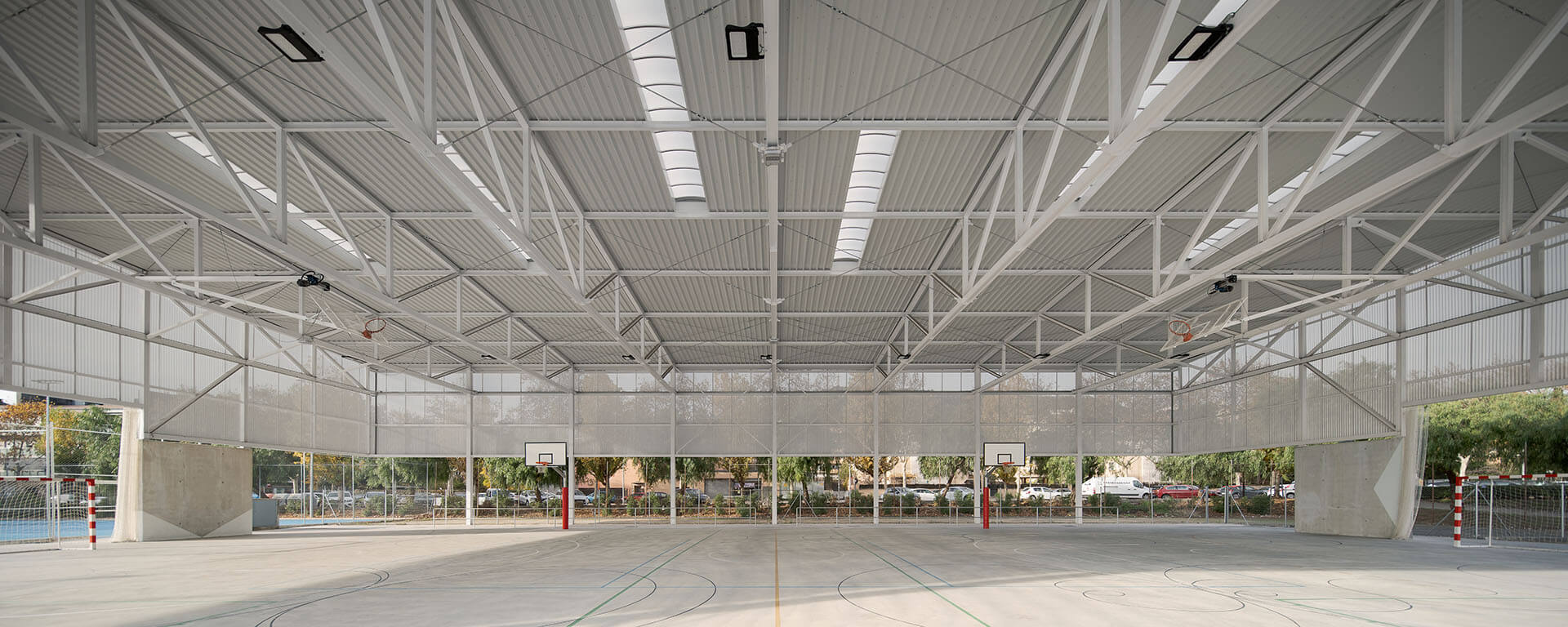
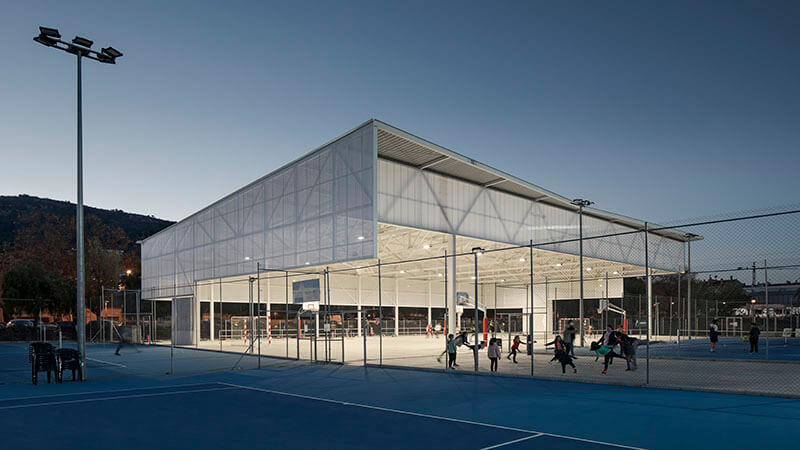
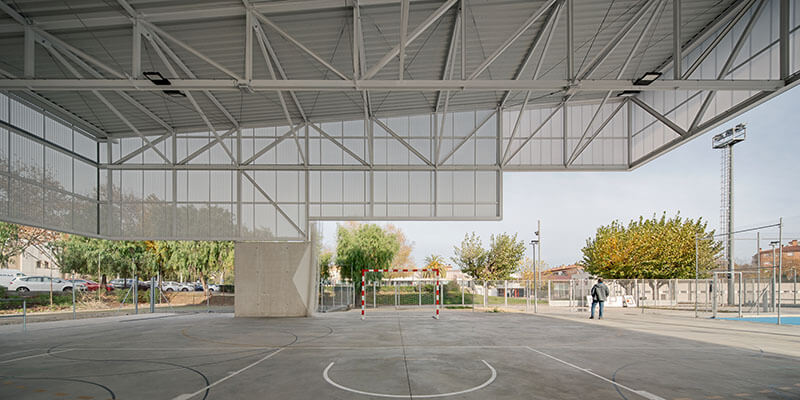
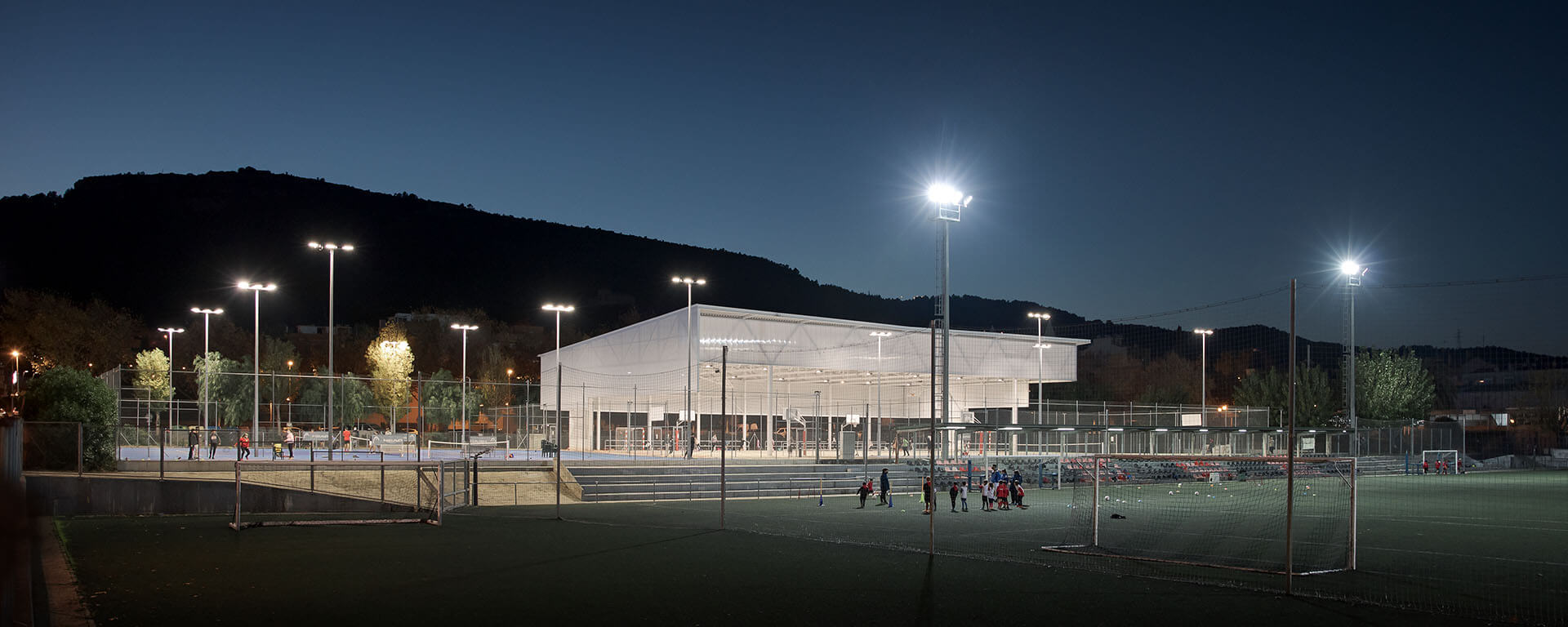
Lode­rer­platz sports hall

Lode­rer­platz sports hall in Erding

36,000 m³ of vibrant life

Fuchs und Rudolph

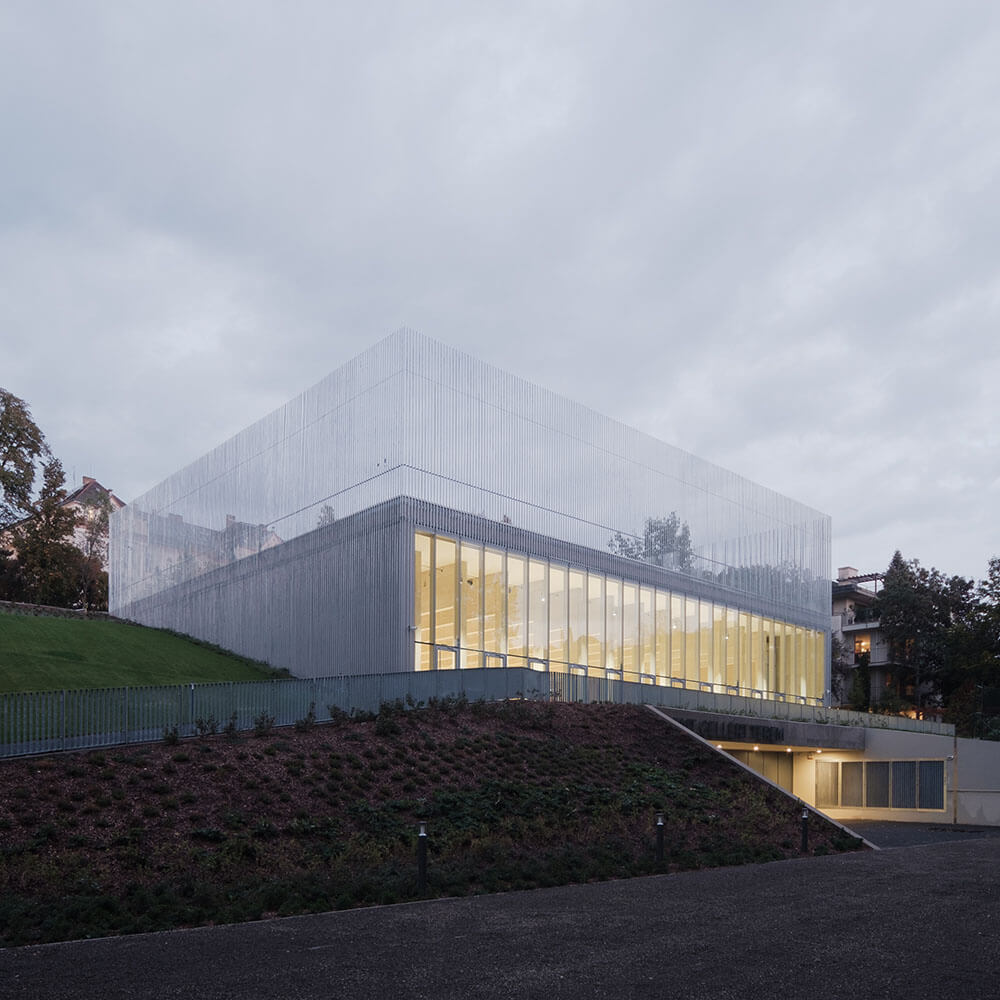
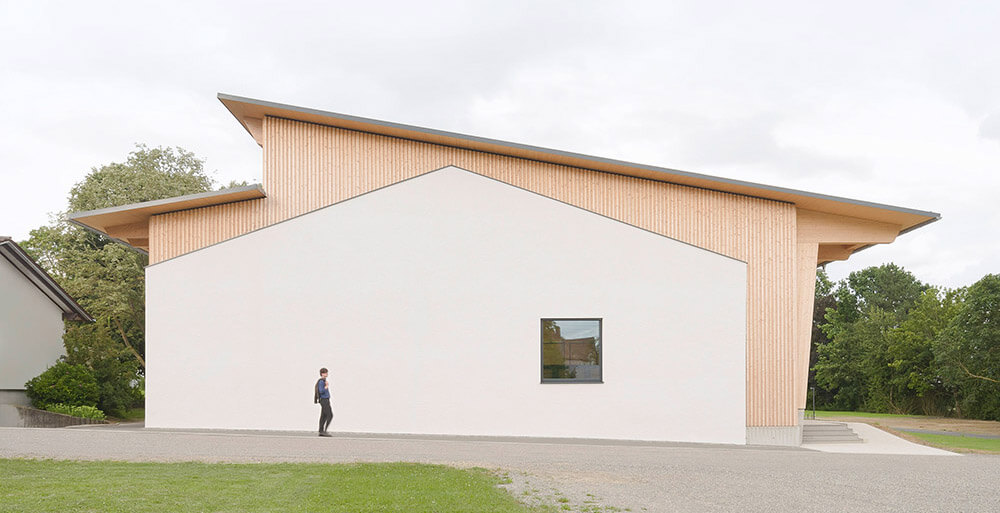
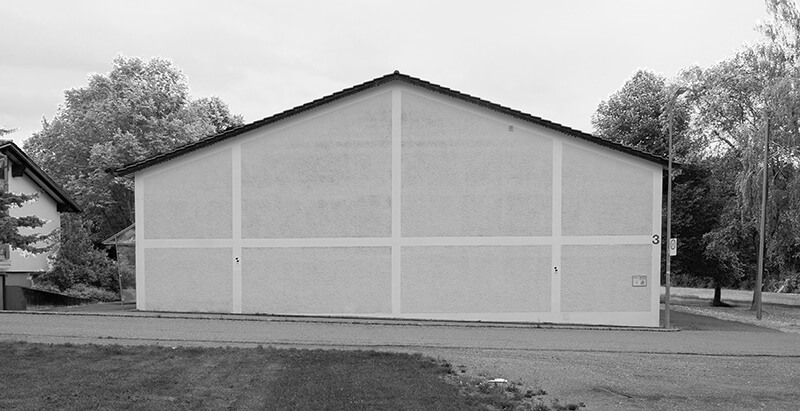
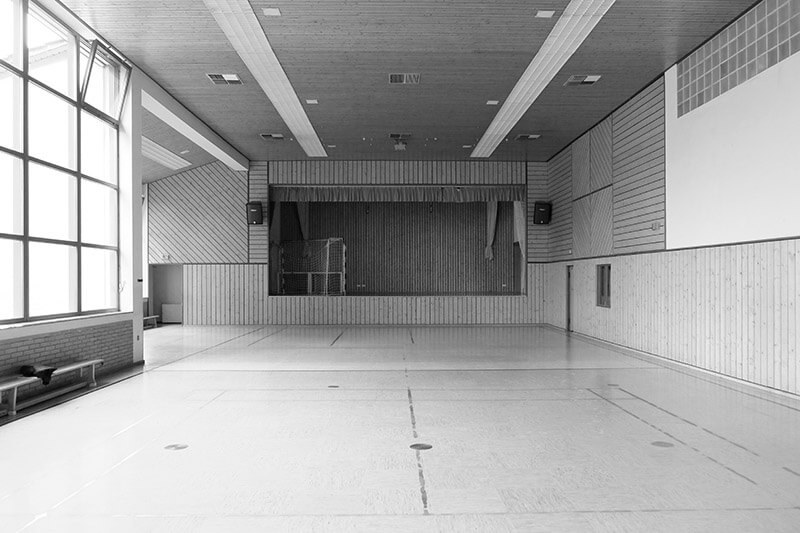
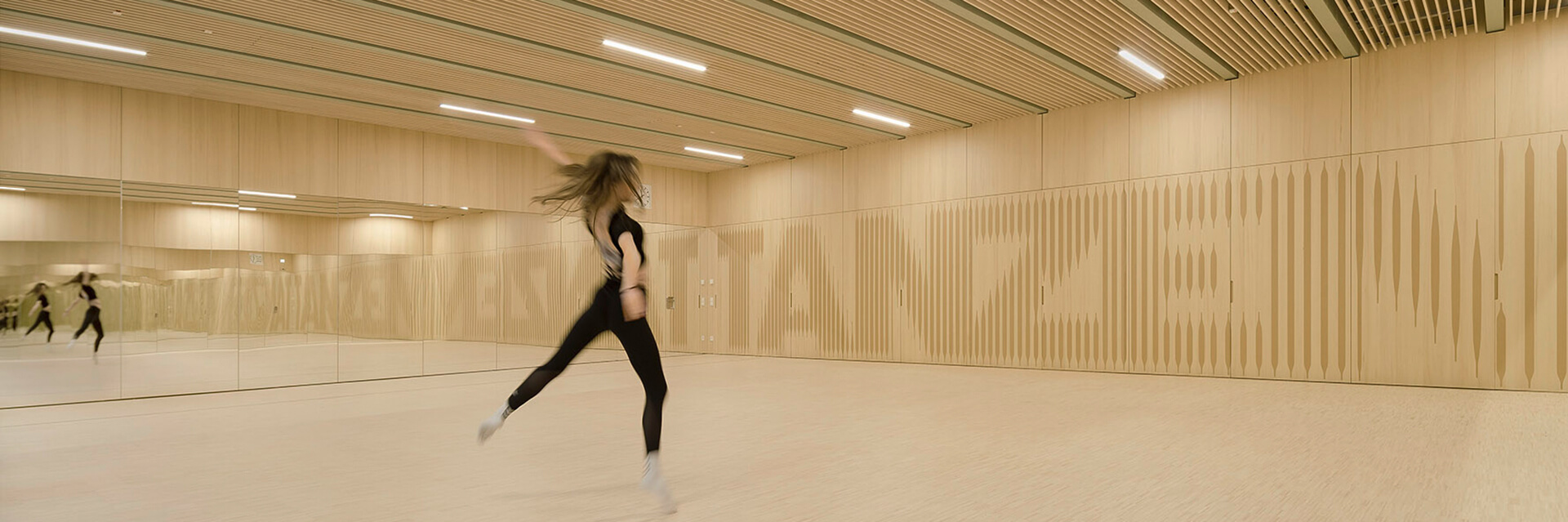
With the new Lode­rer­platz sports hall and cafe­teria, the city of Erding is inves­ting 34 million euros not only in sports, but also in educa­tion, commu­nity, and the future. The money is well spent, not least because the hall combines archi­tec­ture, user comfort, and high‑quality mate­rials and work­man­ship in a remar­kable way.

Invi­ting

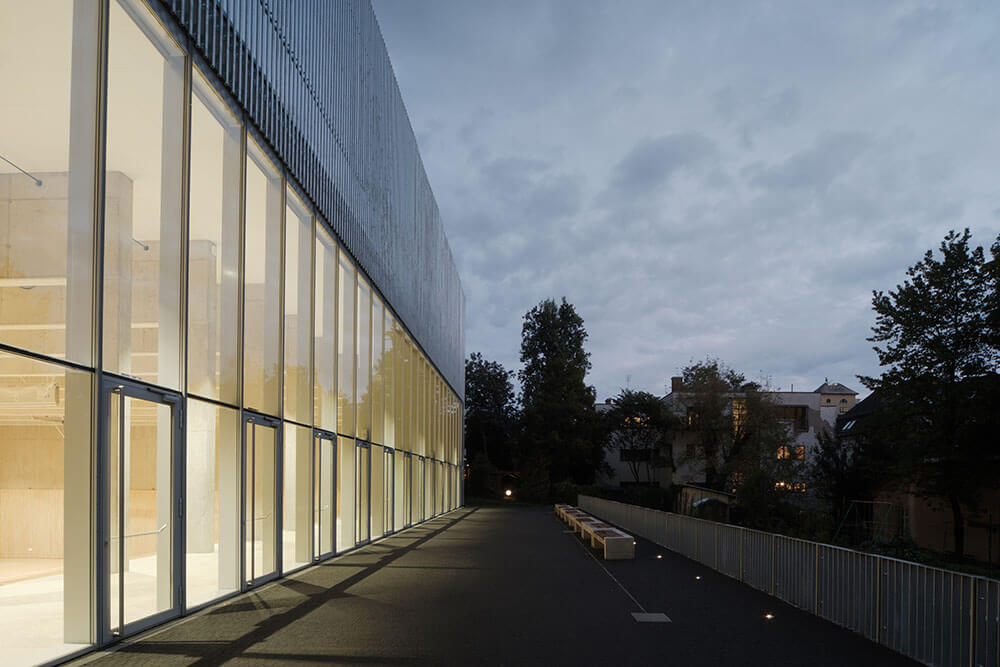
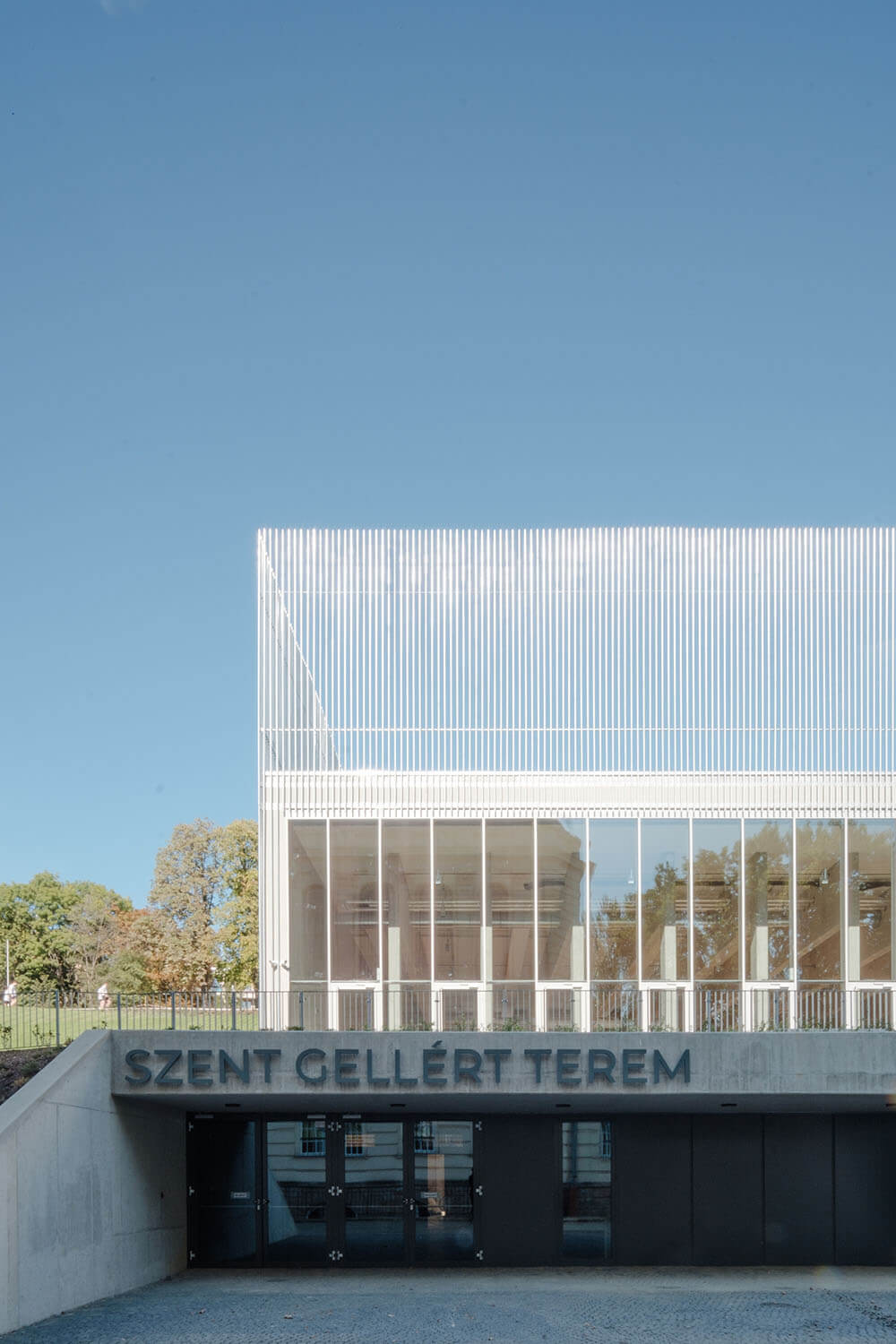
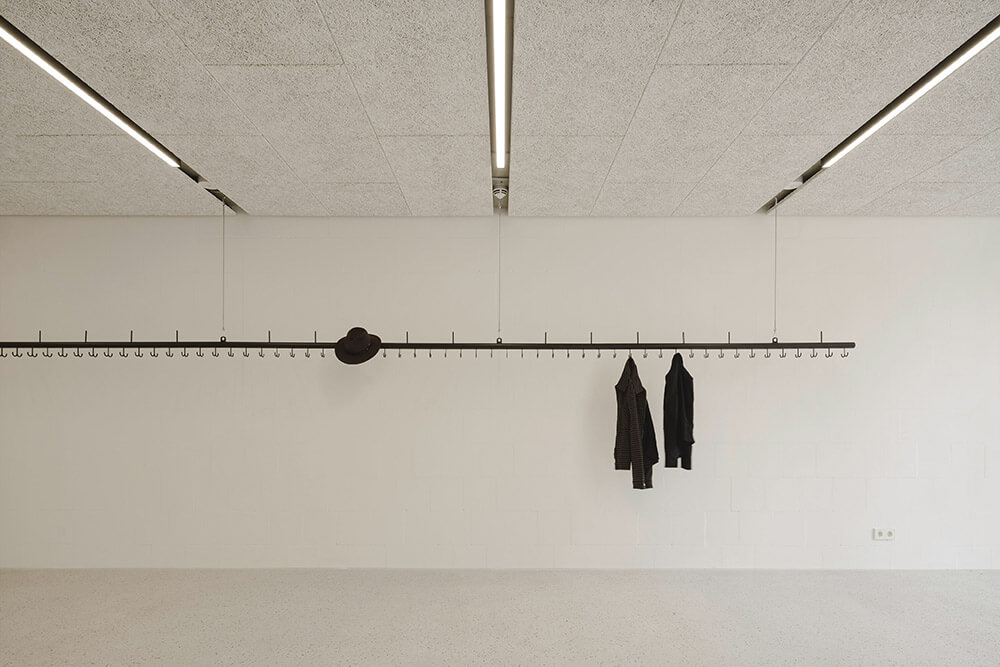
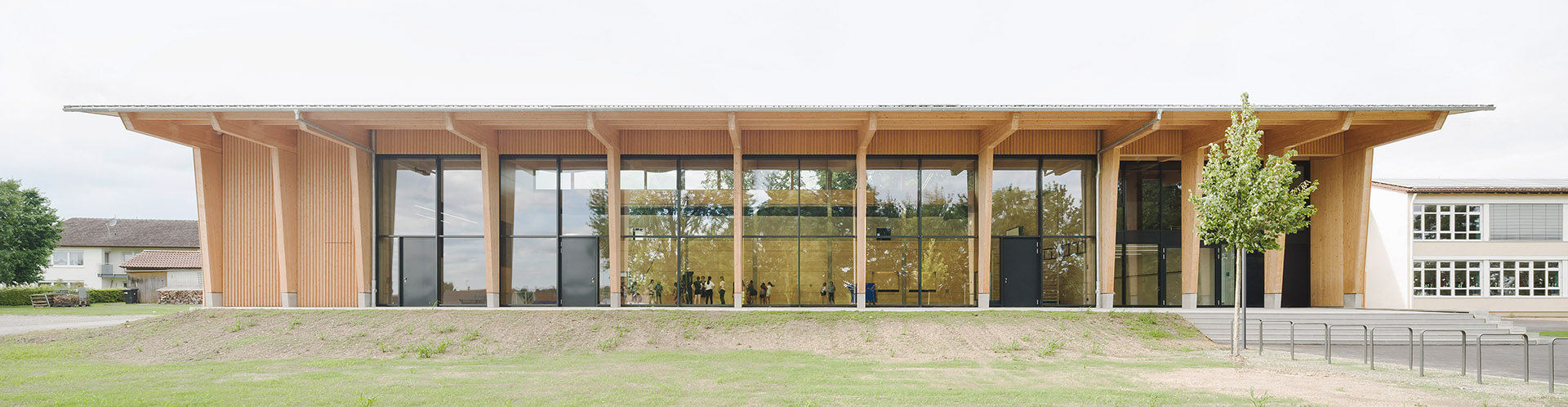
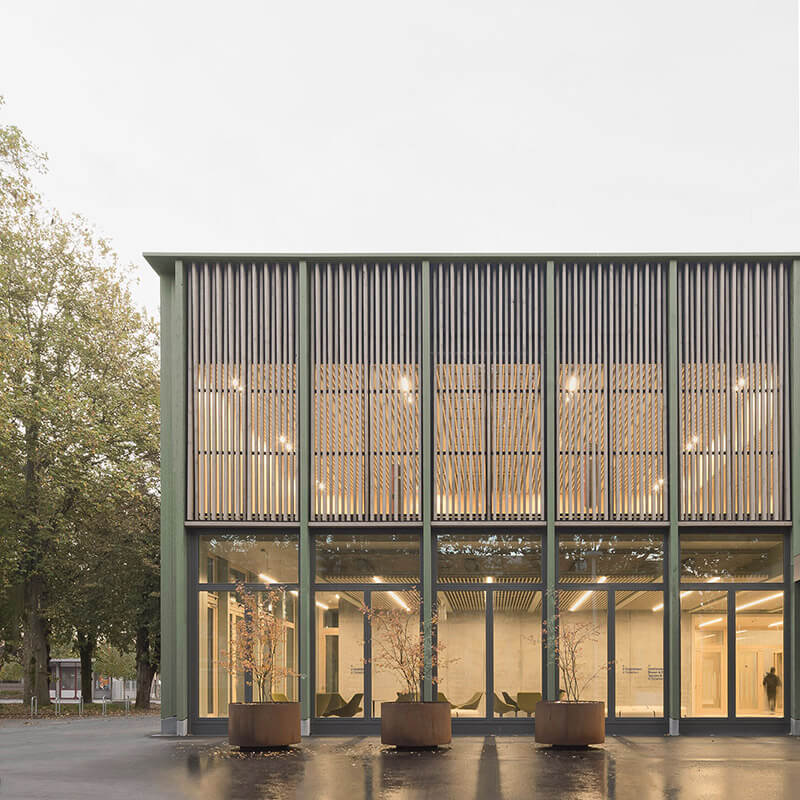
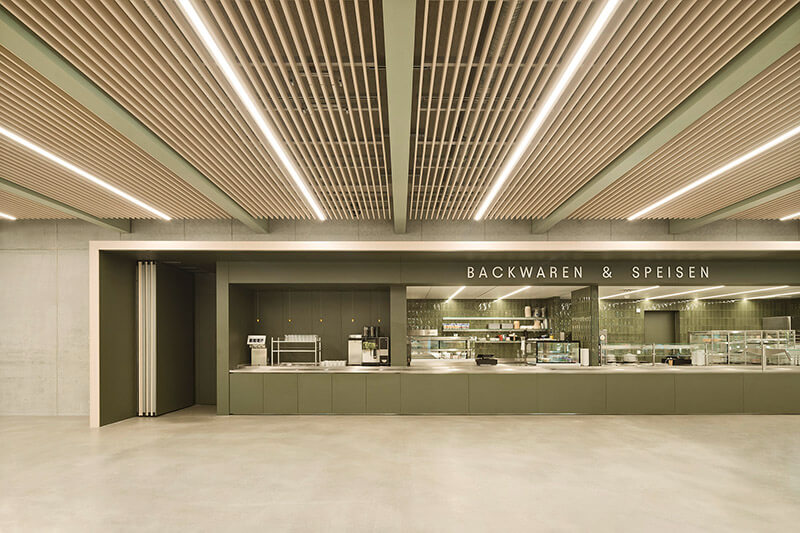
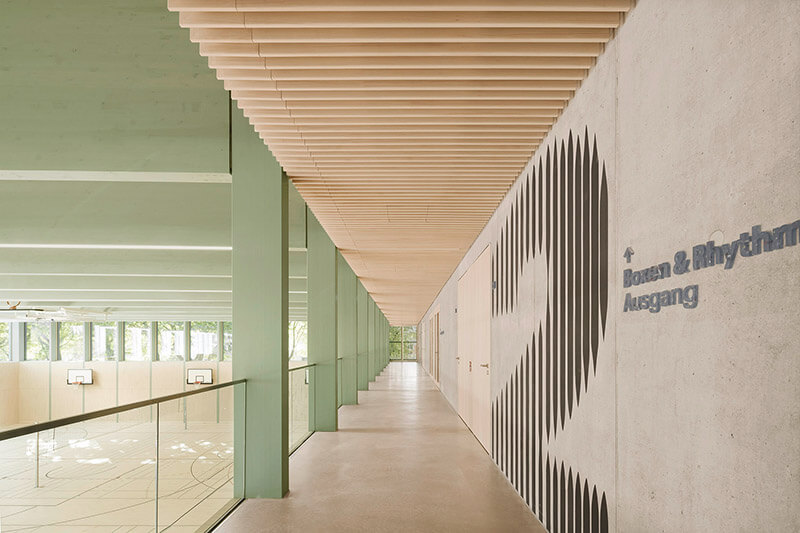
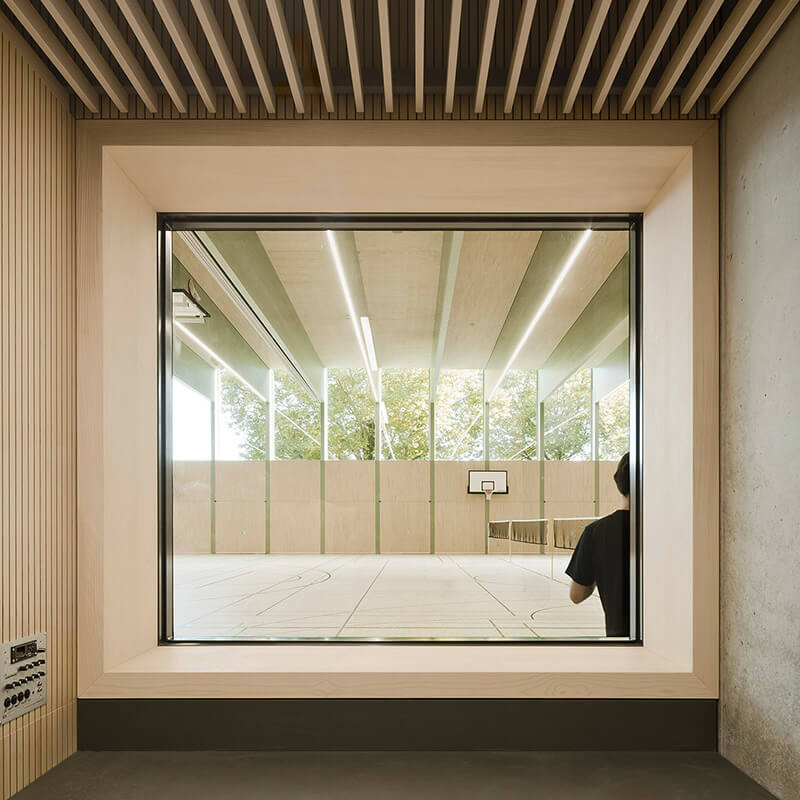
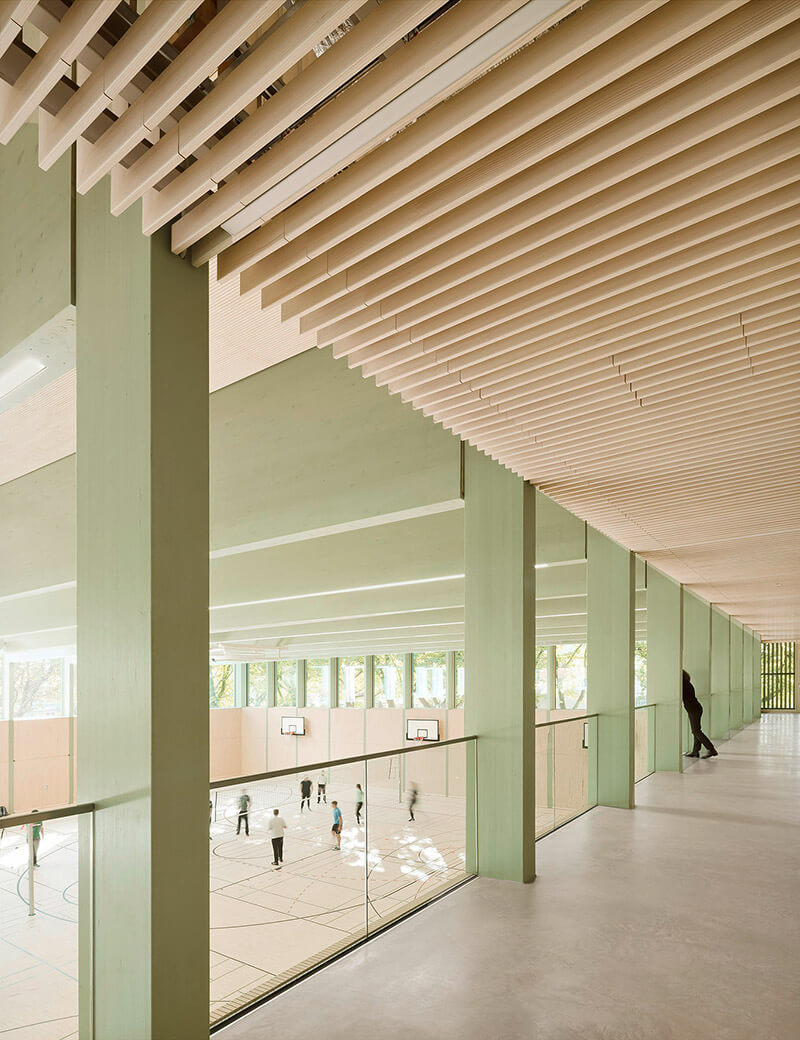
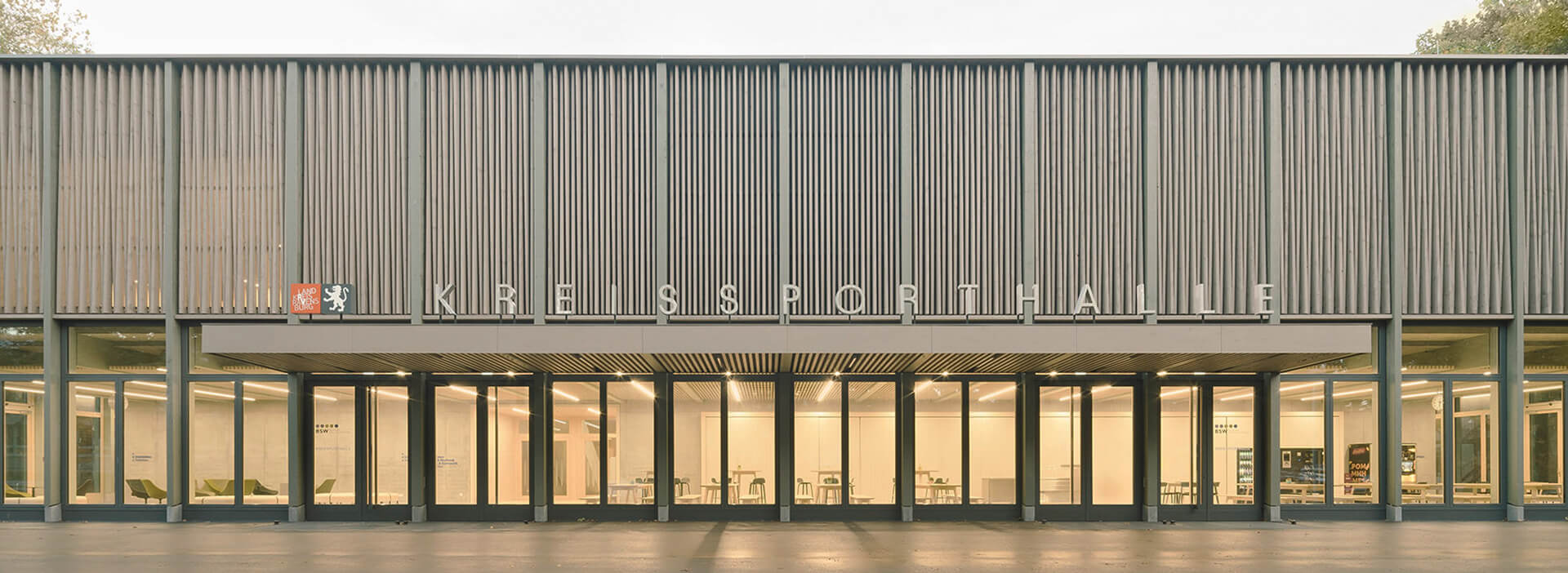
The two-story entrance foyer already expresses a sense of desi­gned open­ness. On ente­ring, visi­tors can look directly into the hall and then move either to the seated lower level or up to the tribune area. This trans­pa­rent sequence of spaces provides orien­ta­tion and brings plenty of daylight into the buil­ding. Sliding elements allow the hall area and foyer to be sepa­rated or connected for events that require strong blackout and acou­stic sepa­ra­tion from the foyer.

“Multi­pur­pose hall” is a very sober term; this is much more a hall for coming toge­ther.

Flexi­bi­lity

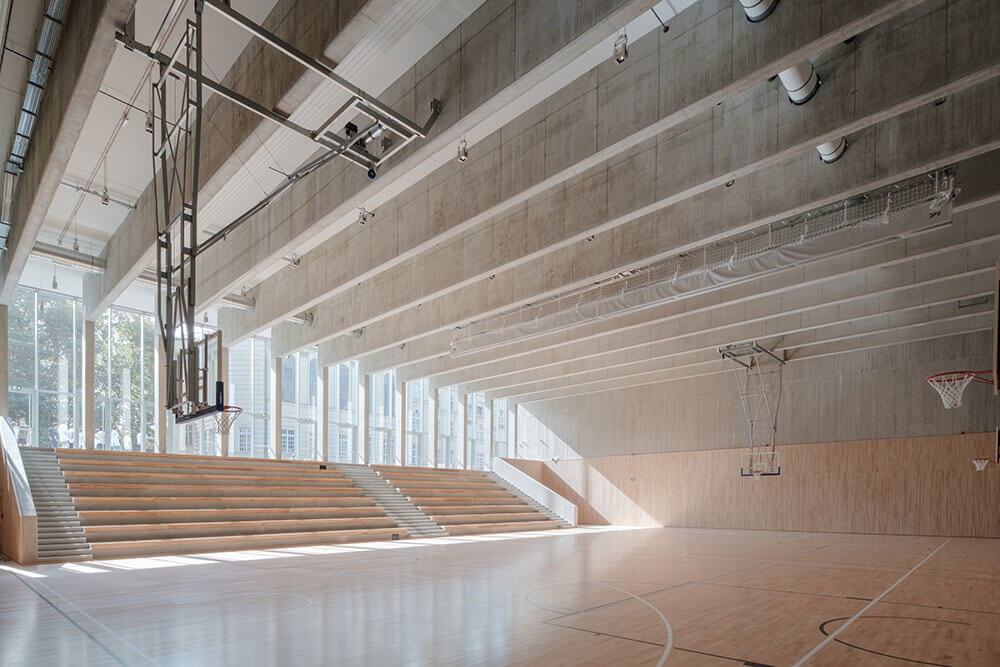
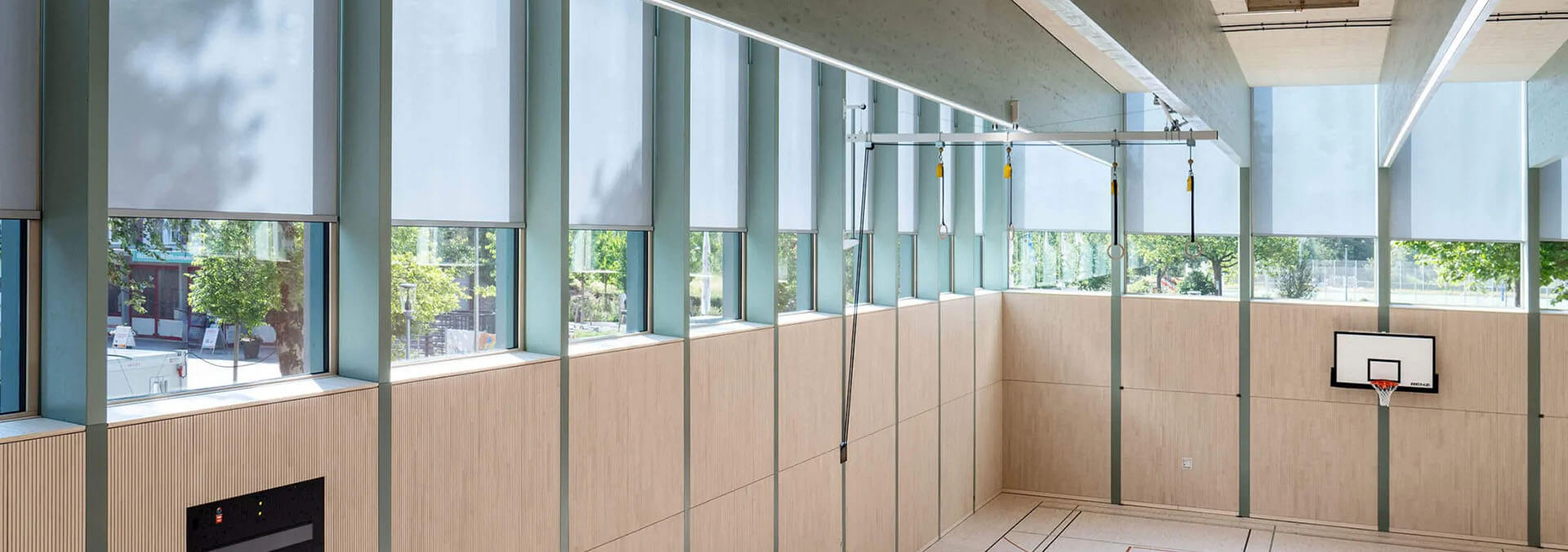
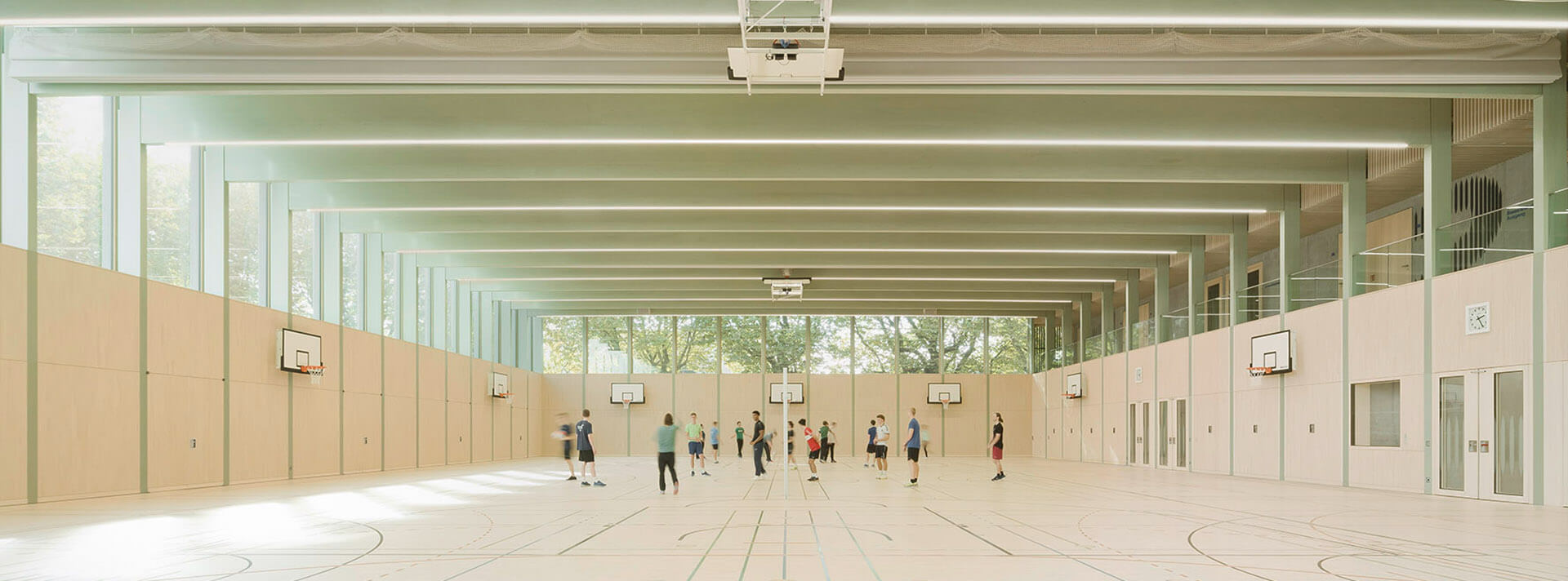
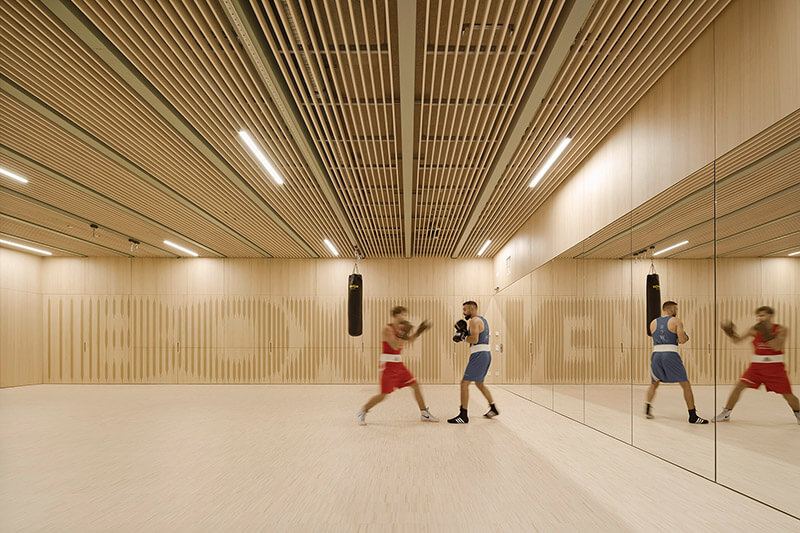
The hall prima­rily serves school and club sports. Beyond that, several large events per year are planned. For this reason, the hall is desi­gned archi­tec­tu­rally and tech­ni­cally for maximum flexi­bi­lity.

This also includes its own cafe­teria for the two schools, a mile­stone in view of the legal entit­le­ment to all‑day care in primary schools that comes into force in 2026.

Divider curtains

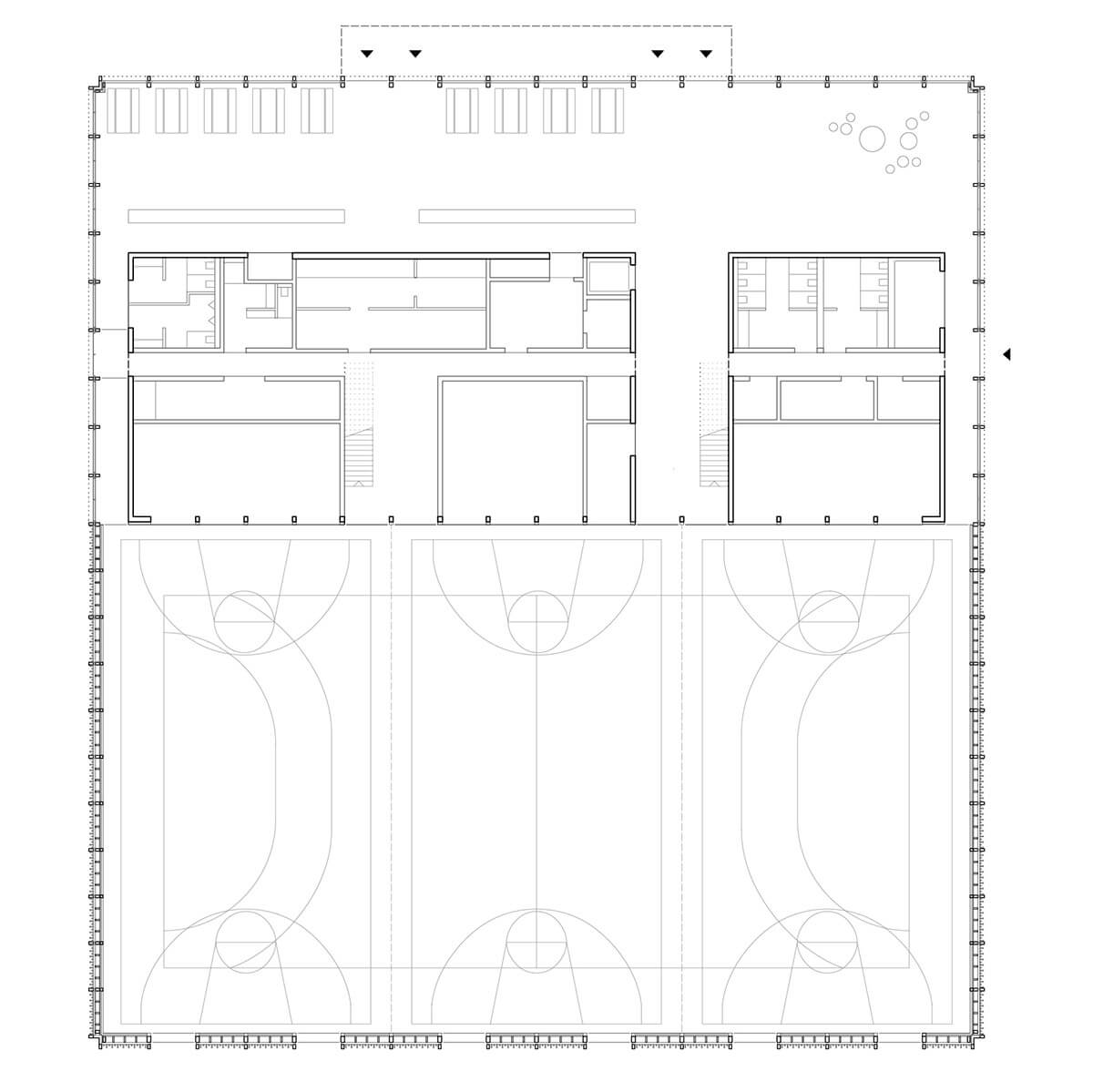
The hall space can be divided into three inde­pen­dent sections by divider curtains, each with direct access to chan­ging rooms and ancil­lary spaces. Event orga­ni­zers benefit from clearly sepa­rated circu­la­tion: back­stage and deli­very areas are located to the north and operate comple­tely inde­pendently of public access. A freight elevator provides direct access to the hall.

A sepa­rate circu­la­tion system was created for the schools. The cafe­teria and routes to physical educa­tion are orga­nized so that student flows do not collide with event opera­tions. At the same time, the open foyer provides an attrac­tive place to linger and meet for sports and cultural events.

Lighting system

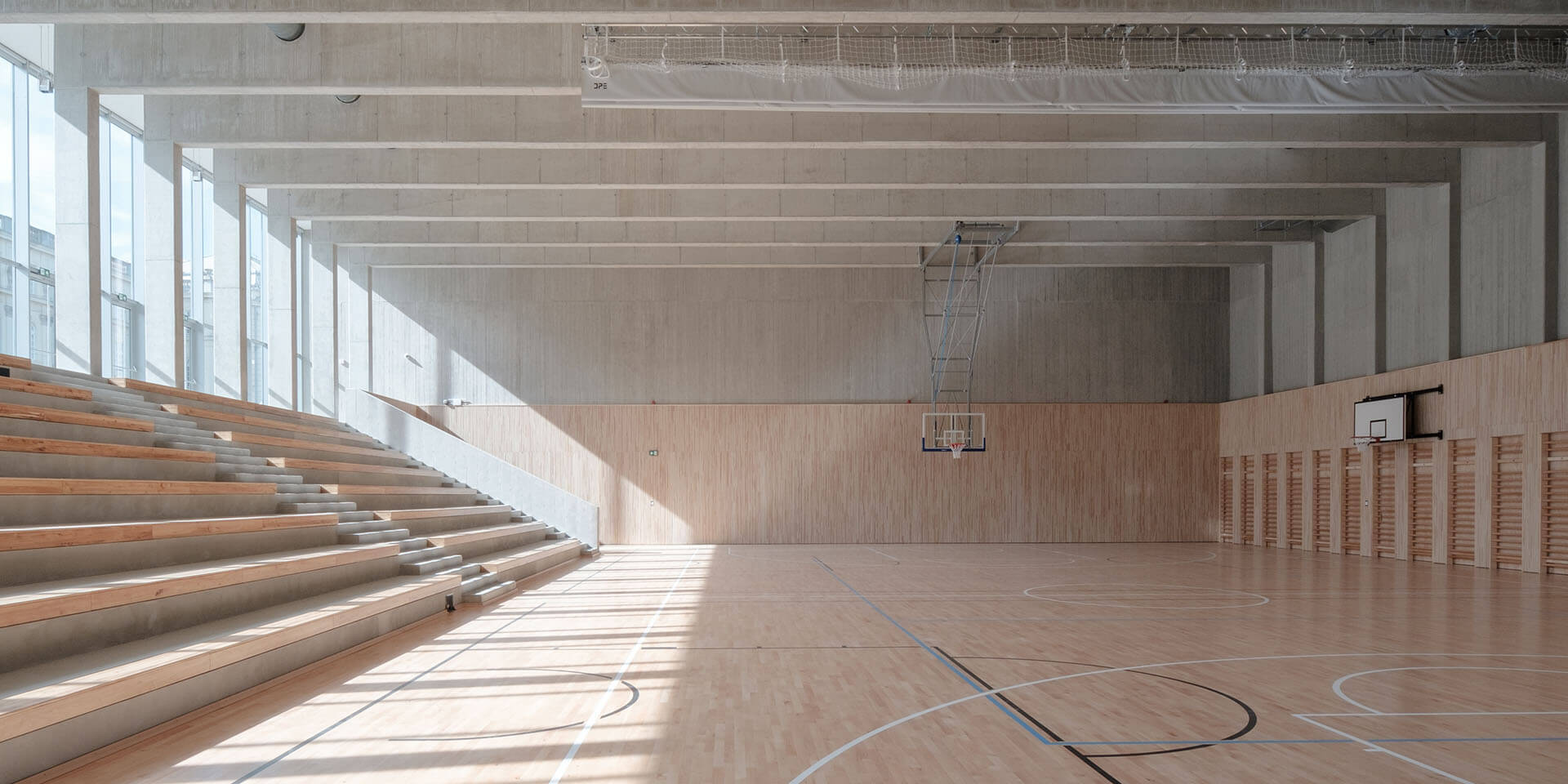
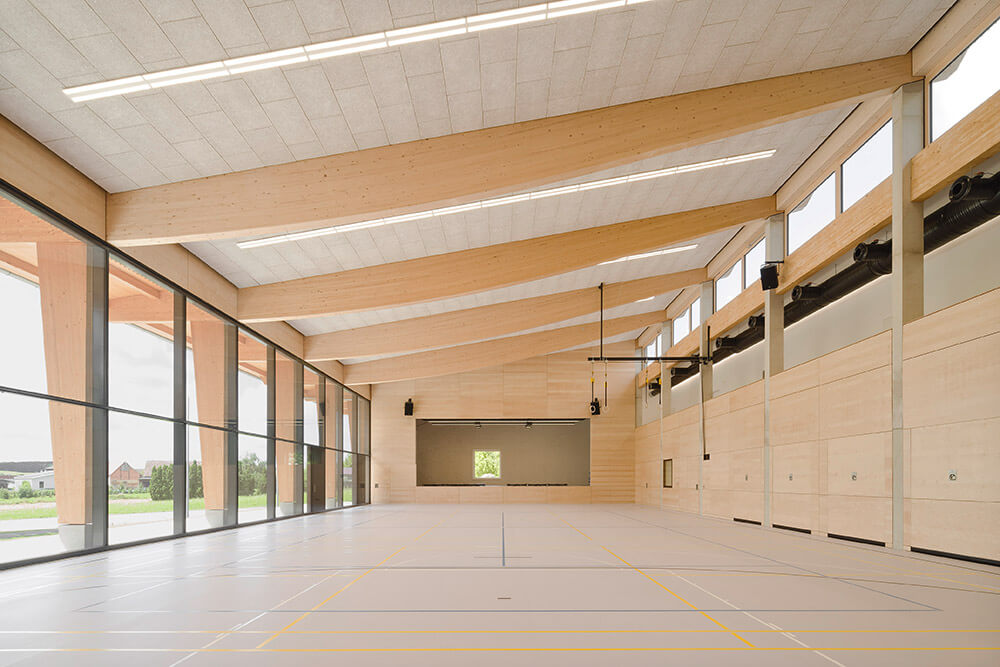
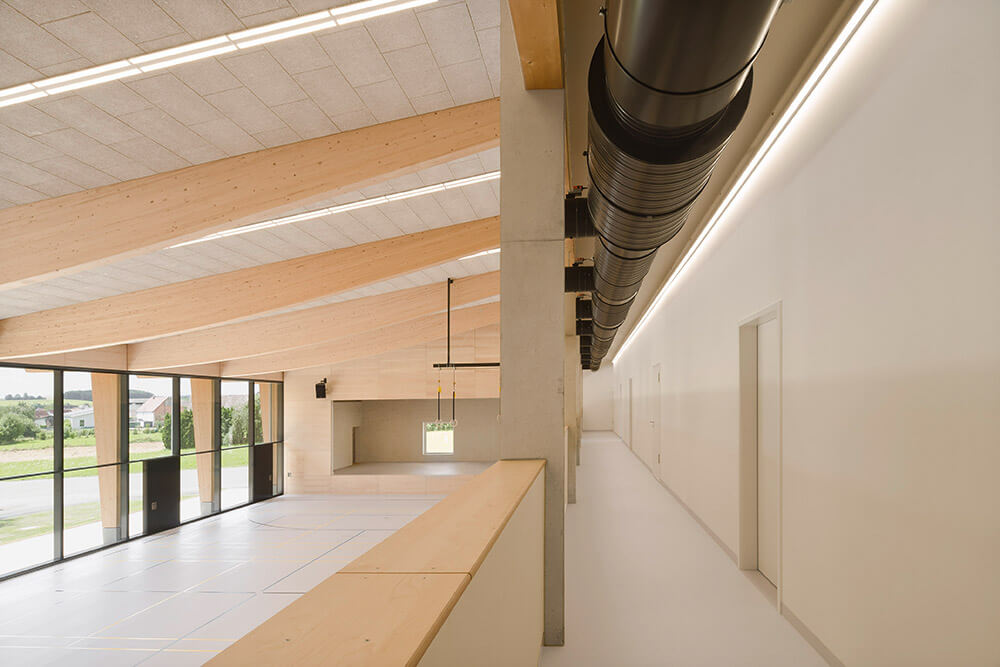
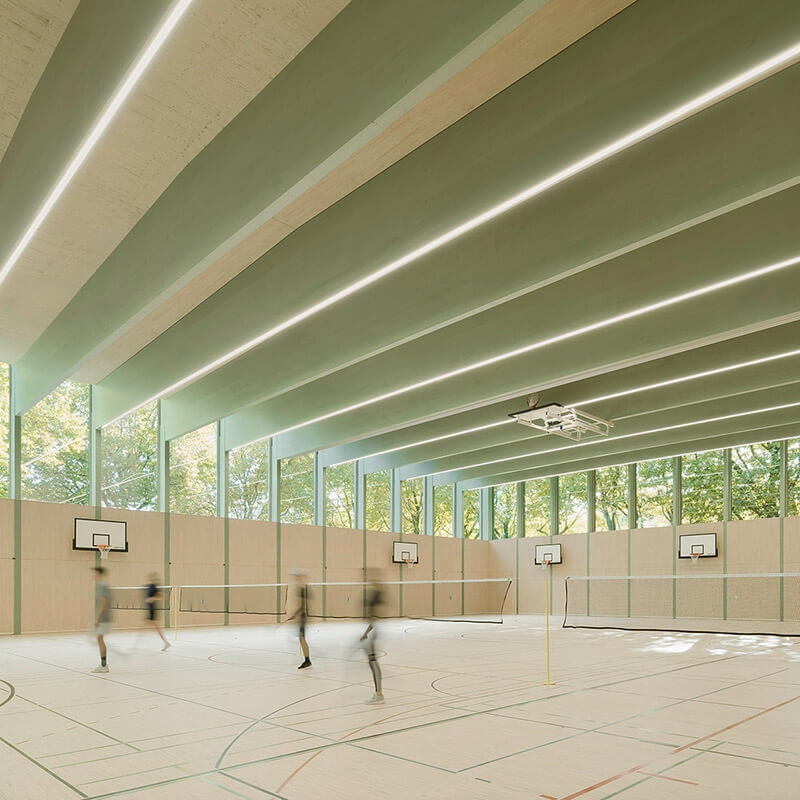
A parti­cu­larly deli­cate lighting system with LED light chan­nels has been imple­mented in the Lode­rer­platz sports hall, combi­ning aesthe­tics and func­tion­a­lity. The slender EKL sports lumi­n­aires fit harmo­niously into the ceiling design and, with a lumi­nous flux of up to 12,000 lumens, ensure uniform, glare‑free lighting – ideal for fast ball sports and versa­tile use. The sports lumi­n­aires are TÜV Süd-certi­fied as ball-impact resistant and compliant with safety lighting requi­re­ments.

Thanks to robust cons­truc­tion and high energy effi­ci­ency, they deliver maintenance‑free perfor­mance for at least 80,000 opera­ting hours and create optimal visual condi­tions for sports, trai­ning, and events.

Lighting design and lumi­n­aires are by AS LED Lighting GmbH, Penz­berg.

Struc­ture

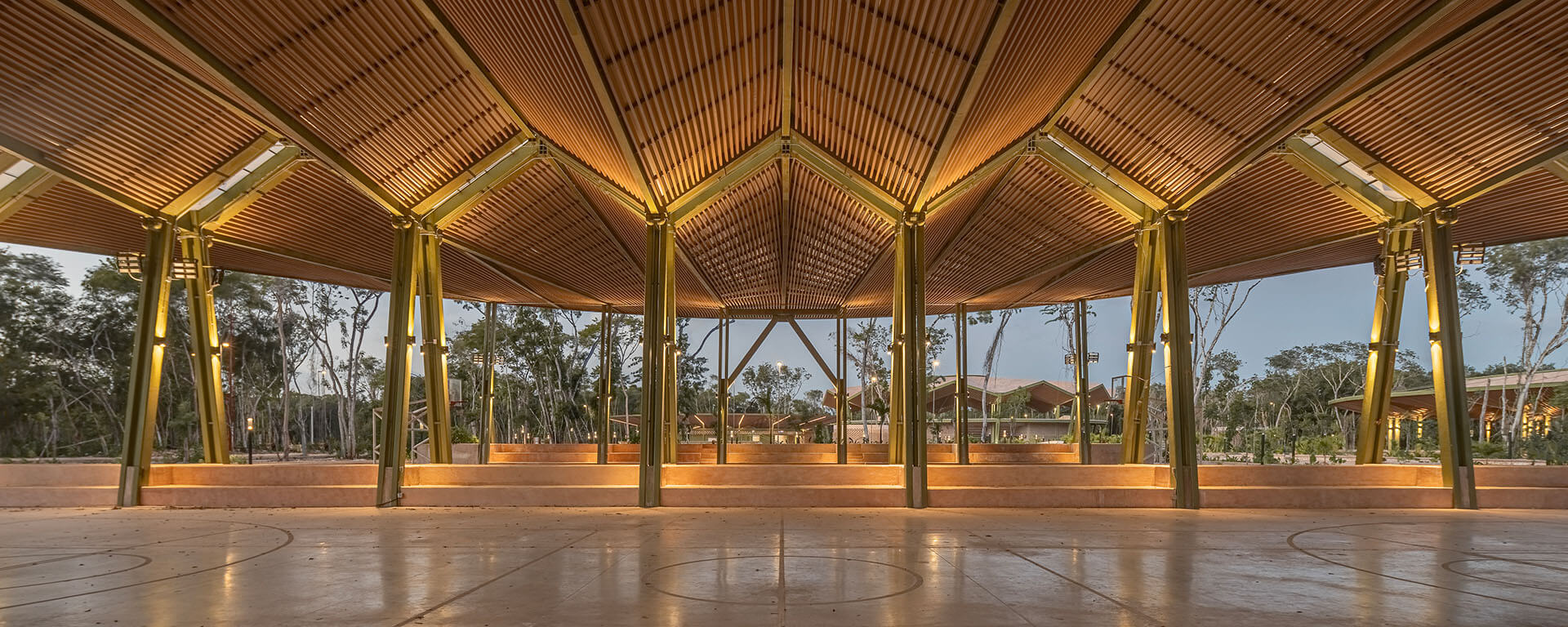
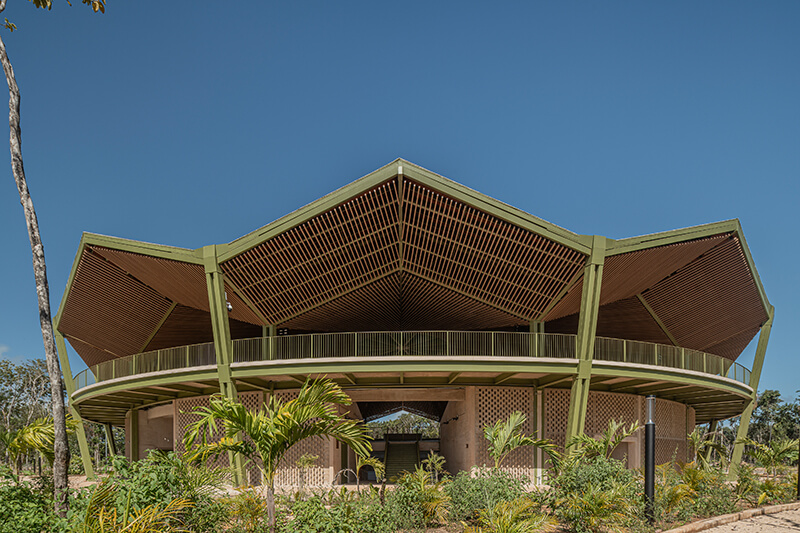
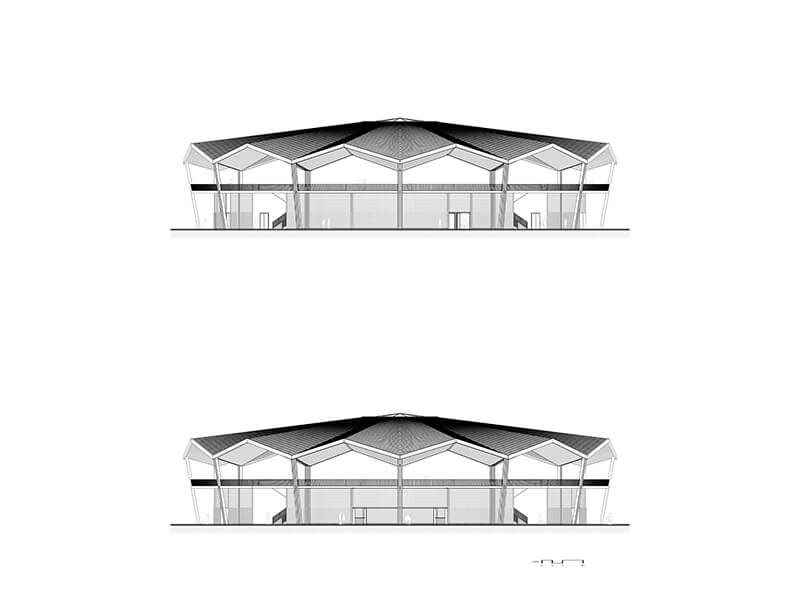
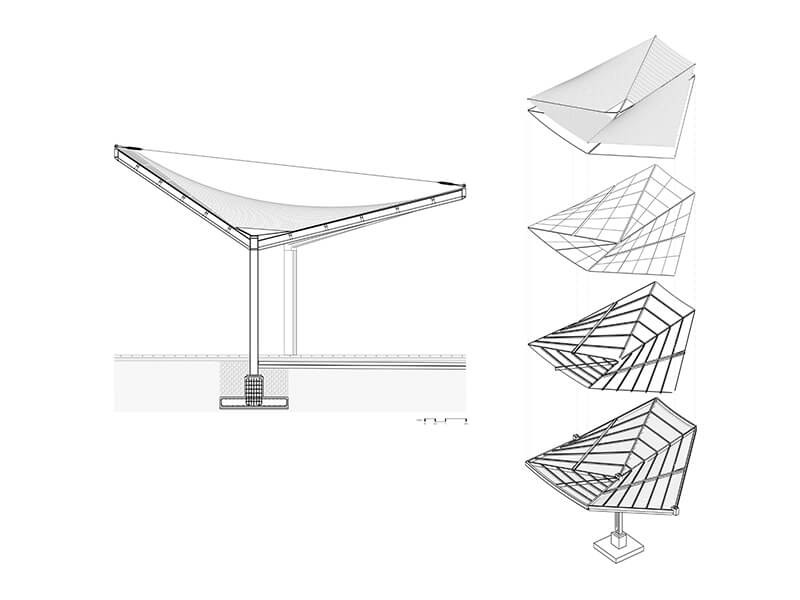
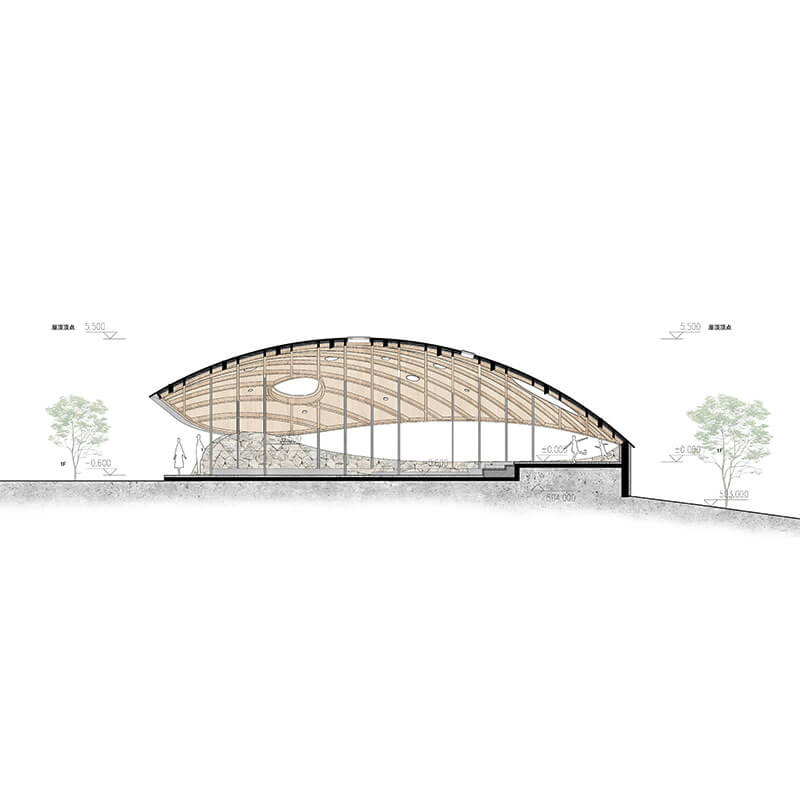
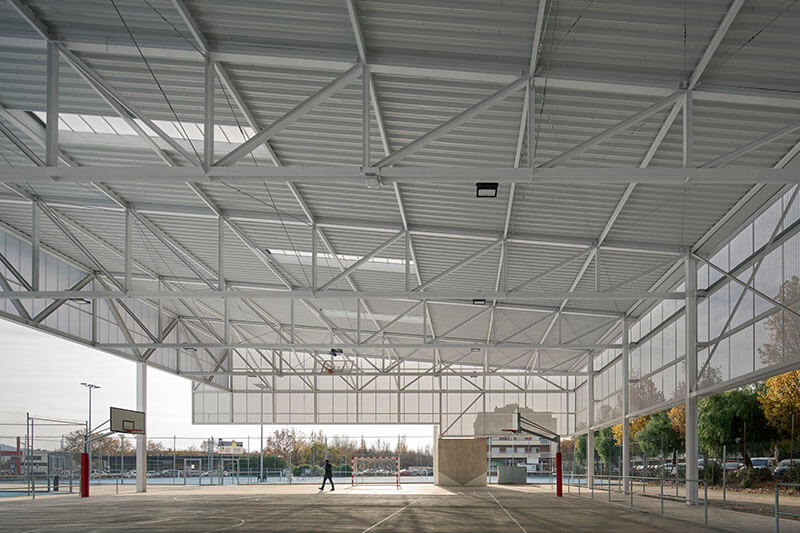
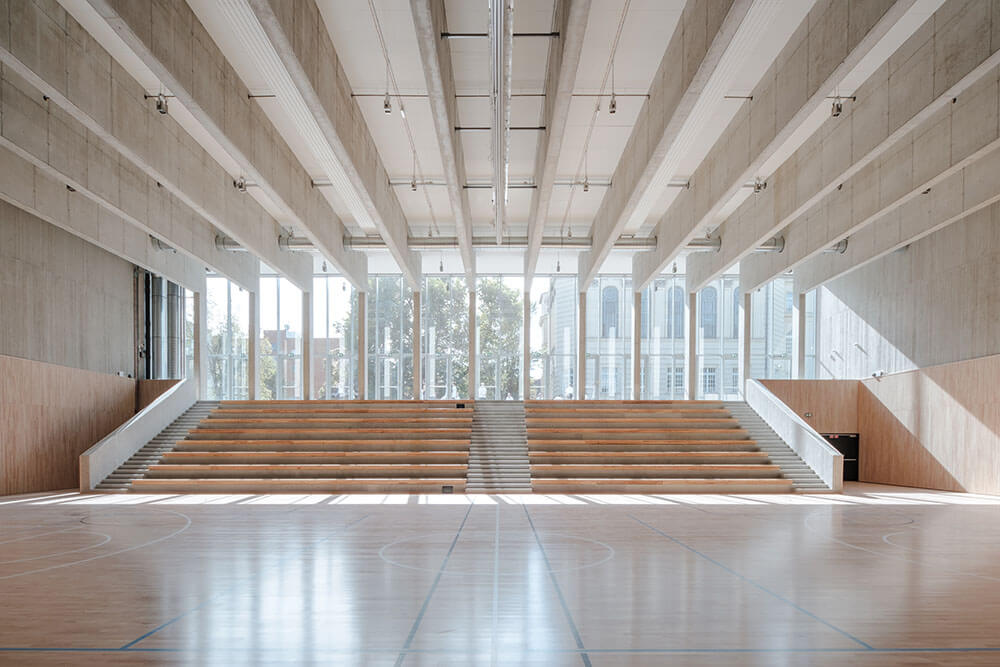
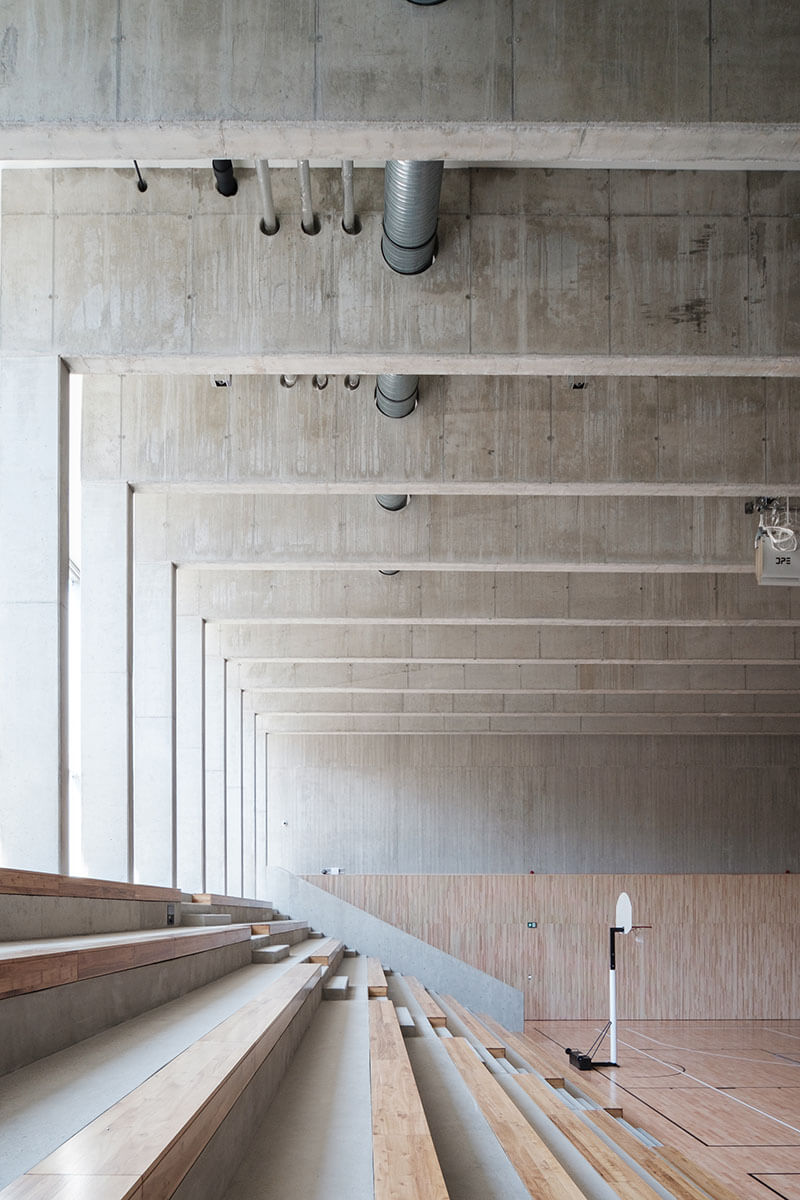
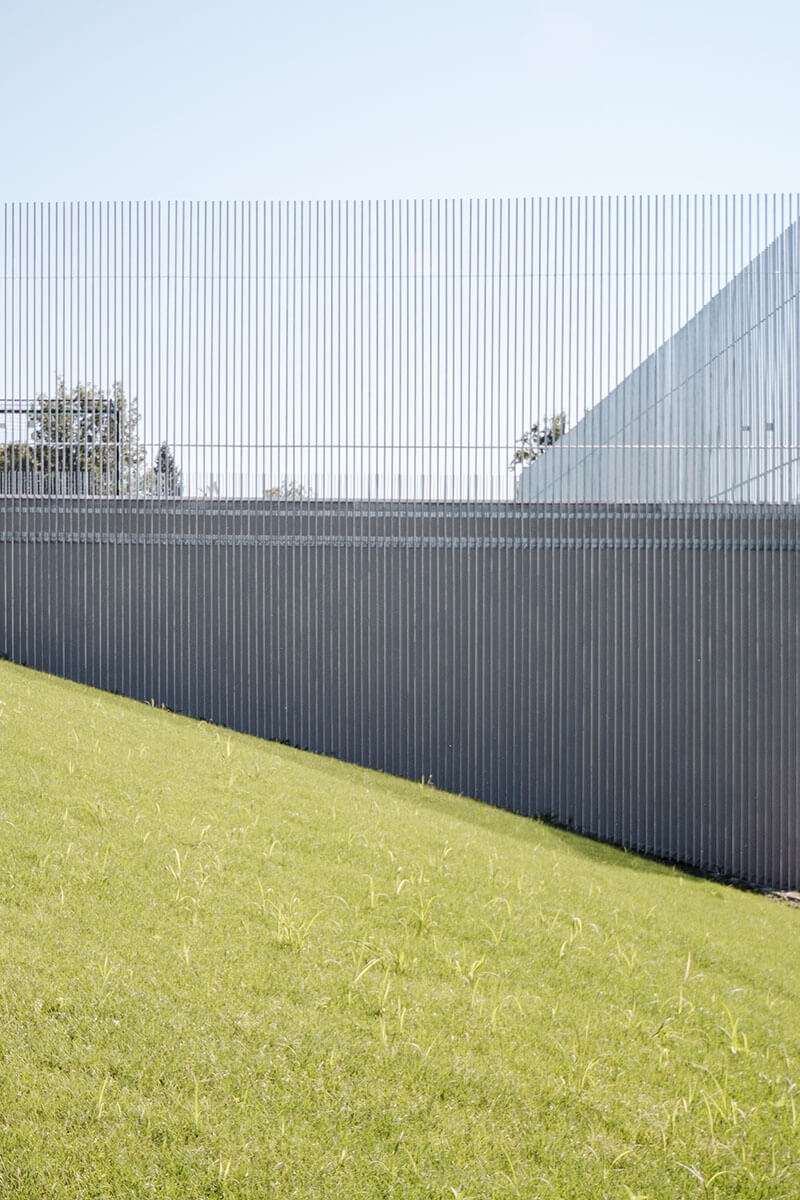
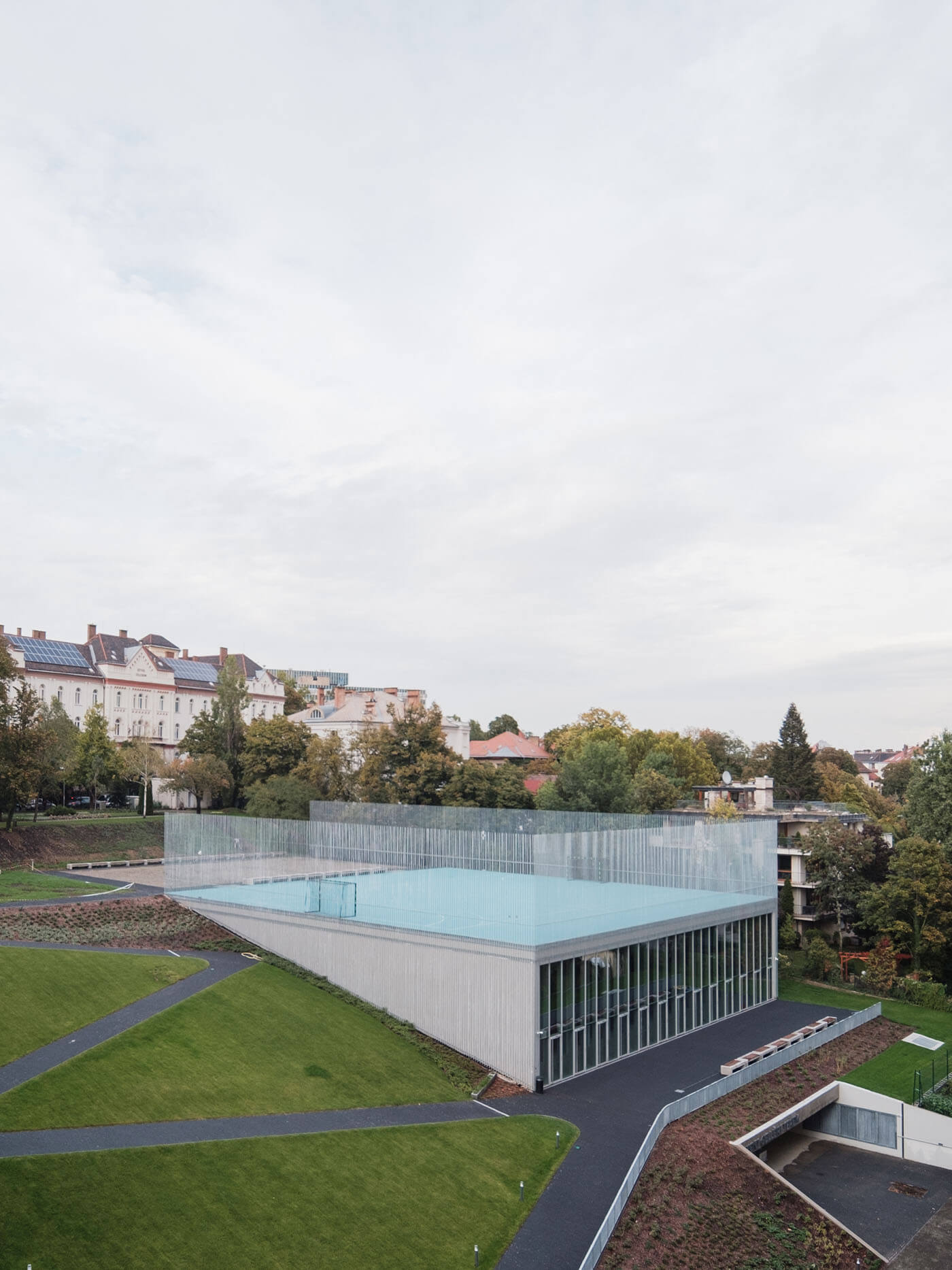
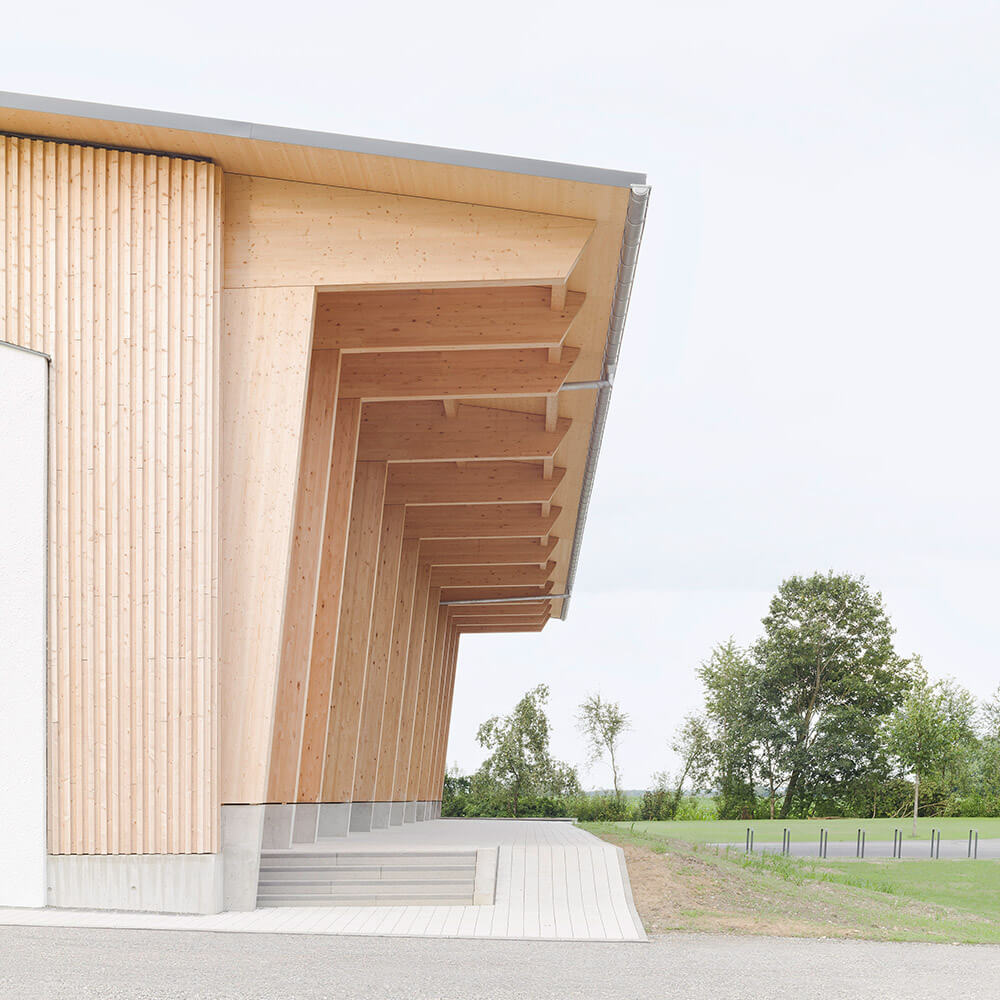
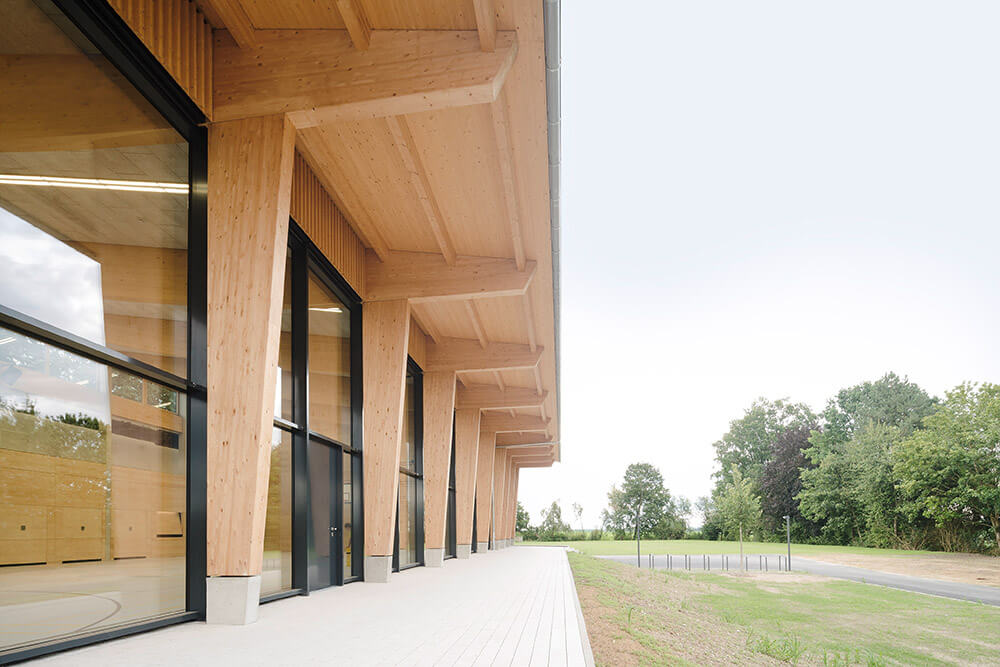
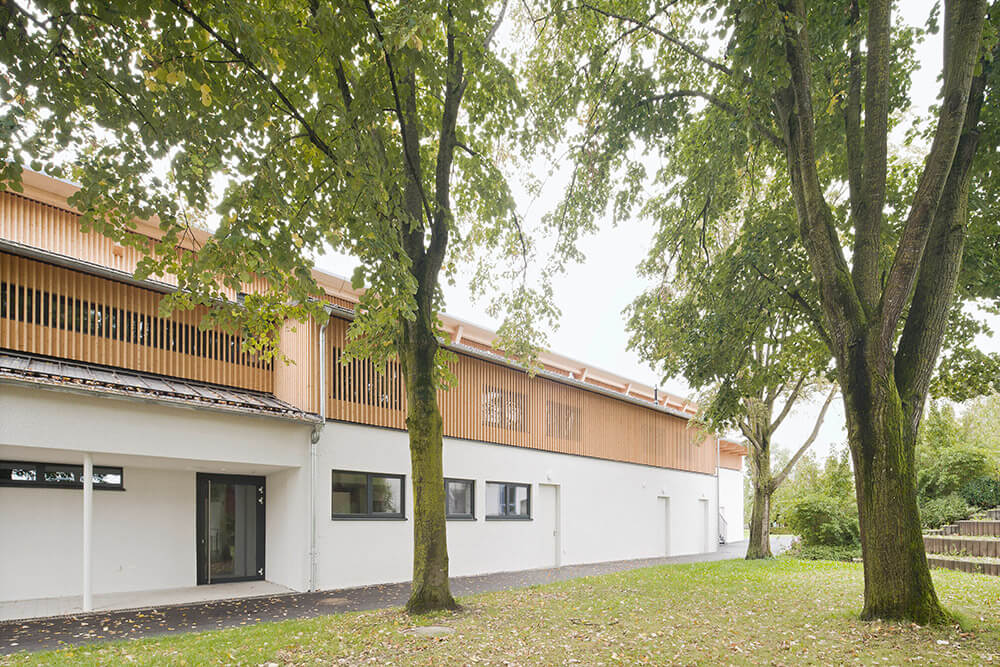
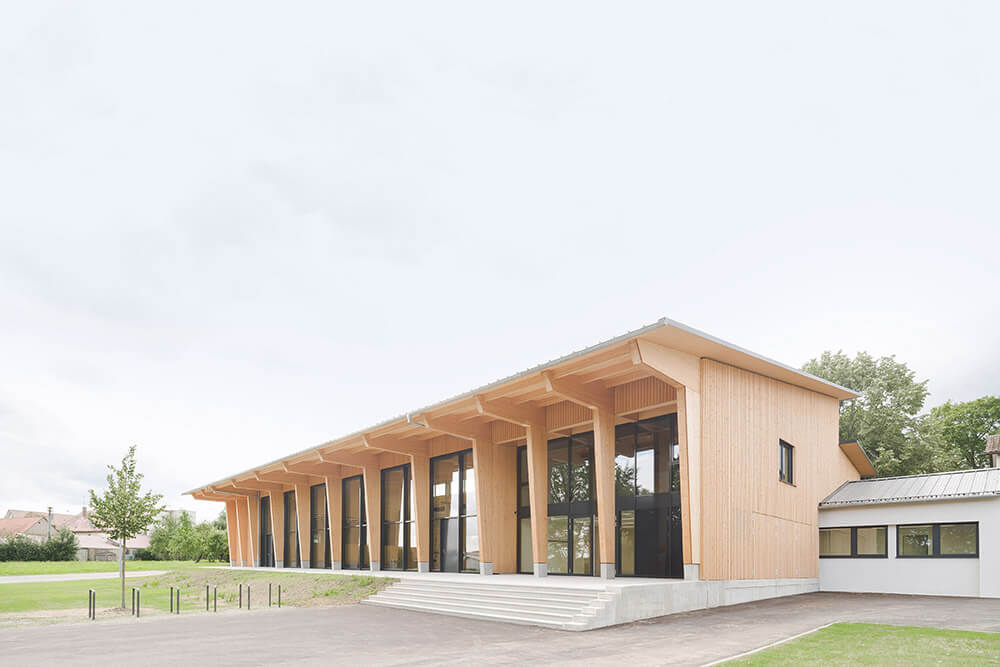
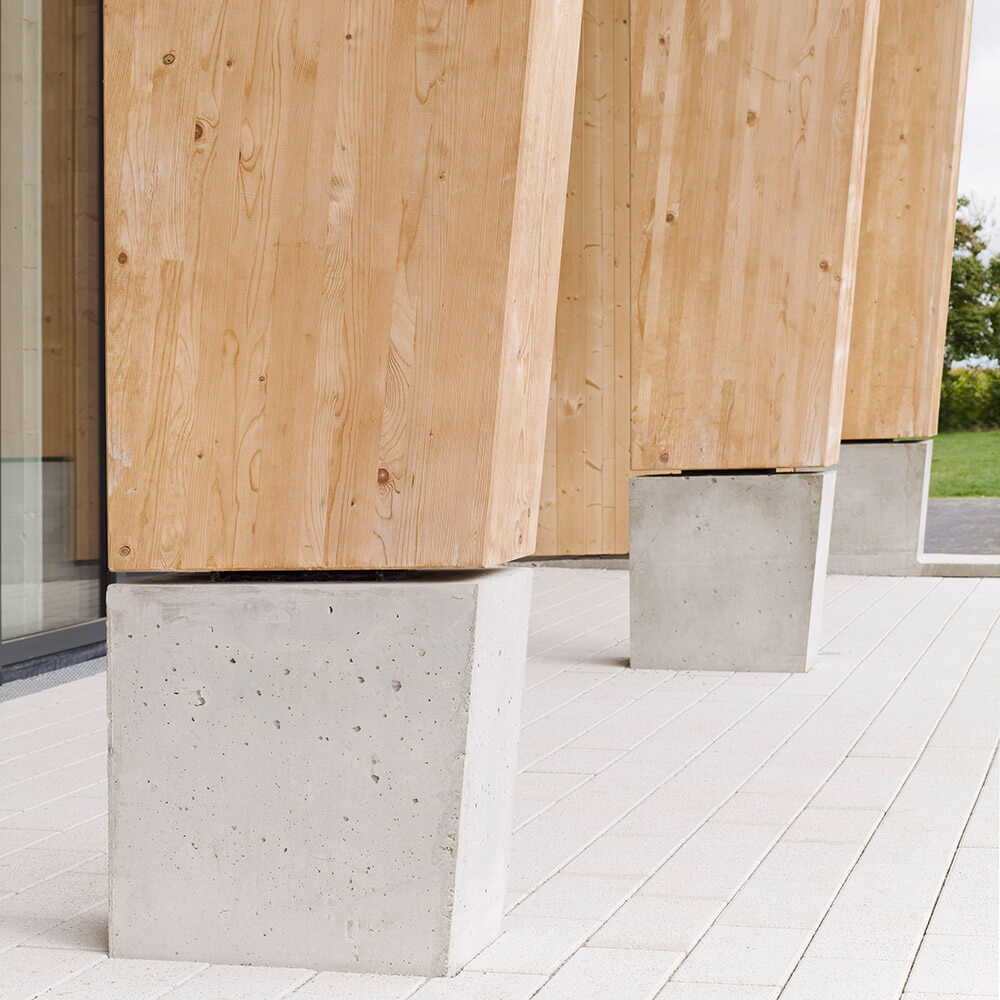
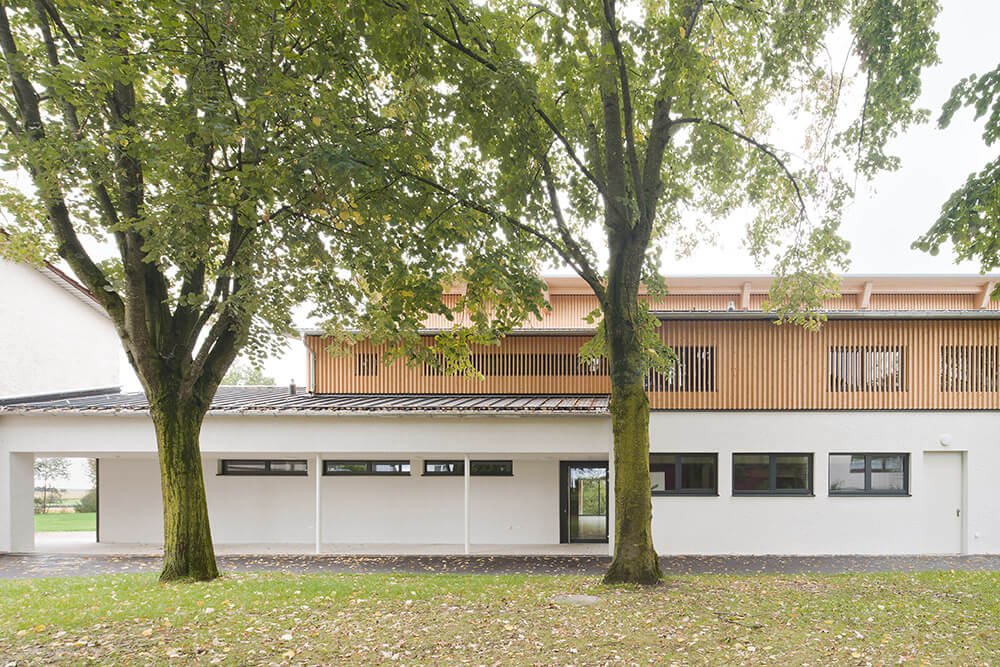
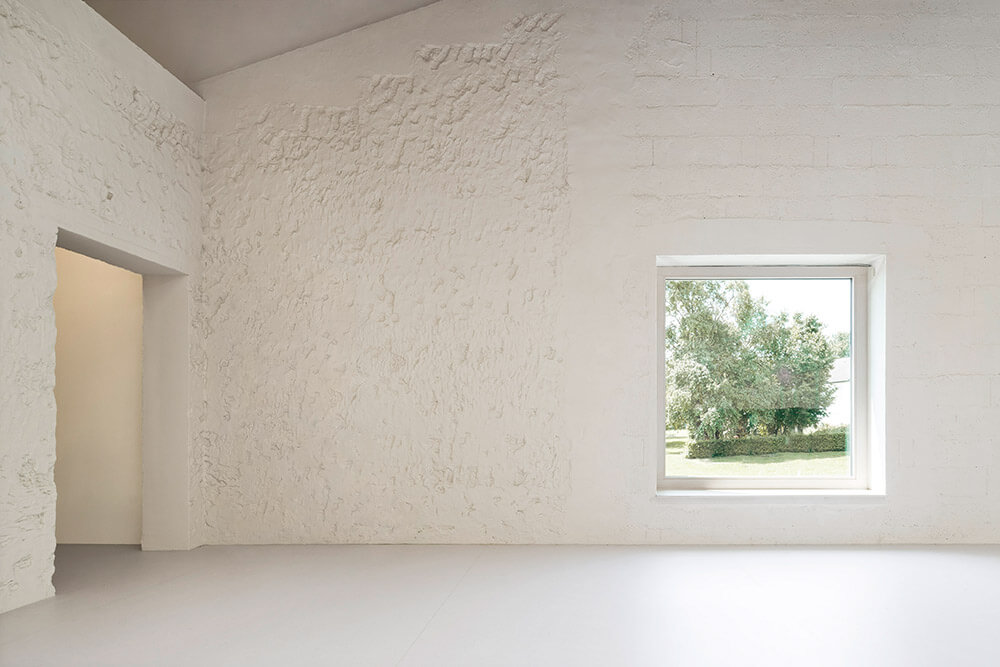
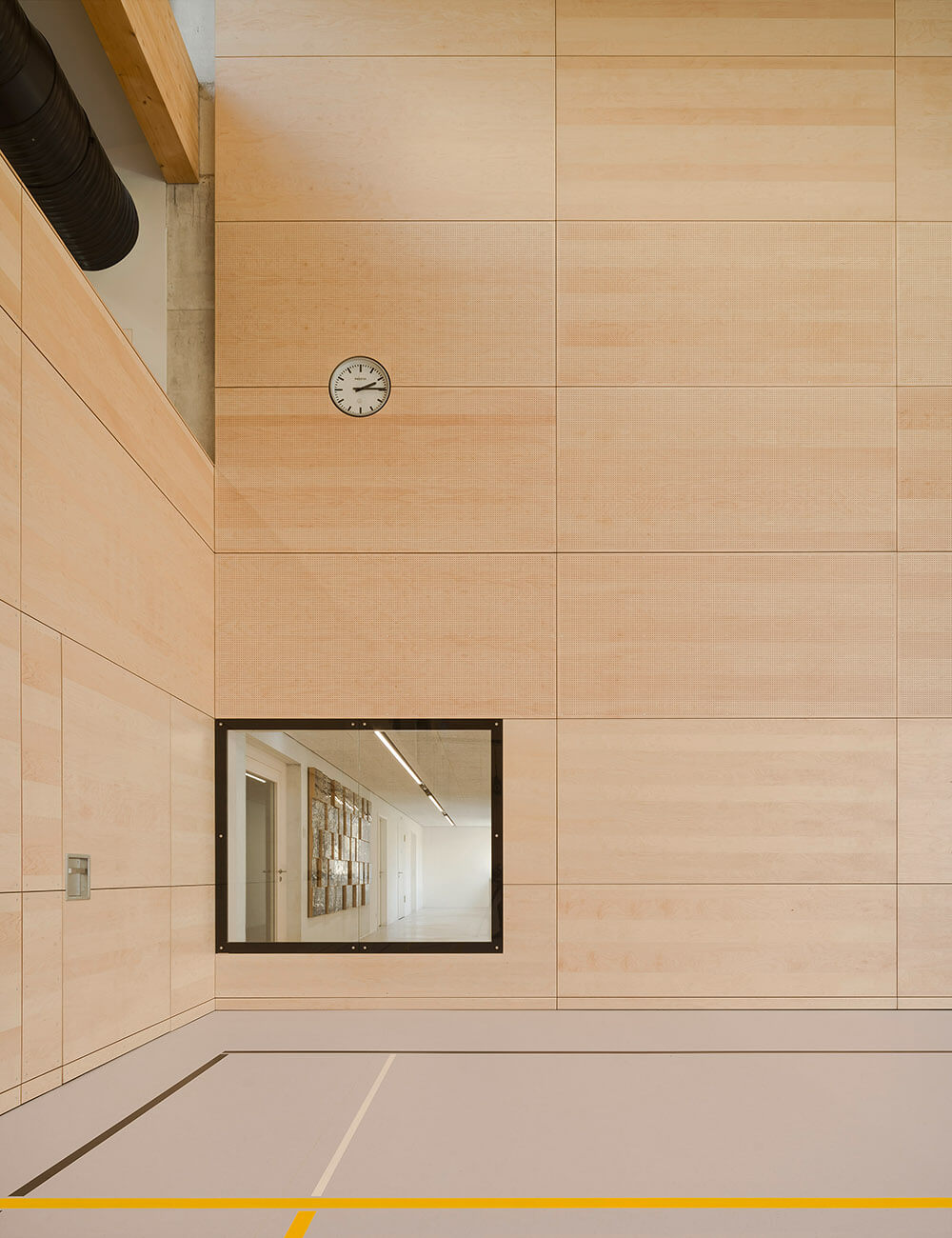
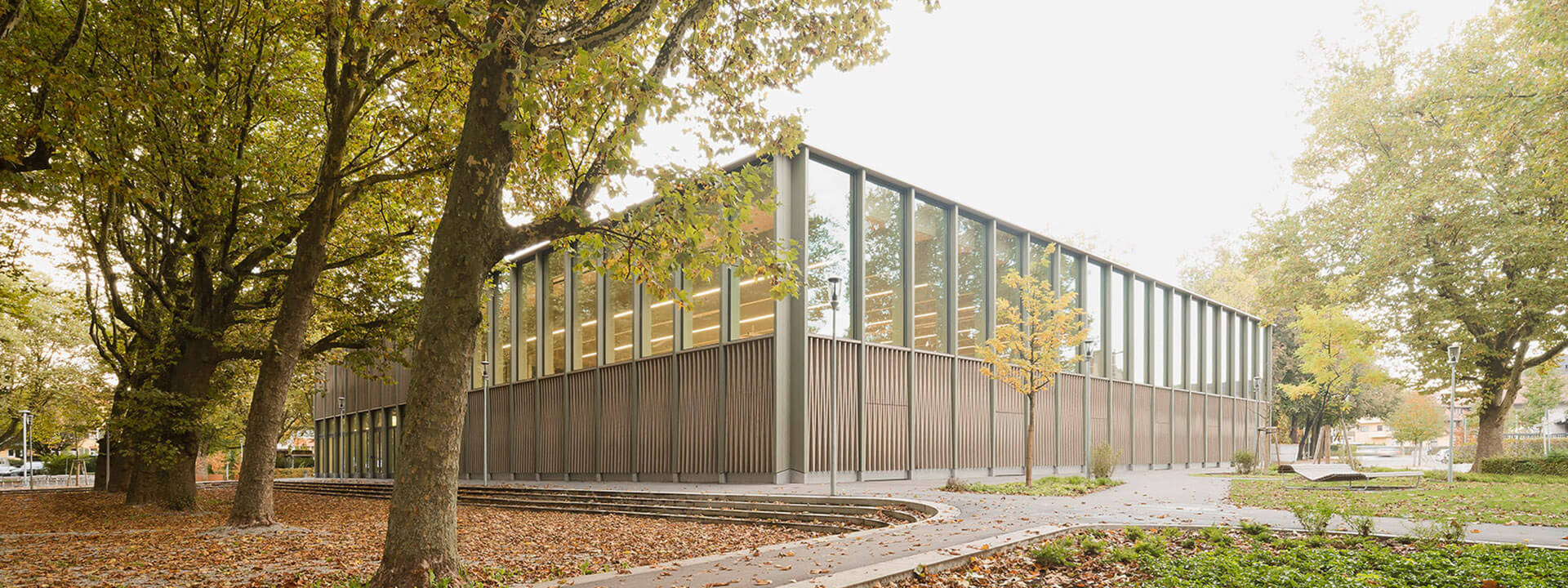
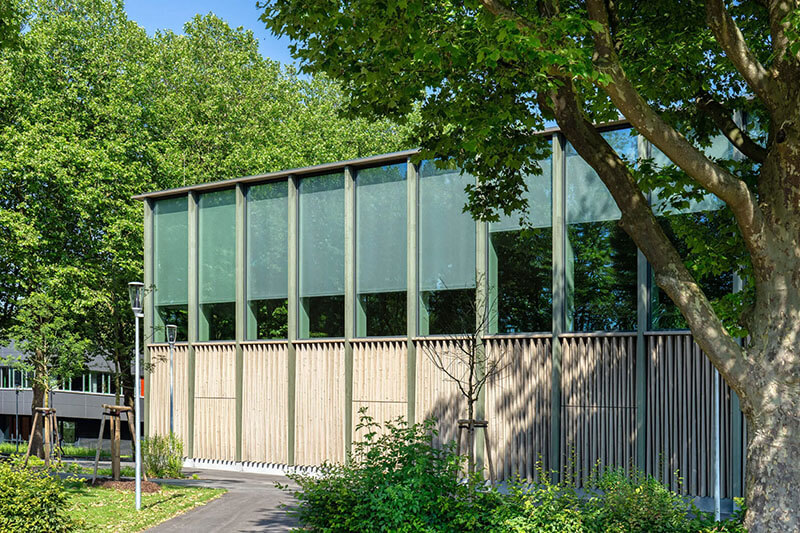
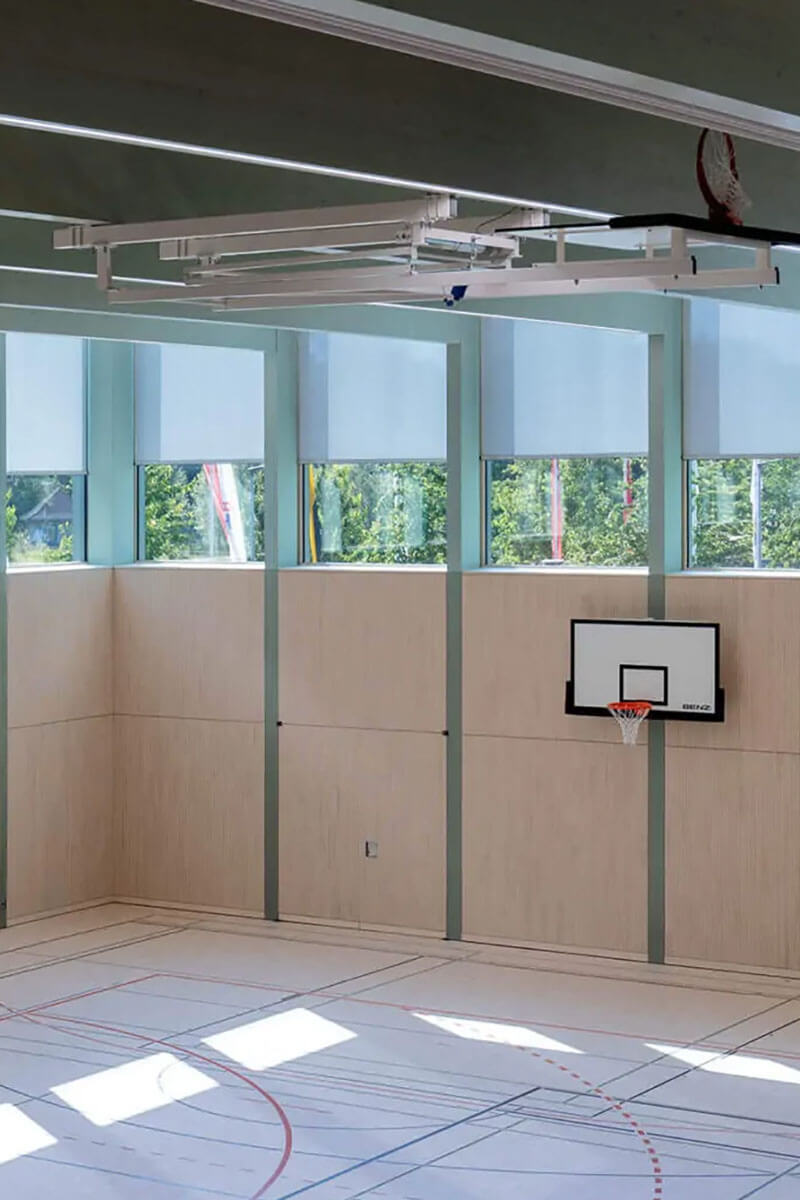
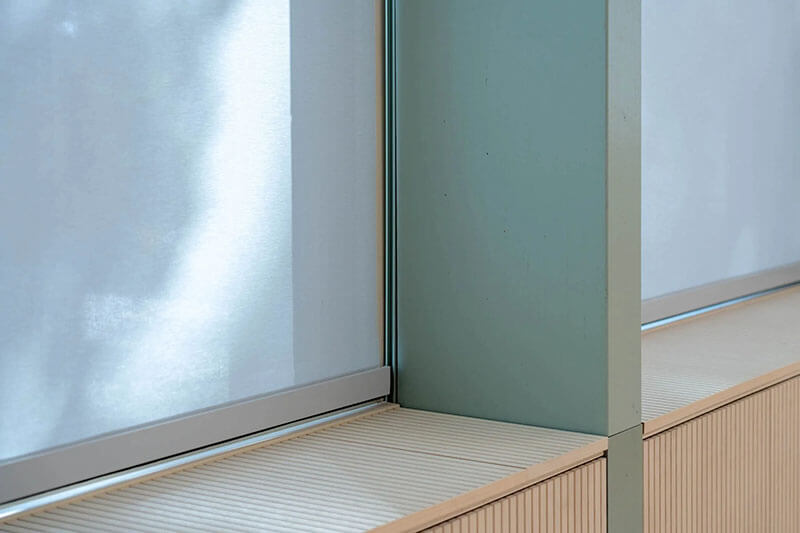
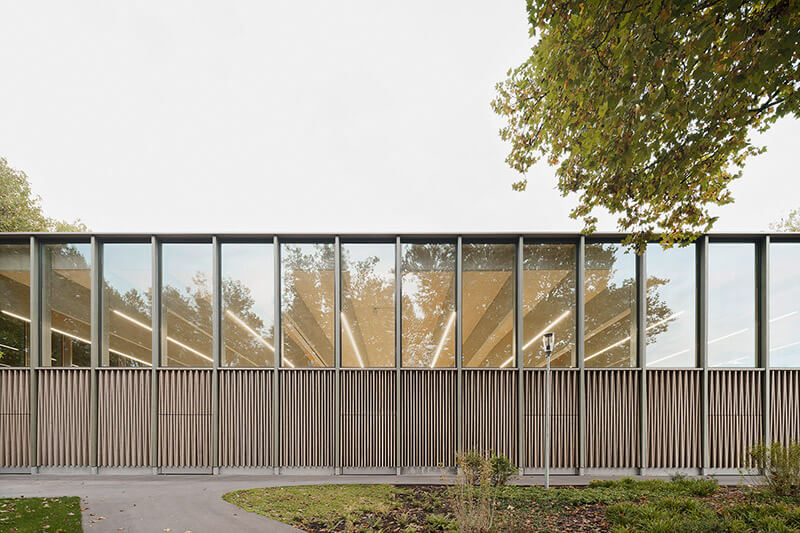
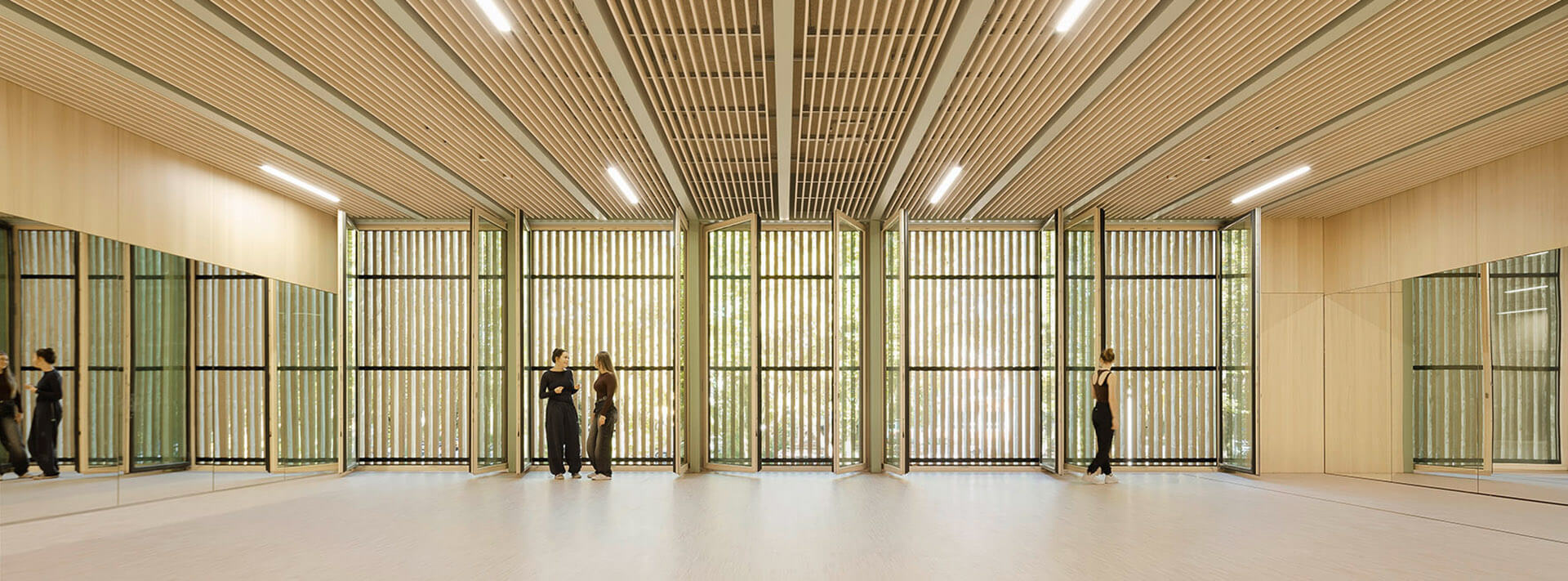
The struc­tural concept follows a clear prin­ciple: wood defines the sports hall, concrete the ancil­lary spaces. Double glued-lami­nated timber girders (each 38 meters long) shape the atmo­sphere of the hall and enabled a high degree of prefa­bri­ca­tion. The result is a robust struc­ture with clearly legible mate­rials and an effi­cient cons­truc­tion period. At the same time, the concrete of the foyer and func­tional rooms provides the neces­sary dura­bi­lity for the daily demands of school and sports use.
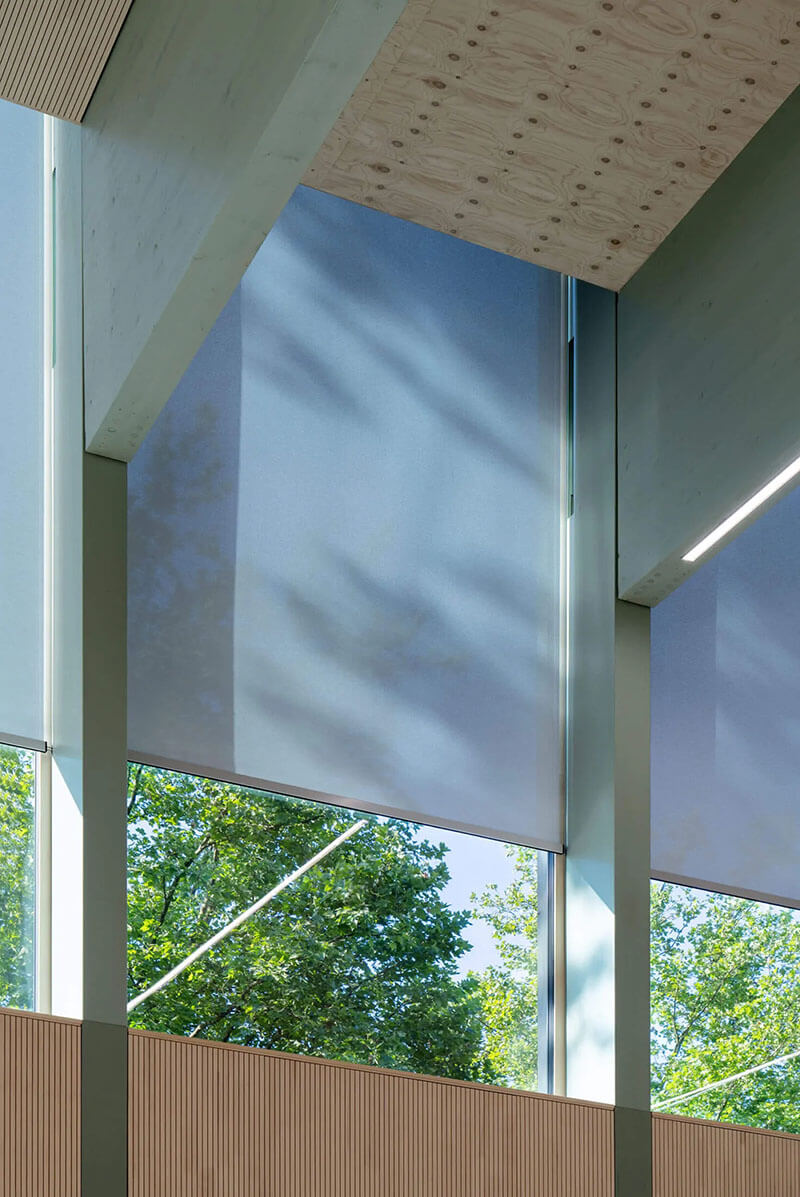
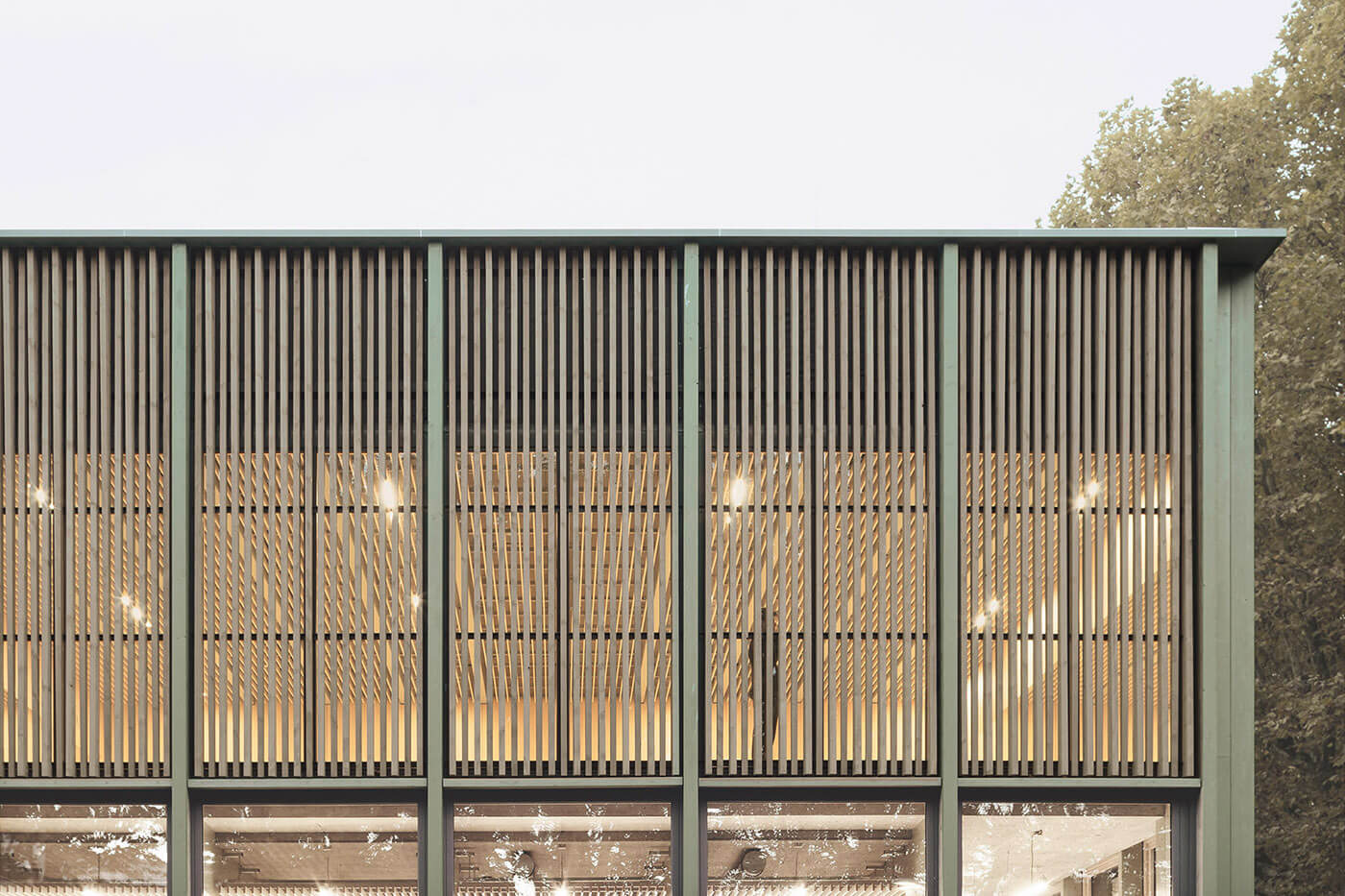
The south façade features inte­grated blackout options so that diffe­rent lighting scena­rios can be created for sports, stage programs, or large events. All tech­nical infra­struc­ture is located in the base­ment. This keeps the roof free of instal­la­tions and the buil­ding volume clear and calm.

Buil­ding services

The engi­nee­ring firm Kinast was respon­sible for the buil­ding services of the Lode­rer­platz sports hall from plan­ning through commis­sio­ning.

The flexible tech­nical concept includes a combined heat supply from ground­water heat pumps and district heating, an internal nega­tive-pres­sure roof drai­nage system, and exten­sive water and sani­tary instal­la­tions for sports opera­tions, the cafe­teria, and back­stage areas. Large partial air-condi­tio­ning systems ensure venti­la­tion of the hall, foyer, and cafe­teria, supple­mented by free cooling using well water in summer.

A networked buil­ding manage­ment and control system links all instal­la­tions, opti­mizes energy use, and increases opera­tional relia­bi­lity. The result is a powerful, econo­mical, and long-term sustainable tech­nical infra­struc­ture.

A model faci­lity

Since opening, the hall has proven its versa­ti­lity multiple times. School and club sports, exami­na­tions, long‑awaited gradua­tion cere­mo­nies, cultural programs, and the first major events illus­trate how flexibly the 5,600 m² complex can be used – a remar­kably broad range for a city the size of Erding (37,000 inha­bi­tants).

The Lode­rer­platz sports hall is a fine example of how multi­func­tional sports and event venues can work today: tech­ni­cally clear, spati­ally flexible, precisely posi­tioned in urban design terms, and robust in its detailing. It is a buil­ding that shapes the ever­yday life of many users while clearly reflec­ting the care taken in its plan­ning and craft­sman­ship.

Project data

Archi­tect

Fuchs und Rudolph
Archi­tekten Stadt­planer PartG mbB
Konrad­in­straße 3
D – 81543 München

Client

City of Erding

Buil­ding Services

Inge­nieur­büro Kinast GmbH 
Leon­rod­straße 61
D – 80636 München

Lighting System

AS LED Lighting GmbH
Sees­haupter  Str. 2
D – 82377 Penz­berg

Opening

2024

Address

Mehr­zweck­halle Lode­rer­platz
D – 85435 Erding

Photos

Oliver Heinl

Text

Johannes Bühl­be­cker
More Sports Media

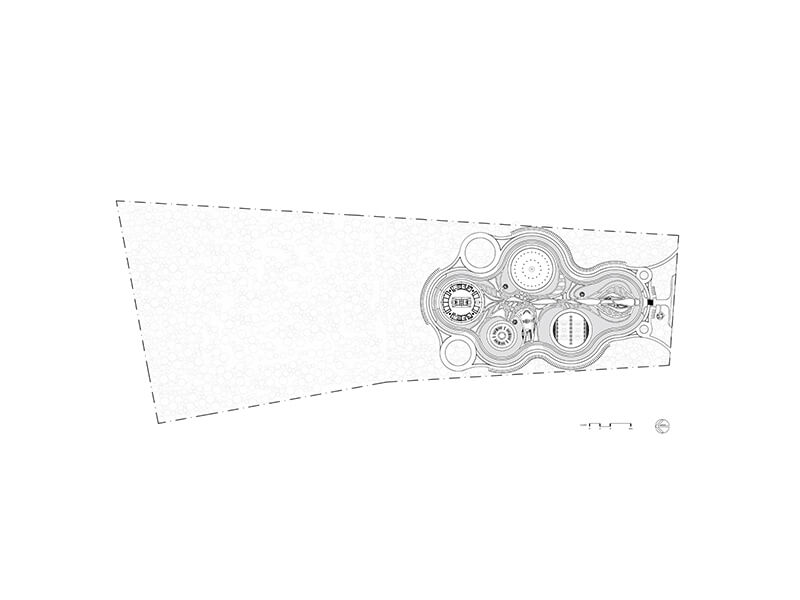
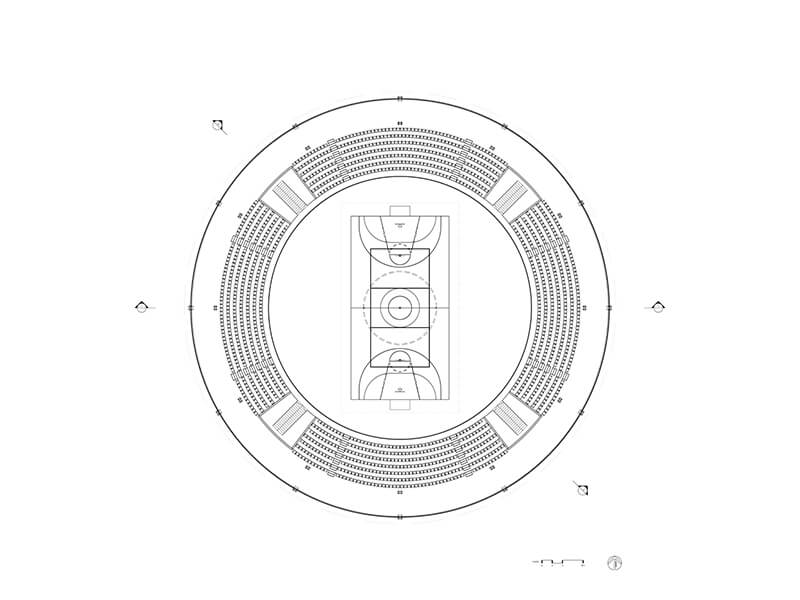
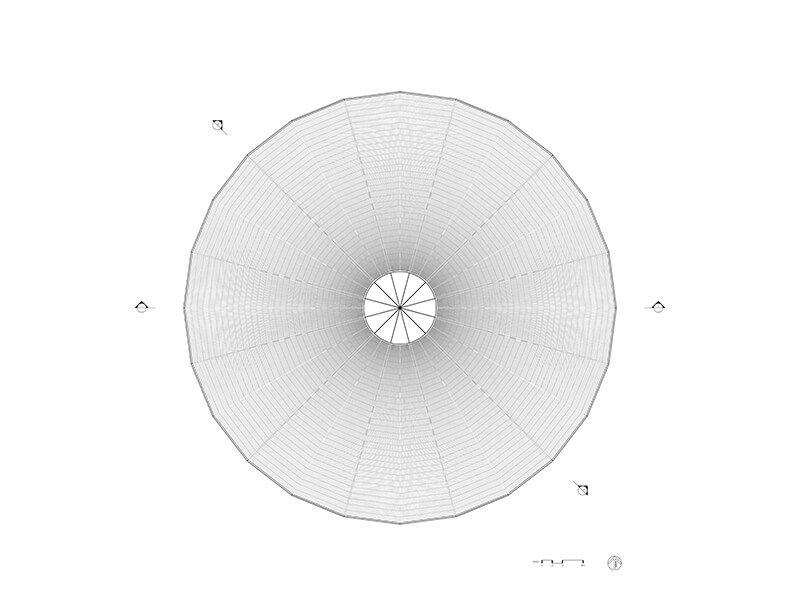
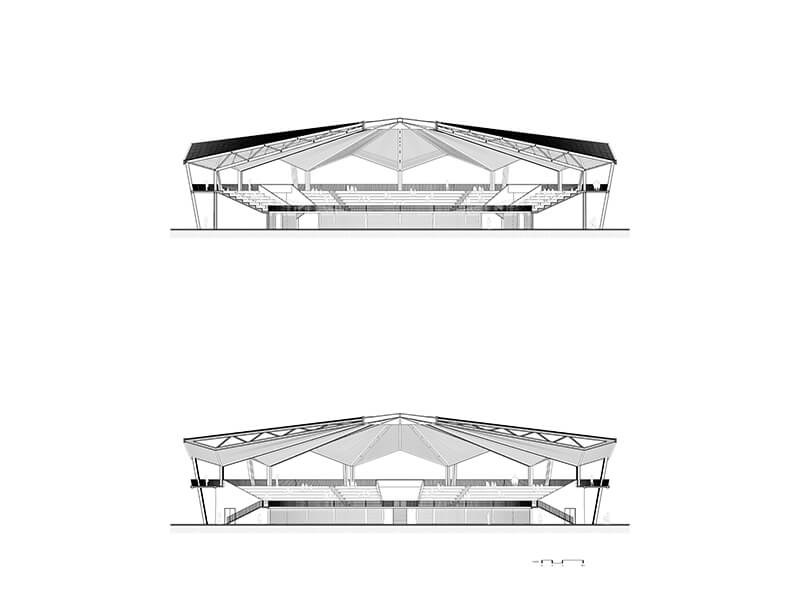
Plans

[dica_divi_carousel item_width_tablet=“100%” item_width_phone=“100%” item_width_last_edited=“on|phone” show_items_desktop=“1” show_items_tablet=“1” multislide=“on” transition_duration=“1000” loop=“on” autoplay=“on” hoverpause=“on” autoplay_speed=“3500” arrow_nav=“on” item_spacing=“10” item_vertical_align=“flex-start” advanced_effect=“1” arrow_nav_color=”#5E5C4D” arrow_bg_color=”#FFFFFF” dots_color=“#FAF4E4” dots_active_color=”#5E5C4D” overlay_color_field_bgcolor=“rgba(255,255,255,0.85)” carousel_container_margin=”||50px||false|false” _builder_version=“4.27.4” _module_preset=“default” title_font=“Roboto Condensed||||||||” body_font=“Roboto Condensed||||||||” width=“90%” width_tablet=“100%” width_phone=“100%” width_last_edited=“on|tablet” custom_margin=”|50px||30px|false|false” custom_margin_tablet=”|50px||30px|false|false” custom_margin_phone=”|0px|0px|0px|false|false” custom_margin_last_edited=“on|phone” custom_padding_tablet=”” custom_padding_phone=”||0px||false|false” custom_padding_last_edited=“on|phone” global_colors_info=”{}”][dica_divi_carouselitem button_url_new_window=“1” image=“https://moresports.network/wp-content/uploads/2025/12/Lageplan.jpg” image_lightbox=“on” _builder_version=“4.27.4” _module_preset=“default” global_colors_info=”{}”][/dica_divi_carouselitem][dica_divi_carouselitem button_url_new_window=“1” image=“https://moresports.network/wp-content/uploads/2025/12/1200px_02-Layout-EG-200.png” image_lightbox=“on” _builder_version=“4.27.4” _module_preset=“default” global_colors_info=”{}”][/dica_divi_carouselitem][dica_divi_carouselitem button_url_new_window=“1” image=“https://moresports.network/wp-content/uploads/2025/12/1200px_01-Layout-UG-200.png” image_lightbox=“on” _builder_version=“4.27.4” _module_preset=“default” global_colors_info=”{}”][/dica_divi_carouselitem][dica_divi_carouselitem button_url_new_window=“1” image=“https://moresports.network/wp-content/uploads/2025/12/Schnitte.jpg” image_lightbox=“on” _builder_version=“4.27.4” _module_preset=“default” global_colors_info=”{}”][/dica_divi_carouselitem][/dica_divi_carousel]

Video

Subscribe to our news­letter.

Every three weeks, we provide infor­ma­tion about new and exem­plary projects and products. With heart, enthu­siasm and exper­tise.

Sports Hall Fasa­nenhof School

Fasa­nenhof School sports hall in Stutt­gart

There for ever­yone


Dasch Zürn + Partner

With the cons­truc­tion of the new Fasa­nenhof School sports hall, Stutt­gart has gained a sophisti­cated and contem­po­rary venue for sports and socia­li­sing in the south of the city, which is desi­gned for both daily school sports and compe­ti­tive events.

This is thanks to the design by Dasch Zürn + Partner, but also to the quality of the mate­rials used and the compa­nies involved.

Situa­tion

The new buil­ding comple­ments the elon­gated school buil­ding to form an L‑shaped ensemble. The posi­tion of the compact struc­ture along the street creates clearly defined and protected outdoor areas, inclu­ding a covered fore­court, the play­ground with outdoor sports area and parking spaces. A shared canopy connects the hall directly to the school buil­ding and forms the main entrance for pupils and teachers.

The gene­rous glazing facing the play­ground and outdoor area creates an intense connec­tion between the inte­rior and exte­rior of the entire complex.

User

The new Fasa­nenhof School sports hall is both a place for sport and a space for the school commu­nity. The hall can accom­mo­date up to 150 spec­ta­tors, and toge­ther with the foyer, even larger school events are possible. This makes the buil­ding the sporting and cultural centre of the neigh­bour­hood.

The hall is desi­gned for dual use by both the school and sports clubs, which is clearly evident from the two main entrances, one from the schoo­lyard to the east and one from the car parks on the west side.

The actual hall level is around 70 cm below the level of the schoo­lyard, thus compen­sa­ting for the exis­ting diffe­rence in ground level to the car parks to the west. This diffe­rence in height allows for a stag­gered grand­stand solu­tion on the long side of the playing field, consis­ting of two rows of seating steps for a good 100 visi­tors and a stan­ding area at schoo­lyard level.

Mate­rials

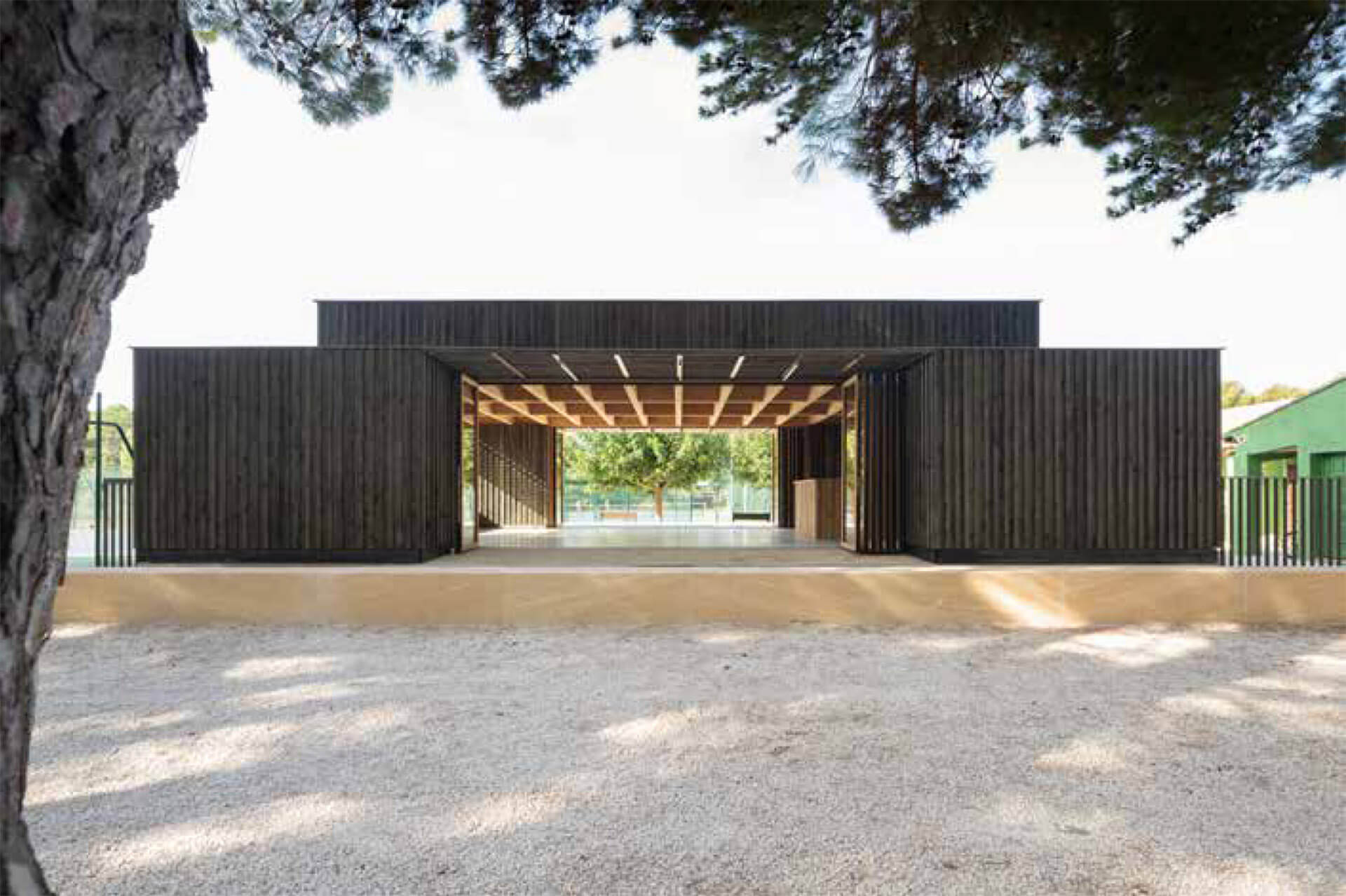
The appearance of the sports hall is defined by wood, concrete and gene­rous glazing. The closed façade surfaces are clad with a curtain-type, rear-venti­lated wooden façade cons­truc­tion, using three verti­cally arranged, pre-greyed slats of diffe­rent widths. The glazing was desi­gned as a mullion-transom cons­truc­tion with triple glazing.

The rein­forced concrete struc­ture and the func­tional and ancil­lary rooms are concealed behind the wooden façade: on the ground floor, these are equip­ment rooms, storage rooms and WCs, while chan­ging rooms and showers are located on the upper floor. A caret­a­ker’s flat with a sepa­rate entrance is also inte­grated, comple­ting the func­tional design of the buil­ding.

The hall itself is spanned by three wooden double trusses arranged above the main roof area. This cons­truc­tion forms the striking sheds that are visible from the outside. The nort­hern beams are desi­gned as truss beams so that glare-free nort­hern light falls into the inte­rior of the hall between their diago­nals.

Inte­rior

Inside, the simple colour scheme is deter­mined by mate­rials that are both func­tional and aesthetic. The higher wall areas and the walls in the foyer are made of exposed concrete with embedded board form­work. The sports faci­li­ties are equipped with resi­lient sports floo­ring and a simi­larly resi­lient white fir rebound wall on the south side, which also serves as sound insu­la­tion. In addi­tion, yellow-painted wood wool panels on the ceilings connect the foyer with the adjoi­ning rooms.

This Energy

All roof surfaces are covered with photo­vol­taic panels, and the caret­a­ker’s flat is heated using solar thermal energy. The combi­na­tion of durable mate­rials, a robust supporting struc­ture and energy-effi­cient measures results in a sustainable, future-proof school and sports buil­ding.

The Fasa­nenhof School sports hall shows what contem­po­rary sports archi­tec­ture can look like: archi­tec­tu­rally clear, warm in atmo­sphere, flexible in use and closely linked to its school envi­ron­ment.

There for ever­yone.

Project data

Archi­tects

dasch zürn + partner
Böheim­straße 43
D – 70199 Stutt­gart

Client

Landes­haupt­stadt Stutt­gart
Referat Jugend und Bildung

Opening

2022

Address

Fasen­hof­schule
Markus-Schlei­cher-Str. 15
D – 70565 Stutt­gart

Photos

Henrik Schipper Photo­graphy

Text

Johannes Bühl­be­cker
More Sports Media

Subscribe to our news­letter.

Every three weeks, we provide infor­ma­tion about new and exem­plary projects and products. With heart, enthu­siasm and exper­tise.

Grand Ball­room Tirana

Grand Ball­room in Tirana

Urban Hybrid


MVRDV

With “The Grand Ball­room”, Tirana gains a highly expres­sive piece of contem­po­rary archi­tec­ture that merges sports infra­struc­ture, housing, hospi­ta­lity, and public space into a single, compact volume. The sphe­rical design by MVRDV estab­lishes a strong urban land­mark while respon­ding precisely to func­tional, spatial, and urban-plan­ning requi­re­ments.

Sport as an Urban Cata­lyst

Located in the Alba­nian capital, the project replaces the exis­ting Asllan Rusi Sports Palace with a new mixed-use buil­ding conceived as a sphe­rical urban block with a diameter of more than 100 meters. At its core lies a 6,000-seat arena desi­gned for basket­ball and volley­ball, surrounded by comple­men­tary programs inclu­ding resi­den­tial units, a hotel, retail spaces, and publicly acces­sible outdoor areas.

With a gross floor area of appro­xi­m­ately 90,200 m², the project repres­ents one of the largest and most ambi­tious mixed-use deve­lo­p­ments in Albania, posi­tio­ning sport as a driver for urban rege­ne­ra­tion and social inter­ac­tion.

An Iconic Geometry

The sphe­rical geometry is not merely a formal gesture but a stra­tegic urban decision. The absence of a “backside” allows the buil­ding to address its surroun­dings equally on all sides, streng­thening its rela­ti­onship with the city. The compact foot­print enables high spatial effi­ci­ency on a dense inner-city site while freeing up ground-level space for public use.

Towards the base, the volume recedes to create plazas, stepped seating areas, and outdoor sports faci­li­ties, acti­vating the public realm. Upper-level setbacks gene­rate gene­rous terraces for resi­den­tial use, provi­ding shading and tran­si­tional spaces between inte­rior and exte­rior.

Layered Spatial Orga­niza­tion

Intern­ally, the buil­ding follows a clear vertical laye­ring of func­tions. A sunken public plaza forms the base, surrounded by a conti­nuous ring of retail, gastro­nomy, and service spaces that support both ever­yday use and event opera­tions. Above this level sits the main arena, with two addi­tional trai­ning halls inte­grated beneath the seating tiers.

The arena is topped by two hotel floors that main­tain a visual connec­tion to the sports hall via a large central oculus. This opening can be adjusted to meet acou­stic and climatic requi­re­ments, rein­for­cing the spatial dialogue between sport and hospi­ta­lity.

Living Within the Double Shell

The resi­den­tial units are embedded within the double-shell struc­ture of the sphere, enclo­sing a semi-open inte­rior cour­tyard conceived as a communal green space. Large openings within the buil­ding enve­lope enhance natural venti­la­tion and daylight while crea­ting shared social areas for resi­dents.

Apart­ments are oriented either outward toward pano­r­amic city views or inward toward the cour­tyard and arena. The upper­most levels accom­mo­date predo­mi­nantly maiso­nette-style apart­ments with private roof terraces, empha­si­zing the vertical grada­tion from public to private space.

A Contem­po­rary Urban Land­mark

With The Grand Ball­room, MVRDV proposes a typo­logy that fuses arena archi­tec­ture with urban living. The project rede­fines the sports venue as an inte­gral compo­nent of the city fabric—simultaneously a place for events, ever­yday life, and public interaction—contributing a strong archi­tec­tural iden­tity to Tirana’s evol­ving urban land­scape.

Project data

Archi­tect

MVRDV
Achter­klooster 7
Rotterdam
NL- South Holland 3011 RA

Client

Trema Tech shpk
Likado BV 
Alba­nian Capital Group shpk 
BCN Invest­ments BV

Artist

Helidon Xhixha

Staff

MVRDV: Winy Maas, Bert­rand Schippan, Stavros Garga­retas, Cathe­rine Drieux, Piotr Janus, Americo Iannaz­zone, Angel Sanchez Navarro, Ana Melga­rejo Lopez, Sylvain Totaro, Lola Elisa Cauneac, Miguel del Campo Grijalbo, Stanisław Rochala, Maria Stamati, Antonio Luca Coco, Angelo La Delfa, Luana La Martina, Jaroslaw Jeda, Stefano Fiaschi, Ciprian Buzdugan

Address
Asllan Rusi Sports Palace

Rruga Ali Kolonja
Tirana
Alba­nien
Visua­li­sa­tions

MVRDV

Text

Johannes Bühl­be­cker
More Sports Media

Video

Subscribe to our news­letter.

Every three weeks, we provide infor­ma­tion about new and exem­plary projects and products. With heart, enthu­siasm and exper­tise.

The Eight-Court Sports Hall, Monheim am Rhein

The eight-court sports hall in Monheim am Rhein

Eight at a stroke

NÜSSLI Group

One might ask whether the first eight-court sports hall in Europe for a city such as Monheim am Rhein is a little over­sized.

The response to this ques­tion is: No, it isn’t. 84% of the time slots will be used for school sports; the hall will be used by Monheim sports clubs in the evenings and at the weekends.

Two levels, eight courts

Many sports halls can be divided into three, four, five or even six segments. The first eight-court sports hall in Europe opened in Monheim in spring 2025.

The purpose of the eight-court sports hall in Monheim an Rhein is to offer more flexi­bi­lity to both neigh­bou­ring schools and the local sports groups in terms of school, trai­ning and compe­ti­tion use. The sports hall offers two levels each with four courts, which can be combined based on specific needs. This means the eight hall segments can be used indi­vi­du­ally or as two large four-court halls. A mobile stand can be connected.

The NÜSSLI Group acted as a full-service contractor and part­nered with asp Archi­tekten, Schlaich Berger­mann Partner, Herzner & Schröder and Corall Inge­nieure.

Requi­re­ments

The eight-court sports hall in Monheim am Rhein is a signi­fi­cant part of the large-scale reor­ga­ni­sa­tion of the educa­tion system in Monheim. It prima­rily serves a compre­hen­sive school and a secon­dary school, both of which will have over seven forms in the near future. It also offers more space for local sports groups.

The buil­ding and the court level was dug five metre deep into the land. This aimed to reduce the building’s presence on the city’s skyline as well as allo­wing spec­ta­tors to look down on the court as they enter.

Design

The decisive design element of the eight-court sports hall in Monheim am Rhein is the divi­sion of the sports area into two levels. Four courts can be found on the ground floor with four on the upper floor. The courts can be combined flexibly and, in the case of tour­na­ments for example, used as two four-court halls or one eight-court hall as required.

The hall offers a total area of 4,400 m² for sports. Plus a further 3,000 m² for chan­ging areas, tech­no­logy, deve­lo­p­ment and a gymnastics area. The lower hall has an exten­dable teles­copic stand with 500 seats which means the buil­ding is suitable for sports events hosting the general public.

Equip­ment

In order to have as little impact on school opera­tions as possible, the work had to be carried out as quickly as possible. It would have taken too long to build this large buil­ding using conven­tional cons­truc­tion methods. The city of Monheim am Rhein awarded the cons­truc­tion of the hall to NÜSSLI because their combi­na­tion of quick cons­truc­tion, prefa­bri­cated parts and high-quality mate­rials promised sustainable quality – and because their know-how of tempo­rary cons­truc­tion promised fast and compe­tent imple­men­ta­tion.

The use of pre-fabri­cated concrete and wood elements was advan­ta­geous. This not only allowed a weather-inde­pen­dent and quick instal­la­tion but also the precise timing of cons­truc­tion processes. The cons­truc­tion site required a frac­tion of the usual personnel costs, as many compon­ents only had to be assem­bled on site.

The façade design is clear and impres­sive. The “original” sports hall was clad with light grey perfo­rated steel plate to promote a balance between trans­pa­rency and unity. The four-level adjoi­ning buil­ding with foyer, chan­ging rooms, tech­no­logy and social spaces has a larch wood façade and blends beau­tifully into the surroun­dings. In addi­tion, the support struc­ture consists enti­rely of wooden elements, which not only offers design advan­tages but also considers sustaina­bi­lity.

Daily use

One might ask whether the first eight-court sports hall in Europe for a city such as Monheim am Rhein is a little over­sized. The response to this ques­tion is: No, it isn’t, because the use of the capa­city of the hall speaks volumes. 84% will be used for school sports; the hall will be used by Monheim sports clubs in the evenings and at the weekends.

This is extre­mely effec­tive. The layout and orga­ni­sa­tion of the sports hall makes a wide range of uses possible – from ball sports to appa­ratus gymnastics and fitness and gym sessions.

And this for future decades.

Project data

General cortractor

NÜSSLI Group

Client

City of Monheim am Rhein

Archi­tec­ture

asp Archi­tekten GmbH

Load-bearing struc­ture

Schlaich Berger­mann Partner

Opening

2025

Address

Berliner Ring 5
D – 40789 Monheim am Rhein

Photos

Tim Kögler

Text

Johannes Bühl­be­cker
More Sports Media

Plans

[dica_divi_carousel item_width_tablet=“100%” item_width_phone=“100%” item_width_last_edited=“on|phone” show_items_desktop=“1” show_items_tablet=“1” multislide=“on” transition_duration=“1000” loop=“on” autoplay=“on” hoverpause=“on” autoplay_speed=“3500” arrow_nav=“on” item_spacing=“10” item_vertical_align=“flex-start” advanced_effect=“1” arrow_nav_color=”#5E5C4D” arrow_bg_color=”#FFFFFF” dots_color=“#FAF4E4” dots_active_color=”#5E5C4D” overlay_color_field_bgcolor=“rgba(255,255,255,0.85)” carousel_container_margin=”||50px||false|false” _builder_version=“4.27.4” _module_preset=“default” title_font=“Roboto Condensed||||||||” body_font=“Roboto Condensed||||||||” width=“70%” width_tablet=“50%” width_phone=“50%” width_last_edited=“on|desktop” custom_margin=”|50px||30px|false|false” custom_margin_tablet=”|50px||30px|false|false” custom_margin_phone=”|0px|0px|0px|false|false” custom_margin_last_edited=“on|phone” custom_padding_tablet=”” custom_padding_phone=”||0px||false|false” custom_padding_last_edited=“on|phone” global_colors_info=”{}”][dica_divi_carouselitem button_url_new_window=“1” image=“https://moresports.network/wp-content/uploads/2025/06/1200px_Lageplan.png” image_lightbox=“on” _builder_version=“4.27.4” _module_preset=“default” global_colors_info=”{}”][/dica_divi_carouselitem][dica_divi_carouselitem button_url_new_window=“1” image=“https://moresports.network/wp-content/uploads/2025/06/1200px_Grundriss_EG-Kopie.png” image_lightbox=“on” _builder_version=“4.27.4” _module_preset=“default” global_colors_info=”{}”][/dica_divi_carouselitem][dica_divi_carouselitem button_url_new_window=“1” image=“https://moresports.network/wp-content/uploads/2025/06/1200px_Querschnitt-Kopie.png” image_lightbox=“on” _builder_version=“4.27.4” _module_preset=“default” global_colors_info=”{}”][/dica_divi_carouselitem][dica_divi_carouselitem button_url_new_window=“1” image=“https://moresports.network/wp-content/uploads/2025/06/1200px_Langschnitt-Kopie.png” image_lightbox=“on” _builder_version=“4.27.4” _module_preset=“default” global_colors_info=”{}”][/dica_divi_carouselitem][dica_divi_carouselitem button_url_new_window=“1” image=“https://moresports.network/wp-content/uploads/2025/06/1200px_Ansicht_Sued-Kopie.png” image_lightbox=“on” _builder_version=“4.27.4” _module_preset=“default” global_colors_info=”{}”][/dica_divi_carouselitem][dica_divi_carouselitem button_url_new_window=“1” image=“https://moresports.network/wp-content/uploads/2025/06/1200px_Ansicht_Ost-Kopie.png” image_lightbox=“on” _builder_version=“4.27.4” _module_preset=“default” global_colors_info=”{}”][/dica_divi_carouselitem][/dica_divi_carousel]

Video

Our News­letter

Your stage

Publish your project or product here!

Bergen ByArena

Bergen ByArena

Life in full swing


C.F. Møller Archi­tects

C.F. Møller Archi­tects are desig­ning the Bergen ByArena with hotel and confe­rence center – and the deve­lo­p­ment of the Nygård­stangen urban area.

The Couch by MVRDVPhoto: ©Daria Scagliola & Stijn Brakkee

Toge­ther with HLM Arki­tektur from Bergen, engi­nee­ring company DIFK from Oslo and Neill Woodger Acou­stic and Theatre Design from London, C.F. Møller Archi­tects won the inter­na­tional archi­tec­tural compe­ti­tion for Bergen ByArena. Bergen ByArena is a new multi-purpose arena for up to 12,000 spec­ta­tors, a large hotel and confe­rence centre and the deve­lo­p­ment plan for the Nygård­stangen area, where a new public trans­port terminal and 800 homes will be built.

The deve­loper is Nygård­stangen Utvi­k­ling by Thon Gruppen, Rexir and EGD Property. Their vision for Bergen ByArena is to contri­bute to making Bergen an inter­na­tional desti­na­tion for cultural and sporting events, while trans­forming the area from a run-down tempo­rary car park into a vibrant new urban and resi­den­tial area.

Bergen ByArena is located at Nygård­stangen, which today consists of paved logi­stics areas, a motorway bridge, a large tempo­rary car park and an inef­fi­cient bus station. The area curr­ently appears cold and unfri­endly, crea­ting barriers to the city’s use and connec­tions.  

From the start, the architect’s primary approach has been about how the flexible ByArena and the hotel can func­tion as a cultural beacon and become a gene­rator for urban deve­lo­p­ment. The design wants to remove today’s grey barriers and instead connect the city with a series of green connec­tions, nice streets and open spaces that work for ever­yday and festive use.

In addi­tion to the arena, the project consists of two super­blocks with 800 homes, large green cour­ty­ards, a modern multi-storey car park and a new public trans­port terminal for buses and light rail. In addi­tion, there are three new large public squares, a long park street and a wide avenue that connects to the city centre at the central station. 

Bergen ByArena itself is desi­gned as a super-flexible multi-arena that can accom­mo­date ever­y­thing from major sporting events, concerts and E‑games to confe­rences, exhi­bi­tions and much more. The arena is divided into three main elements, one with an open city base with a main foyer and outward-facing func­tions that contri­bute to city life, then a confe­rence and VIP floor that connects the arena and hotel – and Kronen, an iconic figure that hovers at the top of the city base and marks the multi-arena as a new land­mark in Bergen.

In the judge­ment of the multi-arena, the compe­ti­tion jury empha­sised that the arena’s base at street level creates a good and posi­tive rela­ti­onship with the city, crea­ting an important iden­tity for the area Nygård­stangen.

The project was won in two phases, with the first phase consis­ting of the compe­ti­tion for Bergen ByArena and Hotel, which led to the second phase inte­gra­ting a master­plan for the urban deve­lo­p­ment of Nygård­stangen with 800 homes and a new public trans­port terminal.

Work on the zoning plan and further sket­ching will start at the end of 2023.

Photos

image-slider-with-thumbnail1.jpeg
image-slider-with-thumbnail3.jpeg
image-slider-with-thumbnail4.jpeg
image-slider-with-thumbnail5.jpeg
previous arrow
next arrow
image-slider-with-thumbnail1.jpeg
previous arrow
previous arrow
next arrow
next arrow

Project data

Archi­tect

C.F. Møller Archi­tects
HLM Arki­tektur

Client

Nygård­stangen Utvi­k­ling AS

Images

Sora Images

Text

C.F. Møller Archi­tects

Plans

[dica_divi_carousel item_width_tablet=“100%” item_width_phone=“100%” item_width_last_edited=“on|phone” show_items_desktop=“1” show_items_tablet=“1” multislide=“on” transition_duration=“1000” centermode=“on” loop=“on” autoplay=“on” hoverpause=“on” autoplay_speed=“2500” arrow_nav=“on” item_spacing=“10” equal_height=“on” advanced_effect=“1” arrow_nav_color=”#5E5C4D” arrow_bg_color=”#FFFFFF” dots_color=“#FAF4E4” dots_active_color=”#5E5C4D” overlay_color_field_bgcolor=“rgba(255,255,255,0.85)” carousel_container_margin=”||50px||false|false” _builder_version=“4.24.2” _module_preset=“default” custom_margin=”|50px||30px|false|false” global_colors_info=”{}”][dica_divi_carouselitem button_url_new_window=“1” image=“https://moresports.network/wp-content/uploads/2024/03/1400px_07-Bergen-ByArena_Plan-01–1.jpg” _builder_version=“4.24.2” _module_preset=“default” global_colors_info=”{}”][/dica_divi_carouselitem][dica_divi_carouselitem button_url_new_window=“1” image=“https://moresports.network/wp-content/uploads/2024/03/1400px_07-Bergen-ByArena_Plan-01–1.jpg” _builder_version=“4.24.2” _module_preset=“default” global_colors_info=”{}”][/dica_divi_carouselitem][dica_divi_carouselitem button_url_new_window=“1” image=“https://moresports.network/wp-content/uploads/2024/03/1400px_01-Bergen-ByArena_Diagram.jpg” _builder_version=“4.24.2” _module_preset=“default” global_colors_info=”{}”][/dica_divi_carouselitem][dica_divi_carouselitem button_url_new_window=“1” image=“https://moresports.network/wp-content/uploads/2024/03/1400px_03-Bergen-ByArena_Diagram.jpg” _builder_version=“4.24.2” _module_preset=“default” global_colors_info=”{}”][/dica_divi_carouselitem][dica_divi_carouselitem button_url_new_window=“1” image=“https://moresports.network/wp-content/uploads/2024/03/1400px_02-Bergen-ByArena_Diagram.jpg” _builder_version=“4.24.2” _module_preset=“default” global_colors_info=”{}”][/dica_divi_carouselitem][/dica_divi_carousel]

Video

Do you want more?

Your turn.

Intro­duce yourself

Your stage

DO YOU WANT TO PUBLISH YOUR PROJECT OR PRODUCT?

Brighton Dome

Brighton Dome

Super Trouper

Feilden Clegg Bradley Studios

ABBA started their world career in the Brighton Dome. After exten­sive refur­bish­ment, more can now follow.

The Couch by MVRDVPhoto: ©Daria Scagliola & Stijn Brakkee

Set in historic Regency gardens and adjoi­ning the famous Royal Pavi­lion, Brighton’s Grade 1 listed Corn Exch­ange and Grade 2 listed Studio Theatre have been refur­bished by Feilden Clegg Bradley Studios for a 21st century audi­ence.

The circa £38m project makes major tech­nical and opera­tional impro­ve­ments to the venues. The project unites restores and upgrades four exis­ting buil­dings: the Corn Exch­ange, Studio Theatre, 29 New Road and the Church Street entrance, while a new link buil­ding captures a former cour­tyard space, provi­ding a foyer and public and support faci­li­ties.

Essen­tial conser­va­tion work to the listed buil­dings peels back the layers to restore hidden spaces and reveal them to the public. The brand-new foyer, top lit bar and gallery space, and a restau­rant that opens out onto New Road improve the visitor expe­ri­ence and new toilets and circu­la­tion provide better faci­li­ties and acces­si­bi­lity for visi­tors, perfor­mers and artists.

Brighton Dome’s remo­delled buil­dings give it much-needed flexi­bi­lity in terms of layout, seating, infra­struc­ture and acces­si­bi­lity – allo­wing a wider range of artists and perfor­mers to come to Brighton. A new crea­tive space – called Anita’s Room – is also available for artists and commu­nity groups to use for work­shops, meetings and rehear­sals.

Brighton Dome’s Concert Hall and Corn Exch­ange were the first Regency buil­dings in Brighton, heral­ding a new era for the town. From riding stables for a Prince, to a place of protest for Suffra­gettes, to a tempo­rary hospital in World War I, to the stage that laun­ched ABBA to global fame, Brighton Dome has had many lives. It is now the South coast’s leading multi-arts venue, committed to driving a thri­ving crea­tive culture across the region.

The Corn Exch­ange was pionee­ring archi­tec­ture from the outset. A column free timber struc­ture, it measures 54m x 18m x 10m and can accom­mo­date 505 seated (max. capa­city) and 1291 stan­ding (max. capa­city) inclu­ding perfor­mers and staff.
Working with theatre experts and skilled craft­speople, the ceilings have been removed to reveal the original timber roof struc­ture, and the original character of the buil­ding restored. Windows along the west side have been opened up, and their original deco­ra­tive timber linings reve­aled and restored using specia­list craft skills and work­man­ship, conser­ving the character of the remar­kable 1806 inte­rior. 

 The better equipped Corn Exch­ange can now host a diverse range of uses, from dance and music perfor­mances to banque­ting, exhi­bi­tions, meetings, gradua­tion cere­mo­nies and cele­bra­tions. New inter­ven­tions include new sub-floor storage, suspended rigging, a new north-end balcony which conceals a 232 seat retrac­table blea­cher seating unit and an enti­rely new venti­la­tion system using heat-exch­ange tech­no­logy that opti­mises the re-use of energy within the venue.

Opening up the west side windows to the Corn Exch­ange intro­duces borrowed daylight through the new public foyer and gallery and also opens up views into the Corn Exch­ange from the gallery and Studio Theatre foyer, crea­ting a dialogue between the audi­ences of the diffe­rent spaces.

The Studio Theatre is housed in a Grade II listed 1930s, former supper room, that hosts 225 seats for more inti­mate perfor­mances, spoken word and rehear­sals. 

The theatre has been reno­vated and replanned to improve capa­city in a more flexible arran­ge­ment, with the addi­tion of side balco­nies. A new lift and escape stair enable the Theatre to have its own acces­sible foyer space with views through the windows of the Corn Exch­ange. New dres­sing rooms and tech­nical infra­struc­ture drama­ti­cally improve the usabi­lity of the faci­lity.

The ground floor of the Studio Theatre Buil­ding is occu­pied by a public restau­rant, opera­ting inde­pendently of the venues.

The new foyer and gallery connects the exis­ting buil­dings, adding key faci­li­ties for audi­ences and perfor­mers to unite the venues and improve the expe­ri­ence for all.

Corn Exch­ange

image-slider-with-thumbnail1.jpeg
image-slider-with-thumbnail3.jpeg
image-slider-with-thumbnail4.jpeg
image-slider-with-thumbnail5.jpeg
previous arrow
next arrow
image-slider-with-thumbnail1.jpeg
previous arrow
previous arrow
next arrow
next arrow

Studio Theatre

image-slider-with-thumbnail1.jpeg
image-slider-with-thumbnail3.jpeg
image-slider-with-thumbnail4.jpeg
image-slider-with-thumbnail5.jpeg
previous arrow
next arrow
image-slider-with-thumbnail1.jpeg
previous arrow
previous arrow
next arrow
next arrow

More photos

Project data

Archi­tect

Feilden Clegg Bradley Studios

Client

Brighton Dome & Brighton Festival Ltd and Brighton & Hove City Council

Opening

2023

Address

Brighton Dome
Church Street
Brighton
BN1 1UE
UK

Text

Feilden Clegg Bradley Studios

Plans

[dica_divi_carousel item_width_tablet=“100%” item_width_phone=“100%” item_width_last_edited=“on|phone” show_items_desktop=“3” show_items_tablet=“1” multislide=“on” transition_duration=“1000” loop=“on” autoplay=“on” hoverpause=“on” autoplay_speed=“2500” arrow_nav=“on” item_spacing=“10” equal_height=“on” advanced_effect=“1” arrow_nav_color=”#5E5C4D” arrow_bg_color=”#FFFFFF” dots_color=“#FAF4E4” dots_active_color=”#5E5C4D” overlay_color_field_bgcolor=“rgba(255,255,255,0.85)” carousel_container_margin=”||50px||false|false” _builder_version=“4.24.2” _module_preset=“default” custom_margin=”|50px||30px|false|false” global_colors_info=”{}”][dica_divi_carouselitem button_url_new_window=“1” image=“https://moresports.network/wp-content/uploads/2024/03/1200px_1729_PR_01_Site-Plan-1_1000_A1.jpg” _builder_version=“4.24.2” _module_preset=“default” global_colors_info=”{}”][/dica_divi_carouselitem][dica_divi_carouselitem button_url_new_window=“1” image=“https://moresports.network/wp-content/uploads/2024/03/1200px_1729_PR_02_Ground-Floor-Plan-1_200_A1.jpg” _builder_version=“4.24.2” _module_preset=“default” global_colors_info=”{}”][/dica_divi_carouselitem][dica_divi_carouselitem button_url_new_window=“1” image=“https://moresports.network/wp-content/uploads/2024/03/1200px_1729_PR_03_First-Floor-Plan-1_200_A1.jpg” _builder_version=“4.24.2” _module_preset=“default” global_colors_info=”{}”][/dica_divi_carouselitem][dica_divi_carouselitem button_url_new_window=“1” image=“https://moresports.network/wp-content/uploads/2024/03/1200px_1729_PR_04_Second-Floor-Plan-1_200_A1.jpg” _builder_version=“4.24.2” _module_preset=“default” global_colors_info=”{}”][/dica_divi_carouselitem][dica_divi_carouselitem button_url_new_window=“1” image=“https://moresports.network/wp-content/uploads/2024/03/1200px_1729_PR_05_Third-Floor-Plan-1_200_A1.jpg” _builder_version=“4.24.2” _module_preset=“default” global_colors_info=”{}”][/dica_divi_carouselitem][/dica_divi_carousel]

Videos

Do you want more?

Your turn.

Intro­duce yourself

Your stage

DO YOU WANT TO PUBLISH YOUR PROJECT OR PRODUCT?

Nemzeti Atlé­tikai Központ

Nemzeti Atlé­tikai Központ in Buda­pest

Post-Games Pergola

A spec­ta­cular feature of the Nemzeti Atlé­tikai Központ is that the roof will be comple­tely preserved after the event – and will be converted into a covered public space.

The stadium is part of a huge plan to revi­ta­lise a former indus­trial site – with a park, a bridge and a trai­ning centre.

The Nemzeti Atlé­tikai Központ (National Athle­tics Centre) is a stadium which was opened in June 2023 in the Feren­cváros district in the south of the Hunga­rian capital Buda­pest. It was built on the occa­sion of the 2023 World Athle­tics Cham­pi­on­ship to hold 40,000 seats. After the World Cham­pi­on­ship, the faci­lity on the Danube will be reduced to 15,000 seats for reuse.

The plan­ning was carried out by Napur Archi­tect Kft Buda­pest, the roof by Buro Happold and schlaich berger­mann partner (sbp).

The stadium is part of a huge plan to revi­ta­lise a former indus­trial site (Vituki). In addi­tion to the stadium, this includes a park, a bridge and a new trai­ning centre, which can be reached via this new bridge.

A spec­ta­cular special feature is that the upper tier with its 25,000 seats will be comple­tely dismantled after the World Athle­tics Cham­pi­on­ship, but the roof will be comple­tely preserved – and converted into a covered public space.

Archi­tect

Napur Archi­tect Archi­tec­tural Office Ltd.

Client

ÉKM

Athle­tics tracks & equip­ment

Mondo

On week­days, a running track, a roller skating rink, a street workout park, a trai­ning area and a street food service will be available here.

So the legacy of this event is likely to be spec­ta­cular: the Nemzeti Atlé­tikai Központ forms the centre of the new park in the reno­vated indus­trial area, inclu­ding the surroun­ding Danube bank area.

 In addi­tion, Buda­pest will receive a new public sports and recrea­tion park.

The stadium was built in the middle of the park. On week­days, instead of the tempo­rary upper tier, a covered and illu­mi­nated running track, a roller skating rink, a street workout park, a trai­ning area and a street food service will be available here.

The roof consists of a support struc­ture based on the spoked-wheel prin­ciple, consis­ting of compres­sion and tension rings, on each of which two video screens and display boards were hung at the edge of the roof in the curves.

Under the stands there is another running track, which can be used for warming up. All the running tracks are from Mondo.

All the running tracks are from Mondo. MONDOTRACK WS™ is almost half made of natural rubber and non-toxic, recy­cled mate­rials. So it meets the stric­test certi­fi­ca­tion criteria for the emis­sion of vola­tile organic compounds.

In addi­tion to the 14,000 m² running track, the other athle­tics equip­ment also comes from Mondo – for the first time in Buda­pest, it is tail­ored to the visual appearance of the event.

Address

Nemzeti Atlé­tikai Központ
Buda­pest
Hajóál­lomás u. 1
1095 Hungary

Opening

2023

In the future, the roof cons­truc­tion will form a kind of urban pergola, while the inte­rior with its sports areas will serve as a publicly acces­sible urban space on the banks of the Danube.

The roof cons­truc­tion will be preserved after the compe­ti­tions, as will the entire lighting, sound and score­board systems. This will make it possible to host major inter­na­tional events here in the future as well – with the help of mobile grand­stands.

These mobile grand­stands in the upper tier can accom­mo­date up to 25,000 seats, but smaller capa­ci­ties are also possible. In any case, these tempo­rary struc­tures will be dismantled again after future events, and the vacated area will be returned to grass­roots sports.

The roof cons­truc­tion will then form a kind of urban pergola, while the inte­rior with its sports areas will serve as a publicly acces­sible, urban space on the banks of the Danube and ther­e­fore in the heart of Buda­pest.

The 2023 World Athle­tics Cham­pi­on­ship from 19th to 27th August will be the biggest sports event ever held in Hungary.

After that, it will actually become even more exci­ting.

Photos

Text

Johannes Bühl­be­cker
More Sports Media

Videos

Plans

You may have more of this.

Social Media

Follow us!

Pompidou gymna­sium

Georges Pompidou gymna­sium

Commu­nity centre

A place of multiple uses in a dense urban context – and in dialogue with the city. The sports hall as a commu­nity centre.

The Gymnase Georges Pompidou is a link between the city’s histo­rical heri­tage and the ambi­tions of its future deve­lo­p­ment.

The recon­s­truc­tion of the Pompidou gymna­sium is a key phase in the rege­ne­ra­tion of a rapidly chan­ging neigh­bor­hood in Cour­be­voie. Taking advan­tage of its remar­kable loca­tion at the corner of the two major axes of the City, the project assumes an essen­tial func­tion of urban repair between the hete­ro­ge­neous buil­ding heights, a link between the histo­rical heri­tage of the City and the ambi­tion of future faci­li­ties.

The general sobriety of the buil­ding volume contri­butes to its urban inte­gra­tion and gives it the forma­lity of a public buil­ding.

The project chall­enge was to inte­grate a large number of func­tions and spaces within a small site: sports acti­vi­ties (sports hall with stands, dojo, trai­ning room, dance studio, outdoor playing fields), cultural acti­vi­ties (music rooms dedi­cated to the muni­cipal harmonic orchestra) but also the relo­cated muni­cipal public gardens service.

The buil­ding mainly houses sports acti­vi­ties: a sports hall with blea­chers, a dojo hall, a trai­ning room, a dance studio and also outdoor courts.

The coexis­tence of these three enti­ties responds to very diffe­rent opera­tional cons­traints, hence the exch­ange with the extreme and neces­sary compact­ness of the buil­ding.

The proposal is based on the rational super­po­si­tion of these func­tions on three readily acces­sible levels. These access routes adapt to diffe­rent publics while provi­ding views and trans­pa­ren­cies over the entire project areas.

Large windows on the ground floor give pede­strians a good view of the inte­rior, while the glazed areas on the upper floor offer perspec­tives of the neigh­bour­hood.

The buil­ding engages in an inti­mate dialogue with the City which projects inside and, at the same time, opens out to its surroun­dings: large windows on the ground floor provide the passer-by with an exten­sive view of the acti­vity within the rooms, the fully glazed upstairs recep­tion areas over­look the neigh­bor­hood.

The general buil­ding volume is composed of hori­zontal layers – alter­na­ting white concrete facing block and full-height glazed openings – which contri­bute to the unified project.

Project data

Archi­tect

Enia Archi­tectes
46 rue de Lagny 93
F – 100 Montreuil

Client

Ville de Cour­be­voie

Physical address

Gymnase Georges Pompidou
11 Rue Fica­tier 9
F – 92400 Cour­be­voie

Opening

2018

Photo­graph

Jérôme Epail­lard & Teresa Machado

Author

Enia Archi­tectes

Plans

Video

You may have more of this.

Social Media

Follow us!

La Minais sports hall

La Minais sports hall

Fits

A well-equipped key project for the deve­lo­p­ment of the western French town of Sainte-Luce-sur-Loire.

The legible arran­ge­ment of func­tions gives the La Minais sports hall a clear stance.

Key project in the Minais district’s deve­lo­p­ment, the La Minais sports hall is written as a winding that unifies the entire programme in a gesture on the land­scape scale. La Minais sports hall is composed of three main elements: the multi-sports area, the bodily expres­sion room and the service areas.

Orga­nised in a stepped ring around the high volume of the multi-sports area, the ortho­gonal parti­tion deter­mines a use on each side and sectors easily prac­tices with or without public.

The tran­si­tion from the ground, grading the reading scales, mini­mises the verti­cality of the buil­ding and softens the rela­ti­onship with the envi­ron­ment.

The equip­ment is impres­sive: In addi­tion to a clim­bing wall, there are two grand­stands with a total of 500 seats.

The cons­truc­tion system is based on a ground floor level in concrete for walls and floors. The emer­ging volumes are made of metal frame with beams reaching 40m in the multi-sports area. A triple-skin façade with external insu­la­tion consti­tutes a uniform enve­lope.

The stan­ding seam clad­ding is composed of perfo­rated and opaques alumi­nium sheets laid in variable hori­zontal lines. In this unitary clad­ding, the main entrance and the terrace are imme­dia­tely reve­aled as major elements.

La Minais sports hall is written with quiet and bright tones created calm and serene atmo­spheres both inside and outside.

The insu­lated, three-shell façade gives the buil­ding a homo­ge­neous appearance. And verve.

The clubs, sports asso­cia­tions and school groups are located on the ground floor, while the spec­ta­tors are installed on the first floor. A large stairway leads up the public to the stands and to the recep­tion area.

The recep­tion room, gene­rously glazed, is open both to the multi-sports area and toward the park through a long window extended by an acces­sible terrace.

Project data

Archi­tect

Bohuon Bertic Archi­tectes
7 rue Louise Weiss
F – 44200 Nantes

Client

Ville de Sainte-Luce-Sur-Loire

Physical address

Halle spor­tive La Minais
0 Rue Olympe de Gouges
F – 44980 Sainte-Luce-sur-Loire

Opening

2021

Photo­graph

Juan Cardona

Author

Bohuon Bertic Archi­tectes

© 

Plans

© Juan Cardona

More photos

Videos

You may have more of this.

Social Media

Follow us!

Centro Depor­tivo Las Eras

Centro Depor­tivo Las Eras

Kissed awake

How a large but simple sports hall became a sports centre.

The Centro Depor­tivo Las Eras was trans­formed from a mono-func­tional faci­lity of the 1980s into a more than versa­tile sports centre of our time.

The new exten­sion is directly linked to its natural envi­ron­ment. The old facade evolves gene­ra­ting a second faceted skin that protects and charac­te­rizes the project.

The result is a frag­mented volume that gene­rates a new public space with its move­ment and revamps the old sports center’s image.

A trian­gu­lated geometry which mirrors its inner pearl towards the outside: a clim­bing wall for the town resi­dents, intrin­si­cally linked to the moun­tains.

The new faci­li­ties scheme is orga­nized among two elements: “The Box” and “The stairs”.

“The box” is s a free­stan­ding volume with an indus­trial character divided in two diffe­rent levels and finished with oriented strand boards.

The ground floor­plan includes chan­ging rooms and two multi­pur­pose rooms; a 90sqm one and a bigger one, around 130sqm and over 12 meters long with fencing faci­li­ties.

The first floor consists of a 100sqm spin­ning room and a GYM with over 300sqm. There is also a cafe­teria, directly linked to the new urban outdoor space.

The main stair­case serves as a connec­tion between the old pavi­lion and the new exten­sion.

It’s atta­ched to the solid concrete wall of the old fronton court.  Some openings have been placed stra­te­gi­cally to act as “inte­rior windows”, allo­wing for a direct visual connec­tion between the new and the old thus, uniting the whole volume.

Under these stairs there is a large storage area which turns into new tiers towards the inte­rior of the pavi­lion.

The clim­bing wall: a moun­tain symbol

Semi-buried and peeking towards the end of the corridor is the clim­bing wall. Desi­gned toge­ther with local clim­bers, it takes advan­tage of the old pavi­lion, using it as its main clim­bing support. The space loses height towards the boulder, thanks to a series of trian­gular tensioned trusses until it reaches its original human scale.

The project has been thought of taking into account its imme­diate urban surroun­dings too: its access and commu­ni­ca­tions. A new main access for the entire complex has been created, located in a slightly elevated square which is accessed through a comple­tely reno­vated prome­nade.

This square will work as a new meeting point for both athletes and citi­zens.

The main entrance becomes a bright, large double-height space, always lit up thanks to the main façade and the elon­gated skylight.

The mesh: a connec­ting element

The new program is protected and wrapped within a micro-perfo­rated skin that emerges from the exis­ting metal facade and evolves adap­ting itself to the geome­tries and inten­tions of the new project.

It’s a new shell that gives cohe­sion and unity to the entire complex. It acts both as a light filter towards the south and as a protec­tive shell, resistant to possible external impacts.

The chosen see-through mate­rial creates a trans­pa­rent volume where you can “see without being seen” from the inside; a living façade that dema­te­ria­lizes depen­ding on the time of the day.

Project data

Archi­tect

Enkiro

Client

Hoyo de Manz­anares, Madrid

Physical address

Poli­de­por­tivo Muni­cipal Las Eras
C. de las Eras, s/n
28240 Hoyo de Manz­anares
ESP – Madrid

Opening

2021

Photo­graph

IMAGEN SUBLIMINAL
Miguel de Guzmán + Rocío Romero

Author

Enkiro

Plans

© IMAGEN SUBLIMINAL

More photos

You may have more of this.

Social Media

Follow us!

National Sports Centre in Magg­lingen

Indoor running track at the National Sports Centre in Magg­lingen

Run to you

The running track – span­ning appro­xi­m­ately 1,000 m² – can be dismantled into 230 portable elements, which can then be assem­bled and taken down again with ease.

The small village of Magg­lingen in the canton of Bern is, in prac­tice, the trai­ning camp for Swiss top-class sport, inclu­ding the National Sports Centre in Magg­lingen (NSM).

The National Sports Centre in Magg­lingen, a faci­lity of the Swiss Federal Office of Sport, offers trai­ning faci­li­ties for almost every sport, all under compe­ti­tion condi­tions at the very highest level. Among them is a mobile indoor running track that can be set up and taken down as needed. This has now been renewed.

CONIPUR SW was chosen for the floo­ring because, on the one hand, it meets the requi­re­ments of the World Athle­tics and Swiss Athle­tics, and on the other hand it is very light.

The Swiss Federal Insti­tute of Sport in Magg­lingen (EHSM) is the only Swiss higher educa­tion faci­lity exclu­si­vely dedi­cated to teaching, rese­arch, deve­lo­p­ment and services within the disci­pline of sport. It is part of the Swiss Federal Office of Sport (BASPO), which is also based in Magg­lingen.

The small village in the canton of Bern is, in prac­tice, the trai­ning camp for Swiss top-class sport. In this capa­city, it boasts in excess of 80,000 over­night stays annu­ally. For its nume­rous guests, the univer­sity runs the National Sports Centre in Magg­lingen (NSM).

Running tracks

Conica AG
Indus­trie­strasse 26
CH – 8207 Schaff­hausen

Client

Swiss Federal Insti­tute of Sport in Magg­lingen (EHSM)

To allow runners to train in bad weather, there is an indoor running track in a hall that can be set up and taken down as required.

Under the motto “Sporting and mental excel­lence in an inspi­ring envi­ron­ment”, athletes can take advan­tage of the offers of support from sports science thanks to the services available from the EHSM, as well as optimal trai­ning faci­li­ties at one and the same loca­tion. Indoor and outdoor sports venues, as well as seminar rooms, accom­mo­da­tion and cate­ring faci­li­ties are available for this purpose.

The NSM aims to offer the right equip­ment for prac­ti­cally every type of compe­ti­tive sport. In addi­tion to exten­sive outdoor faci­li­ties, it has a five-court hall, two three-court halls, three single court halls inclu­ding a fitness and weights room, and a fencing and squash hall.

Whether for volley­ball, clim­bing or dancing, the halls offer the right envi­ron­ment for almost every sport. To allow runners to train in bad weather, there is an indoor running track in a hall that can be set up and taken down as required.

This was to be comple­tely renewed. The new design should, of course, continue to meet all the demands of compe­ti­tive sport, i.e. a high-quality surface and bend eleva­tions of around one metre. The floo­ring must ther­e­fore, on the one hand, meet the requi­re­ments of World Athle­tics and Swiss Athle­tics and, on the other, weigh as little as possible – an ideal appli­ca­tion for CONIPUR SW.

The 13 mm-thick poly­ure­thane running track system with a PUR-bonded elastic layer compri­sing recy­cled rubber granules incor­po­rates both high quality and dura­bi­lity due to its 3 mm PUR top layer and is a great alter­na­tive to all-plastic floo­ring options. CONIPUR SW is easy on the joints and slip-resistant.

For use in the hall, the impact-sound insu­la­tion is also an advan­tage.

Besides its tech­nical proper­ties, the CONI­CA/­CO­NIPUR-Indoor Running Track was also able to host a convin­cing perfor­mance for the Federal Office when used in Prague. The contract for the instal­la­tion was awarded to Walo Bert­schinger AG from Gümligen, which had only just been named one of the “Best Employers in 2020” in Switz­er­land in February 2020.

Physical address

Eidge­nös­si­sche Hoch­schule für Sport Magg­lingen
Haupt­strasse 247
CH – 2532 Magg­lingen

Opening

2022

The running track – span­ning appro­xi­m­ately 1,000 m² – can be dismantled into 230 portable elements, which can then be assem­bled and taken down again with ease.

The sand­wich struc­ture proved bene­fi­cial for produc­tion. Since only a short time frame was available for the instal­la­tion at the NSM, the base­layer of the SW system was atta­ched to the wooden elements at the manu­fac­turer. The indi­vi­dual elements were then trans­ported to Magg­lingen, assem­bled on-site and coated with CONIPUR 210 blue.

The finished running track was finally sealed with CONIPUR 2200, which soli­di­fies the granu­lated surface of the floo­ring and also faci­li­tates clea­ning.

After the coating was finally cured, cutting could then begin at the joints between the indi­vi­dual elements. Coating the bends, in parti­cular, required a great deal of exper­tise, as these were set at compe­ti­tion level during proces­sing and had a corre­spon­dingly steep gradient. If this is not done carefully, the mate­rial can flow off.

However, the plan­ning proved to be successful. The running track – span­ning appro­xi­m­ately 1,000 m² – can be dismantled into 230 portable elements, which can then be assem­bled and taken down again with ease.

With it, the NSM can now offer optimal trai­ning options for indoor running under compe­ti­tive condi­tions.

Photos

Conica AG

Text

Julian Fernando Nadel
Conica AG
(Adver­to­rial)

You may have more of this.

Social Media

Follow us!

Frin­trop Sports and Citi­zens’ Park

Frin­trop Sports and Citi­zens’ Park

Let’s go!

Frin­trop Sports and Citi­zens’ Park  is a meeting place for all gene­ra­tions, abili­ties and inte­rests. 

The Frin­trop Sports and Citi­zens’ Park promotes inte­gra­tion and creates space for socia­li­sing and parti­ci­pa­tion.

The Frin­trop Sport and Citi­zens’ Park opened in Essen in October 2022. This forward-looking project is the result of the trans­for­ma­tion of a foot­ball ground into a versa­tile sports and leisure faci­lity of social and societal importance.

The faci­lity includes an outdoor hall with an arti­fi­cial grass playing field, a basket­ball court with a plastic surface, play, clim­bing and trend sports areas as well as open spaces for events and cele­bra­tions of all kinds.

With its faci­li­ties, the Frin­trop Sports and Citi­zens’ Park promotes inte­gra­tion and creates space for people to come toge­ther and parti­ci­pate.

When this former foot­ball ground was converted into a multi­func­tional sports and leisure faci­lity, high immis­sion control requi­re­ments had to be taken into account.

The McArena outdoor hall is certainly the most versa­tile offer in the Frin­trop Sports and Citi­zens’ Park.

The park is run by the resi­dent SC Frin­trop 05/21, which was based on two clay sports grounds here three years ago. With the conver­sion of the first large sports ground into an arti­fi­cial turf pitch in the summer of 2020, the foot­ball future of the committed club was ensured with the motto “Inclu­sion. Inte­gra­tion. Coope­ra­tion. Future.”

The Frin­trop Sports and Citi­zens’ Park has now been built on the area of the second large sports ground – with barrier-free move­ment possi­bi­li­ties, adven­ture paths, lying areas, benches and various sports faci­li­ties.

The McArena outdoor hall is certainly the most versa­tile offer in the Frin­trop Sports and Citi­zens’ Park. Thanks to its canopy, the hall can be used all year round, and in the best condi­tions: in winter there is no snow on the playing field, in summer the athletes are in the shade, and on rainy days in the dry.

The tech­nical equip­ment of the open-air hall is remar­kable: digital score­board with time and goal counter, audio system controll­able via Blue­tooth and LED flood­light system.

The outdoor hall has an arti­fi­cial turf surface, which is also suitable for wheel­chair users. The revol­ving boards, the ball catching nets and the roof make the game fast and provide speed, commu­nity and a sense of achie­ve­ment.

This is also ensured by the versa­tile tech­nical equip­ment, which includes a perma­nently installed device measu­ring the speed of the shots on goal.

An indi­vi­du­ally controll­able digital score­board and an audio system can be controlled via Blue­tooth from any mobile phone for any form of acou­stic accom­p­animent – from an announce­ment that a car is incor­rectly parked to the beat for the Zumba course.

The flood­light system consists of energy-saving LED lights under the hall roof. This means that the hall can even be used in the dark.

Of course, the foot­bal­lers of SC Frin­trop are happy about the new hall. However, its versa­ti­lity also makes it suitable for many other acti­vi­ties.

Another special feature of the hall is its adap­ta­bi­lity to the requi­re­ments of sound insu­la­tion. In Essen, two walls were closed for this reason. For people with visual impairm­ents, this design method can even be a benefit, because the sound feed­back improves their orien­ta­tion.

Of course, the foot­bal­lers of SC Frin­trop are also happy about the new hall. However, its versa­ti­lity also makes it suitable for many other acti­vi­ties – open sports and exer­cise offers, senior sports and gymnastics, girls’ dance lessons, taiji and qigong have been taking place since before the opening.

There will be groups and super­vised trai­ning offers for prac­ti­cally all devices and playing fields, which will promote the success of the project.

Another high­light is the basket­ball arena. It’s not only acces­sible to wheel­chair users, but it’s also suitable for them thanks to the non-slip plastic cove­ring.

In this area of the Frin­trop Sports and Citi­zens’ Park , immis­sion control also played a major role, because the basket­ball arena is also located on a property boun­dary. Here, too, the plan­ners from Seeger Land­schafts­ar­chi­tektur have made a virtue out of neces­sity: the required sound­pro­ofing walls, which are more than five metres high, were desi­gned as gabions and are being expanded into a gene­rous clim­bing wall.

The boules court will certainly attract many older people. In addi­tion, there is a calis­the­nics complex, a tram­po­line field, wave running and parcours. The swing area has a net swing and equip­ment suitable for wheel­chair users, which promotes the inter­ac­tion of children with and without rest­ric­tions.

A beach volley­ball court and a func­tion buil­ding are still under cons­truc­tion. Both will be completed this year.

There will be groups and super­vised trai­ning offers for prac­ti­cally all devices and playing fields, which will promote the success of the project.

Frin­trop Sports and Citi­zens’ Park  is a meeting place for all gene­ra­tions, abili­ties and inte­rests. 

So the Frin­trop Sports and Citi­zens’ Park  is a meeting place for all gene­ra­tions, abili­ties and inte­rests. Thanks to the enormous commit­ment of the asso­cia­tion in the field of inclu­sion and the inte­gra­tion of refu­gees, an entire district and its social and societal deve­lo­p­ment can benefit here.

This is probably one of the main reasons why the Ruhr Confe­rence (which is an initia­tive of the NRW state govern­ment to streng­then the Ruhr area) is putting €1,500,000 into the “Frin­trop Sports and Citi­zens’ Park” project. The total cost is €2,000,000.

The park is open every day from 9 am to 9 pm and is freely acces­sible. Let’s go there!

Project data

Design

Seeger Land­schafts­ar­chi­tektur
Cyria­kusstr. 31 a
D – 41468 Neuss

Open-air hall

McArena GmbH
Karl-Ferdi­nand-Braun-Straße 3
D – 71522 Back­nang

Operator

SC Frin­trop 05/21 e.V.
Schem­manns­feld 29
D – 45359 Essen

Physical address

Sport- und Bürger­park Frin­trop
Schem­manns­feld 29
D – 45359 Essen

Opening

2022

Author

Johannes Bühl­be­cker
More Sports Media

Photos

More Sports Media

Video

You may have more of this.

Social Media

Follow us!

GDPR Cookie Consent with Real Cookie Banner