
Heilongtan Dome Music Hall
Nature & Architecture
This open-air hall doesn’t scream for attention, but it sings: quietly, openly and with the calm certainty that it belongs in this very place.
24 slender steel supports allow the dome to float and create a harmonious connection between the building, nature and the community with minimal harmful interventions.
Design:
Studio Dali Architects
.jpg "1920px_室内明亮而灵动(存在建筑-建筑摄影)")
Put down roots
The Heilongtan Dome Music Hall rises gently from the gently sloping landscape at the entrance to an agro-cultural community in Chengdu, China.
The open-air hall by Studio Dali Architects doesn’t scream for attention, but it sings: quietly, openly and with the calm certainty that it belongs in this very place. Enveloped by trees, light and landscape, this hall with its curved roofs is reminiscent of the village meeting room – where stories, music and memories take root naturally under a banyan tree.
Its location on a gentle slope, by the lake and surrounded by young trees combines the domestic with the rural, the creative with the natural.
.jpg)
.jpg)
.jpg "1920px_呈现漂浮感(存在建筑-建筑摄影)")
Spiritual Center
Heilongtan is the name of a new development area in Renshou County in Meishan, and the Heilongtan Dome is the new entrance and landmark.
The design is based on the traditional symbolism of banyan trees. In this area, they are usually found at the entrance to the village and serve as places of encounter and tranquillity. The semi-open hall is reminiscent of the space under the root network of such trees and serves (according to the architects) as a “spiritual center” for the community.
It is mainly used for concerts, theater rehearsals and performances, courses, rest and informal meetings.
Olive trees
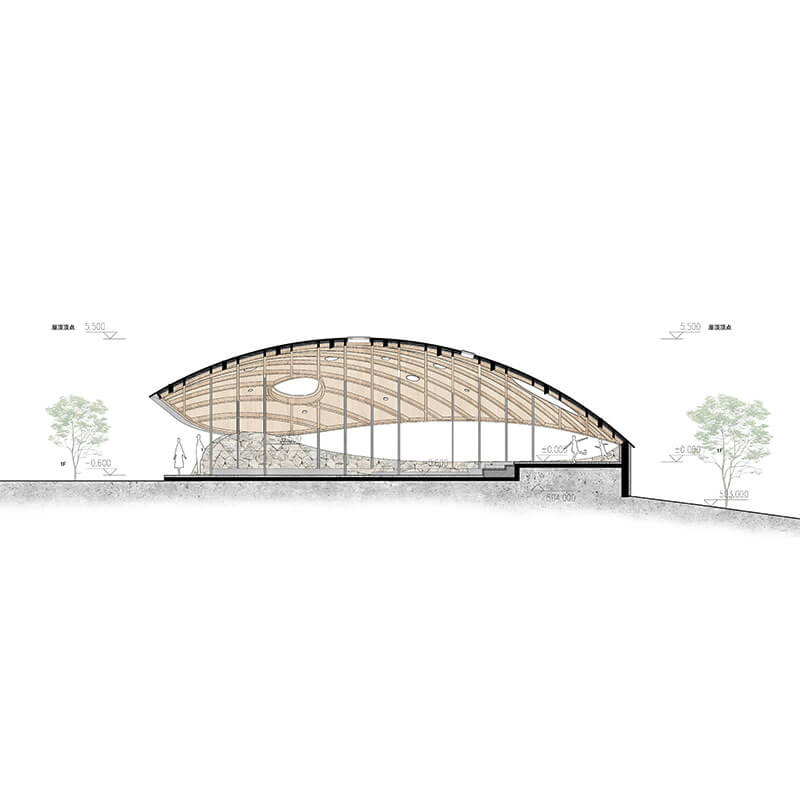
The open-air hall is constructed as a wooden dome, its roof resembling a protective mesh of leaves. Large, open skylights allow three Chinese olive trees to grow through the roof. More than a dozen other openings bring daylight into the interior. The visible timber construction creates an impressive atmosphere and good acoustics.
A few seating steps rise slightly towards the lake, ideal for spectators and open for informal uses such as theater. The arrangement of the chrome-plated steel supports is reminiscent of air-rooted banyan trees and strengthens the connection between architecture and nature.
.jpg)
.jpg)
.jpg)
.jpg)
.jpg)
.jpg)
.jpg)
Architecture
The supporting structure consists of a lightweight wood-steel hybrid construction. 24 slender, chrome-plated steel supports with a diameter of 60–100 mm allow the dome to float, while roof sections reach down to the ground and support water drainage.
The close integration of the hall with nature is of central importance: the building nestles against the slope, opens up to the forest and allows a play of light and shadow between the pillars and through the trees. Daylight floods the interior spaces, while the structure itself creates a harmonious connection between building, nature and community using minimally harmful technology.
Just good architecture.
.jpg)
.jpg "1920px_与自然对话(存在建筑-建筑摄影)")
Project data
(Links are underlined)
Planner
Studio Dali Architects
Li Ye, Zeng Xianming, Lan Lan
Building owner
China Railway Sichuan Ecological City Investment Co., Ltd.
Opening
2024
Address
Heilongtan
Renshou County
Meishan City
Ichuan Province
China
Photos
Arch-Exist
Text
Johannes Bühlbecker
More Sports Media
Videos
More exemplary buildings for sport and leisure
Subscribe to our newsletter.
Every three weeks, we inform you about new and exemplary projects and products. With heart, drive and expertise.